Teac AN-180 (1972–1977)
It doesn’t amplify—just passes through, with nothing added and nothing taken away, a silent gatekeeper of signal purity.
Overview
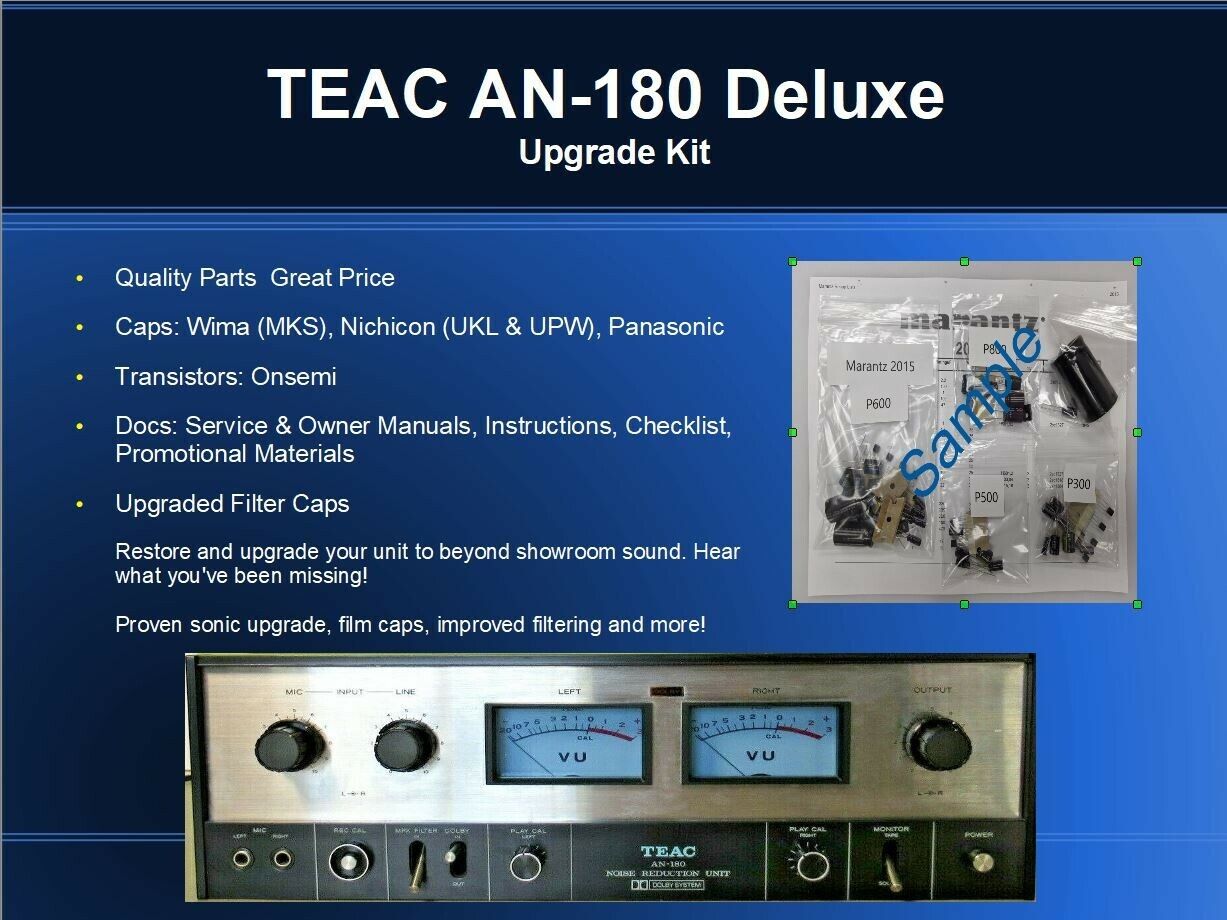
The Teac AN-180 was introduced in 1972 as a dedicated noise reduction unit employing the DOLBY B system, designed for integration into high-fidelity tape recording and playback chains. Manufactured in Japan and reportedly produced through 1977, the AN-180 targeted serious audiophiles and semi-professional users who demanded accurate, low-noise analog tape reproduction. Unlike integrated preamplifiers or signal processors with multiple functions, the AN-180 focused on a single task: applying Dolby B companding to reduce tape hiss during playback and restore it during recording. Its design emphasized reliability and broad applicability, with Teac’s own documentation stating it was "designed to assure years of trouble-free operation." While some online sources misidentify it as a passive preamplifier, the Richard L. Hess service manual and original owner’s manual confirm its role as a noise reduction processor—part of a growing ecosystem of modular audio components that allowed users to build custom systems with specialized units.
Key Features
Dolby B Noise Reduction System with Independent Processing
The core function of the AN-180 is its implementation of the Dolby B noise reduction system, a licensed technology that became standard in high-end cassette and reel-to-reel decks during the 1970s. The unit processes both channels independently, applying compression during recording and expansion during playback to without audible side effects when properly calibrated. This allowed cleaner recordings on Type I and Type II tapes, particularly important for home taping of LPs or FM broadcasts. Owners report that the AN-180 performs consistently when matched with compatible tape decks, though precise alignment is critical—hence the inclusion of a silicone cloth in the accessory kit, used for cleaning record heads and ensuring optimal tape contact.
Robust Build Quality with Modular Design
Housed in a substantial enclosure measuring 140 x 410 x 325 mm and weighing 7 kg, the AN-180 feels solid and well-damped, suggesting attention to mechanical stability and shielding. The finish is reported as either silver or black face with a wood-grain case, though the discrepancy between sources makes definitive identification difficult; both variants likely existed across production runs. The chassis is built for durability, with heavy-duty connectors and internal layout designed for serviceability. According to the owner’s manual, the unit includes input/output connection cords, a fuse, and a hex wrench—tools suggesting user-accessible maintenance, possibly for bias or level adjustments. Its modular nature meant it could be paired with a wide range of tape decks and amplifiers, fulfilling Teac’s stated goal of "versatility and broad applicability."
Specifications
The AN-180 is a two-channel stereo processor with a signal-to-noise ratio of 65 dB, a figure that reflects the effectiveness of the Dolby B system in masking tape noise. Channel separation is rated at 50 dB, ensuring minimal crosstalk between left and right signals—a necessity for accurate stereo imaging. Frequency response is documented in some sources as 20 Hz to 15 kHz, though another claims 20–20,000 Hz; given the limitations of Dolby B and the era’s tape formulations, the narrower range is more plausible and consistent with period expectations. An input specification listed as "3%" likely refers to total harmonic distortion, though the label is incomplete in the source.
Historical Context
The AN-180 emerged during a pivotal moment in consumer audio: the early 1970s, when Dolby Laboratories’ noise reduction systems were being adopted by manufacturers and enthusiasts alike. At a time when cassette tapes were still considered low-fidelity by audiophiles, the AN-180 represented a step toward legitimizing tape as a serious medium. Its release aligns with Teac’s broader push into high-end audio components, alongside models like the AN-300, suggesting a coordinated line of modular units aimed at system builders. Priced at approximately 1,200 DM in its home market, it was a premium accessory—not an impulse buy, but an investment for those committed to high-quality tape recording. Audio (January 1972, p.3) referenced the AN-80 and AN-180 in a brief editorial note, observing that their specifications “would set Rossini to music,” a poetic endorsement of their engineering elegance, if not a technical review.
Collectibility & Value
Today, the Teac AN-180 is a niche collectible, valued more for its historical significance than everyday utility. Units occasionally appear on the used market, often described as "tested and working" by sellers on platforms like Reverb and skyfiaudio.com. However, proper operation requires calibration, and tapeheads.net threads confirm that "calibration updates" may be necessary after decades of dormancy. While not prone to catastrophic failure——oxidation on connectors and misalignment from improper storage can degrade performance. Restoration is possible, as noted in user reports of completed repairs, but expertise in analog tape alignment is essential. No current resale price data is available, though its original cost suggests it was a high-end accessory in its day. Enthusiasts seeking authentic 1970s tape chain fidelity may still seek it out, particularly in Europe and Japan, where modular separates culture remains strong.
eBay Listings



As an eBay Partner, we earn from qualifying purchases. This helps support our independent vintage technology research.
Related Models
- Teac A-120 (1975)
- Teac A-160 (1975)
- Teac A-480 (1975)
- Teac A-110 (1978)
- Teac A-1340 (1977)
- Denon POA-800 (1978)
- Eico 3150 (1967)
- Fisher CUSTOM-ELECTRA-I (K-14/K-15) (1957)
- Fisher CUSTOM-ELECTRA IV (E33/E44) (1960)
- Akai AM-2600 (1977)