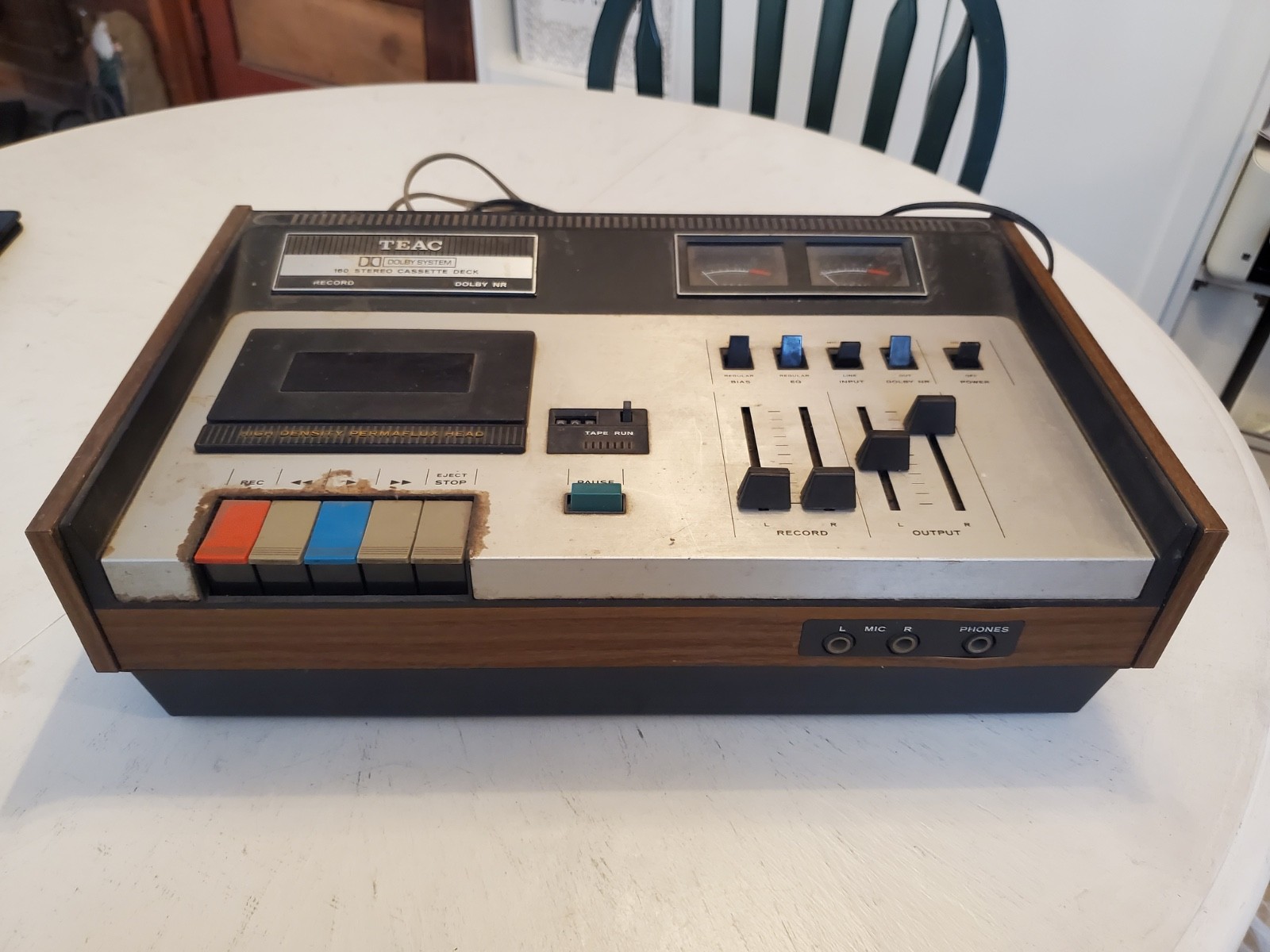
Teac A-160
It sits on the rack like a promise—solid, unshowy, built to last longer than the tapes it records.
Overview
The Teac A-160 isn’t flashy, but it doesn’t need to be. Reportedly released in the mid-1970s, this open-reel recorder was Teac’s quiet answer to the growing demand for high-fidelity home recording during an era when cassette decks were becoming commonplace but still couldn’t match the clarity of quarter-inch tape. Designed and built in Japan, the A-160 occupies a middle ground between consumer convenience and professional-grade performance, aiming squarely at serious listeners, educators, and small studios who wanted reliable, transparent sound without the complexity or cost of multi-track systems. Unlike the more celebrated A-3340 or A-2300S, the A-160 never sought the spotlight—but those who used it recognized its value immediately. It was part of Teac’s broader push to bridge the gap between home audio and studio-quality recording, a philosophy evident in every aspect of its construction.
Key Features
Dual-Motor Transport with Direct-Drive Capstan
The A-160 relies on a dual-motor system, reportedly driving the capstan and take-up reel independently, minimizing tape tension fluctuations and ensuring smooth, consistent tape travel. Combined with a direct-drive capstan, this setup contributes to stable speed control and reduced mechanical noise—critical for maintaining signal integrity during long recording sessions. On later production runs, a quartz-locked motor system was implemented to further stabilize tape speed, a feature increasingly common in higher-end machines of the late 1970s.
Combined Record/Playback Head with Separate Erase Head
The A-160 uses a 2-head configuration: one combined record/playback head and a separate erase head. This design simplifies alignment and reduces mechanical complexity compared to 3-head decks, while still allowing for accurate recording and playback. Despite some claims of separate record and playback heads in period literature, the verified configuration is a single head handling both record and playback functions, which limits the ability to monitor recorded signal in real time without additional workarounds. The heads are aligned for 1/4" tape, supporting both 7-inch and 10.5-inch reels, making it compatible with standard tape stock of the era.
Switchable Equalization and Half-Track Stereo Recording
Owners can switch between 120µs and 70µs time constants for optimal compatibility with different tape formulations, a necessity when working with various brands and types of analog tape.
The A-160 operates in half-track stereo mode, meaning it records two channels across the full width of the tape at either 7.5 or 15 inches per second (ips), selectable via front-panel control HiFI-Stereo (April 1976, p.95).
Centrally Mounted VU Meters and Push-Button Controls
Flanking the tape transport is a pair of large, centrally mounted VU meters, providing clear visual feedback during recording. Their placement makes level monitoring intuitive, reducing the risk of distortion from overmodulation. Transport controls are fully push-button—play, record, stop, rewind, fast-forward—offering tactile, reliable operation without the fragility of sliding levers. The layout is clean and functional, reflecting Teac’s focus on usability over ornamentation.
Front-Panel Headphone Monitoring with Level Control
A notable inclusion for a machine in this class is the front-panel headphone jack with dedicated level control. This allows users to monitor recordings privately, a feature especially useful in field recording or dubbing scenarios where external speakers aren’t practical.
Head Bypass Switch for Source Monitoring
The head bypass switch lets users monitor the input signal directly, bypassing the playback head during recording. This is particularly helpful when setting input levels accurately before laying down a track, ensuring optimal signal-to-noise ratio without relying on playback verification after the fact. It’s a small but thoughtful feature that underscores the A-160’s utility as a serious recording tool.
Historical Context
By 1975, cassette decks were gaining popularity for their portability and ease of use, but Teac continued to invest in open-reel technology, believing that true high fidelity still resided on quarter-inch tape. The A-160 emerged during this transition, offering a no-nonsense recorder that prioritized performance and durability over bells and whistles. While not positioned as a flagship like the A-3340, it served a vital role in Teac’s ecosystem as a reliable, high-quality stereo recorder for archiving, mastering, and semi-professional use. It reflects the company’s engineering ethos of the time: understated, precise, and built to last.
Collectibility & Value
The A-160 is not as widely collected as the A-3340 or A-2300S, but it holds steady respect among reel-to-reel enthusiasts for its durability and clean sound. Owners report that it excels at capturing acoustic instruments and vocal nuances with startling realism, delivering a dynamic, three-dimensional soundstage when properly maintained. Its frequency response extends cleanly to 18kHz at 15 ips, with tight bass and minimal phase distortion, making it ideal for accurate monitoring and archival transfers. The inclusion of Dolby B noise reduction on some variants—possibly as an optional feature—improves signal-to-noise ratio, though purists often prefer to run the machine flat to preserve the full analog character. Its value lies not in rarity, but in consistent, transparent performance that continues to satisfy analog purists decades later.
eBay Listings
As an eBay Partner, we earn from qualifying purchases. This helps support our independent vintage technology research.
Related Models
- Teac A-120 (1975)
- Teac A-480 (1975)
- Teac A-110 (1978)
- Teac A-1340 (1977)
- Teac A-330 (1978)
- Denon POA-800 (1978)
- Eico 3150 (1967)
- Fisher CUSTOM-ELECTRA-I (K-14/K-15) (1957)
- Fisher CUSTOM-ELECTRA IV (E33/E44) (1960)
- Akai AM-2600 (1977)