Teac A-103 (1977–1979)
A no-frills cassette deck that punched above its weight, built for listeners who wanted Dolby-equipped performance without the premium price.
Overview
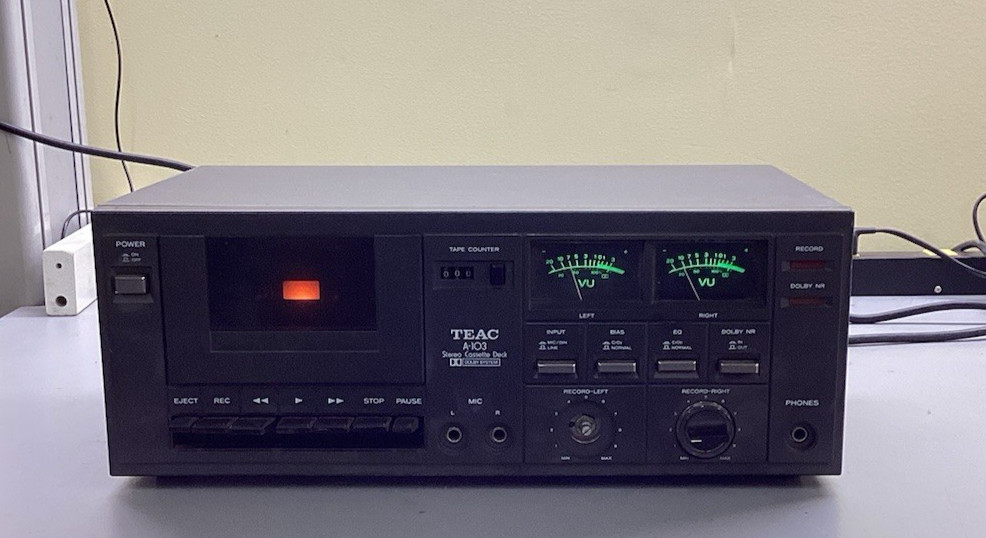
The Teac A-103 wasn’t trying to win design awards or dominate spec sheets. Released in 1977 and reportedly produced through 1979 — though some sources suggest 1978–1980 — this stereo cassette deck was positioned as a practical, well-engineered option for budget-conscious audiophiles who still demanded solid performance. Marketed as a "Stereo Cassette Deck with Dolby System," the A-103 fit squarely into Teac’s mid-tier lineup of the late 1970s, offering key features like Dolby B noise reduction and support for both Type I and CrO₂ tapes. While it lacked the flash of higher-end models, it earned quiet respect for delivering better-than-expected sound quality for its class. Owners report it performs well above expectations for a machine of its price, a sentiment echoed in period commentary.
Key Features
2-Head Configuration with Dolby B
Built around a 2-head system — one combined record/playback head and a separate erase head — the A-103 simplified alignment and reduced mechanical complexity while still supporting solid recording and playback functionality. This configuration was common in mid-range decks of the era, balancing cost and performance. The inclusion of Dolby B noise reduction was a significant selling point, helping to reduce tape hiss on recordings and playback, especially with Type I tapes. Combined with a signal-to-noise ratio of 55dB, the deck delivered cleaner audio than many of its contemporaries in the same price range.
Type I and CrO₂ Tape Compatibility
The A-103 supports both standard ferric (Type I) and chromium dioxide (CrO₂) tapes, allowing users to take advantage of higher-grade tape formulations for improved high-frequency response and dynamic range. While it doesn’t offer automatic tape switching or calibration, owners were expected to manually select the appropriate tape type — a common practice at the time. This flexibility made the A-103 a versatile choice for those building mixtapes or duplicating LPs with better-than-basic fidelity.
Historical Context
The A-103 arrived during a pivotal time for cassette technology. By the late 1970s, cassettes were shedding their reputation as low-fidelity media and gaining traction as a legitimate format for high-quality home recording and portable listening. Teac, already known for its reel-to-reel and tuner designs, expanded its presence in the cassette market with models like the A-103, A-106, A-107, and A-303, though the exact hierarchy within this group is not documented. Stereo Review (1978) covered the A-103 during its release window, indicating it received attention from major audio publications of the day — a sign that it was seen as a credible contender in its segment.
Collectibility & Value
Today, the Teac A-103 is remembered fondly by cassette enthusiasts, though it hasn’t become a high-value collectible. Units occasionally surface at thrift stores or online marketplaces, with one owner noting excitement after picking up a “very nice Teac A-103 at Goodwill.” However, maintenance is a key consideration: many units now require new belts, a common failure point in aging cassette mechanisms. Forum discussions, such as those on Reddit’s r/cassetteculture and Tapeheads.net, frequently mention belt replacement and issues with a large switch on the main PCB, suggesting internal wear can affect functionality. Despite these age-related quirks, the A-103 remains a functional entry point into vintage cassette playback for those willing to service it.
eBay Listings
As an eBay Partner, we earn from qualifying purchases. This helps support our independent vintage technology research.
Related Models
- Teac A-120 (1975)
- Teac A-160 (1975)
- Teac A-480 (1975)
- Teac A-110 (1978)
- Teac A-1340 (1977)
- Denon POA-800 (1978)
- Eico 3150 (1967)
- Fisher CUSTOM-ELECTRA-I (K-14/K-15) (1957)
- Fisher CUSTOM-ELECTRA IV (E33/E44) (1960)
- Akai AM-2600 (1977)