Nakamichi 682ZX (1980–1982)
A no-compromise cassette deck built for those who believed analog tape could rival the best of its era
Overview
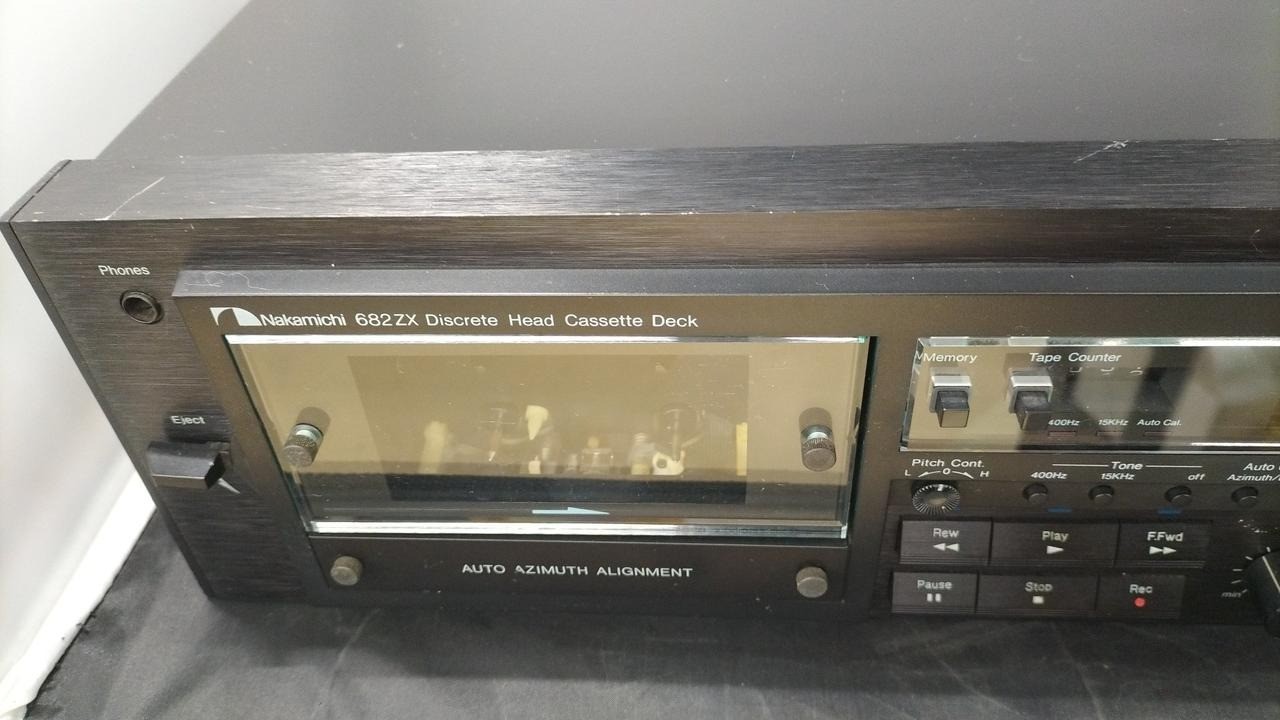
At 9 kilograms, the Nakamichi 682ZX lands in your rack with the authority of a machine engineered to last. Introduced in 1980 as the second generation of the 680ZX, this stereo cassette deck wasn’t chasing convenience—it was chasing perfection. Priced at a steep $1,800 at launch (roughly ¥228,000 in Japan around 1981), the 682ZX sat firmly between the mid-tier 582 and Nakamichi’s flagship models, offering flagship-level engineering without the halo price tag. It was built for users who saw the compact cassette not as a portable compromise but as a legitimate high-fidelity medium—engineers, archivists, and audiophiles who demanded real-time monitoring, precise calibration, and sonics that could stand beside reel-to-reel.
Unlike most decks of its time, the 682ZX didn’t rely on a single head for both record and playback. Instead, it used a discrete three-head system—R-8L for recording, P-8L for playback, and E-8L for erasing—each physically separated and optimized for its task. This allowed users to monitor recordings instantly, without generational loss, and gave technicians the ability to fine-tune azimuth via a front-accessible screw. That kind of hands-on control wasn’t common outside professional studios, but Nakamichi treated the 682ZX like a tool, not a toy.
Discrete Three-Head System with P-8L Playback Head
The heart of the 682ZX’s performance lies in its discrete head configuration. The P-8L playback head uses a laminated crystalline core with an ultra-narrow 0.6-micron gap, minimizing high-frequency loss and enabling extended response up to 22 kHz when using ZX or metal tapes. Paired with the R-8L record head—featuring a 3.5-micron gap and the same laminated core construction—the system ensures accurate flux transfer across the tape. The E-8L erase head is a double-gap design, combining a ferrite core for high-frequency efficiency and a Sendust core for high magnetic flux density, ensuring thorough erasure even on dense Type IV tapes. This full separation means no compromise: playback fidelity isn’t sacrificed for record stability, and alignment can be optimized independently.
Frequency-Distributed Double Capstan System with PLL Servo Motor
Tape speed stability is critical for low wow and flutter, and the 682ZX delivers with a frequency-distributed double capstan system. Unlike belt-driven transports that stretch and slip, this design uses dual direct-drive capstan motors controlled by a PLL (phase-locked loop) servo system. The main motor constantly monitors rotational speed, compares it to a reference oscillator, and adjusts in real time to maintain precise tape travel at 4.8 cm/s. This isn’t just about specs—it’s about rhythm. The result is a deck that locks onto tempo with uncanny accuracy, making it a favorite among classical and jazz listeners who depend on timing integrity. Audio (September 1983, p.107) noted its “remarkable stability under load,” a trait that separates it from contemporaries relying on simpler DC motors.
Auto-Calibration and Bias Adjustment Functions
One of the 682ZX’s most advanced features was its auto-calibration function, a rarity in consumer decks. With a single operation, the system could simultaneously adjust azimuth and record/playback levels, streamlining setup for non-experts while still allowing manual override. Even more valuable was the bias adjustment function, which let users fine-tune the bias current to match the specific tape formulation in use—critical for extracting maximum fidelity from metal tapes. Combined with separate Dolby B and C noise reduction processors for record and playback paths, the 682ZX offered a level of tailoring usually reserved for broadcast equipment. Owners report that once calibrated, the deck holds alignment for hundreds of hours, a testament to its mechanical rigidity.
FL Display Peak Level Meter and RAMM Function
The front panel features a 24-segment FL (fluorescent) peak level meter, displaying levels from –40 dB to +10 dB with smooth, continuous movement. Unlike basic LED meters, the FL display offers analog-like responsiveness, making it easier to catch transient peaks without clipping. Beyond monitoring, the 682ZX includes the RAMM (Random Access Memory Music) function, allowing users to cue and locate specific tracks on a tape—a precursor to digital indexing. While primitive by today’s standards, it was a godsend for DJs and collectors managing long compilation tapes. The deck also includes a built-in Rec Mute function, a timer for scheduled recording, and an MPX filter for clean FM dubbing—features that reflect its semi-professional ambitions.
Historical Context
The 682ZX arrived at a pivotal moment: 1980, when cassette decks were still largely seen as portable or secondary systems. While competitors focused on auto-reverse and Dolby B, Nakamichi doubled down on fidelity. As the successor to the 680ZX, the 682ZX refined its predecessor’s single-speed, high-performance philosophy. It wasn’t trying to be everything to everyone—it was built for a niche. Though overshadowed in collector circles by the later Dragon, the 682ZX laid the groundwork for Nakamichi’s reputation as the last word in cassette engineering. It was a bridge between the raw precision of the 580-series and the fully automated, computer-controlled decks that followed.
Collectibility & Value
The 682ZX isn’t as widely collected as the Dragon or CR-1A, but it holds quiet reverence among cassette connoisseurs. In working condition, units typically sell for $300–$500, though fully refurbished examples with recapped power supplies, realigned heads, and new pinch rollers can command over $2,700. Its value lies in engineering integrity, not rarity—this is a deck that rewards maintenance. Common issues include dried grease in the transport, worn shaft guides (particularly in the playback head assembly), and degraded electrolytic capacitors in the power supply. Owners note that a full service every 500–1,000 hours is essential, including demagnetization and head cleaning. When properly maintained, the 682ZX remains a benchmark for analog tape reproduction.
eBay Listings


As an eBay Partner, we earn from qualifying purchases. This helps support our independent vintage technology research.
Related Models
- Nakamichi 1000ZXL (1985)
- Nakamichi 580 (1975)
- Nakamichi 660ZX (1984)
- Nakamichi 670ZX (1984)
- Nakamichi 680ZX (1983)
- Infinity RS-IIA (1977)
- Sony TC PB5 (1970s)
- Infinity RS-4.5 (1978)
- Sony TC-K333ESG (1989)
- Sony TC-K333ESJ (1991)