Nakamichi 670ZX (1984)
At approximately 9 kg, it occupies shelf space like a precision instrument—because that’s exactly what it is.
Overview
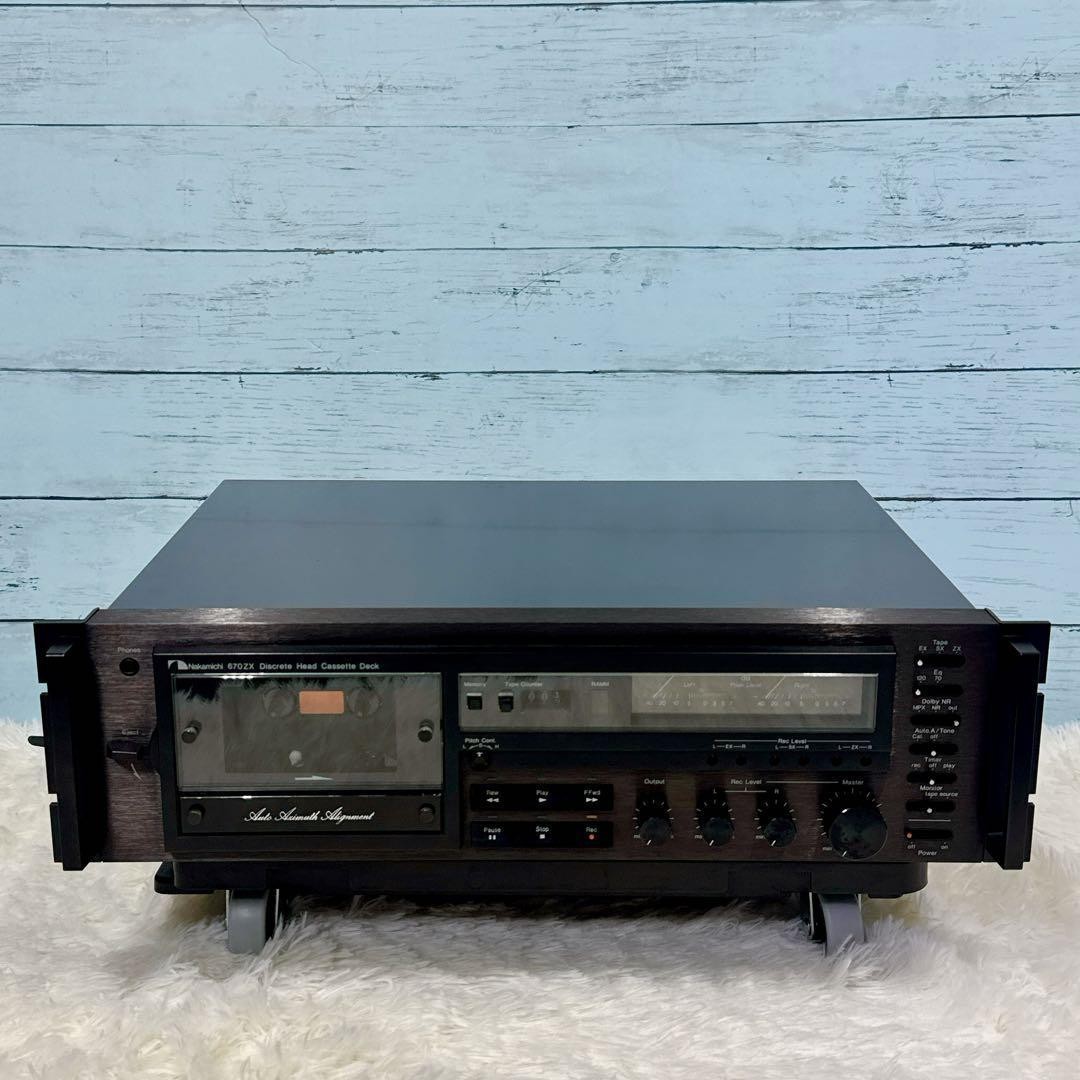
The Nakamichi 670ZX, introduced in 1984, stands as a high-water mark in the evolution of consumer cassette decks—engineered not for casual listening but for those who treated tape as a serious medium. As a 3-head, full-logic auto-reverse cassette deck, it delivered professional-grade performance with an unprecedented level of automation. Designed for the discerning listener demanding laboratory-grade accuracy, the 670ZX bridged the gap between broadcast equipment and home audio, earning favor among engineers, archivists, and audiophiles. Though overshadowed in popular memory by the legendary Dragon, the 670ZX represented the bleeding edge of what was possible in cassette reproduction during its era, combining advanced signal path design with real-time mechanical intelligence.
Discrete Three-Head System with P-8L Playback Head
At the core of the 670ZX’s performance is its discrete three-head system—recording, playback, and erase heads are physically separate and optimized for their specific roles. The P-8L playback head features a 0.6-micron gap and is constructed from crystal, enabling extended high-frequency response up to 22 kHz with minimal loss. This narrow gap design, paired with the R-8L record head (3.5-micron gap, also crystal-based), ensures accurate flux transfer and tight azimuth alignment. The E-8L erase head uses a direct flux double-gap configuration, providing thorough erasure across all tape types, including dense Type IV metal formulations. Because each head operates independently, users can monitor recordings in real time without generational degradation—a feature rare outside professional studios.
Auto Azimuth Correction with Dual Playback Heads
The defining innovation of the 670ZX is its Auto Azimuth Correction (AAC) system, which uses a secondary playback head to continuously monitor high-frequency response during playback and dynamically adjusts the main P-8L head’s angle via motorized actuators. This real-time correction compensates for tape misalignment, wear, or manufacturing variances, ensuring consistent high-end clarity. HiFi-Stereo (February 1980, p.13) described Auto Azimuth Alignment as “undoubtedly the most advanced and sophisticated innovation in cassette-recorder technology,” launching “a new era in high-fidelity recording.” While the marketing copy from Nakamichi emphasized convenience, the result was measurable: owners report sustained channel separation of 37 dB or more at 1 kHz and crosstalk exceeding 60 dB, even with imperfect tapes.
Frequency-Distributed Double Capstan System with Direct Drive
Tape speed stability is critical for low distortion and rhythmic accuracy, and the 670ZX delivers with a frequency-distributed double capstan system driven by direct-drive servo motors. Unlike belt-driven transports prone to slippage and wear, this design maintains precise tape travel at 4.8 cm/s (1⅞ ips), minimizing speed fluctuations. The system achieves a wow and flutter rating of 0.04% or less (WTD RMS), a figure competitive with high-end reel-to-reel machines. This stability ensures tight bass definition and accurate pitch, making the 670ZX suitable not only for music but also for voice archiving and broadcast duplication where timing integrity is paramount.
Dolby S Noise Reduction with Dedicated Circuitry
The 670ZX was among the first consumer decks to support Dolby S noise reduction, a significant advancement over Dolby B and C. With up to 24 dB of noise reduction and minimal pumping artifacts, Dolby S preserved the dynamic range of metal tapes with remarkable transparency. The deck’s dedicated Dolby circuitry for both recording and playback ensures optimal calibration, while the overall signal-to-noise ratio reaches 78 dB with Dolby S engaged (ZX tape, 70 μs). Even without noise reduction, the 60 dB or greater S/N ratio (WTD rms) at 0 dB output provides a clean, low-noise floor. The inclusion of switchable 120 μs and 70 μs equalizers allows fine-tuning for different tape formulations, enhancing compatibility across Type I (ferric), Type II (chrome), and Type IV (metal) tapes.
Automatic Calibration and Tape Optimization
One of the 670ZX’s most user-friendly features is its auto-calibration system, which uses an internal test tape routine to set optimal record and playback levels, bias, and equalization. This eliminates the need for external alignment tools, bringing professional tape duplication within reach of home users. The 3-position tape selector (EX, SX, ZX) automatically configures bias and EQ settings for each tape type, with metal tapes receiving optimized treatment for maximum dynamic range. Bias frequency is set at 105 kHz, ensuring stable high-frequency recording on metal formulations. The pitch control allows ±6% adjustment of playback speed, useful for fine-tuning tempo or compensating for off-speed recordings.
Full-Logic Transport with Seamless Auto-Reverse
The 670ZX features a full-logic transport system that ensures smooth, reliable operation with no pause between sides during auto-reverse playback. The mechanism threads tape quickly and gently, reducing wear on both the cassette shell and the tape itself. Combined with the direct-drive capstan and servo-controlled reel motors, this transport delivers consistent tension and speed across the entire tape length. Owners note that the system’s durability is matched by its precision—few consumer decks of the era matched its long-term mechanical reliability when properly maintained.
Fluorescent VFD Display with Comprehensive Feedback
The front panel features a large vacuum fluorescent display (VFD) that provides real-time feedback on tape type, mode, Dolby settings, and recording levels. A pointer-type level indicator shows input levels from –40 dB to +7 dB, offering visual precision during recording. The display’s clarity and layout reflect Nakamichi’s emphasis on usability without sacrificing technical depth. Optional integration with the RM-200 remote control (sold separately) extends functionality, allowing remote operation of transport functions and monitoring—a rare feature in cassette decks of this class.
Historical Context
The 670ZX emerged during a pivotal shift in the perception of compact cassettes—from portable music carriers to legitimate high-fidelity media. While not as iconic as the Dragon or CR-7A, it was highly regarded among cassette enthusiasts for its technological sophistication and understated engineering. It represented Nakamichi’s commitment to pushing analog tape to its limits, offering automation without compromise. Though priced at ¥188,000 around 1980 (approximately $1,150 at the time), it occupied a niche between mid-tier models and flagship decks, appealing to users who valued precision over prestige.
Collectibility & Value
In today’s market, a working 670ZX typically sells for $600 to $1,000, with fully restored units commanding higher prices. One eBay listing in 2024 offered a serviced example for $1,600, reflecting strong demand among analog enthusiasts. Collectibility is growing, driven by renewed interest in high-quality tape playback and the deck’s support for Dolby S—making it a rare tool for playing pre-recorded metal tapes from the late 1980s. However, maintenance is critical: common issues include seized azimuth motors, hardened pinch rollers, dried lubricants, and capacitor aging in the power supply. Regular demagnetization and professional alignment are recommended due to the complexity of the head movement system. Service manuals are available through enthusiast communities, and some parts remain obtainable from specialty restoration suppliers.
eBay Listings
As an eBay Partner, we earn from qualifying purchases. This helps support our independent vintage technology research.
Related Models
- Nakamichi 1000ZXL (1985)
- Nakamichi 580 (1975)
- Nakamichi 660ZX (1984)
- Nakamichi 680ZX (1983)
- Nakamichi 682ZX (1980)
- Infinity RS-IIA (1977)
- Sony TC PB5 (1970s)
- Infinity RS-4.5 (1978)
- Sony TC-K333ESG (1989)
- Sony TC-K333ESJ (1991)