Denon POA-3000
At 34 kg, it arrives like a declaration—this is not an amplifier for the timid.
Overview
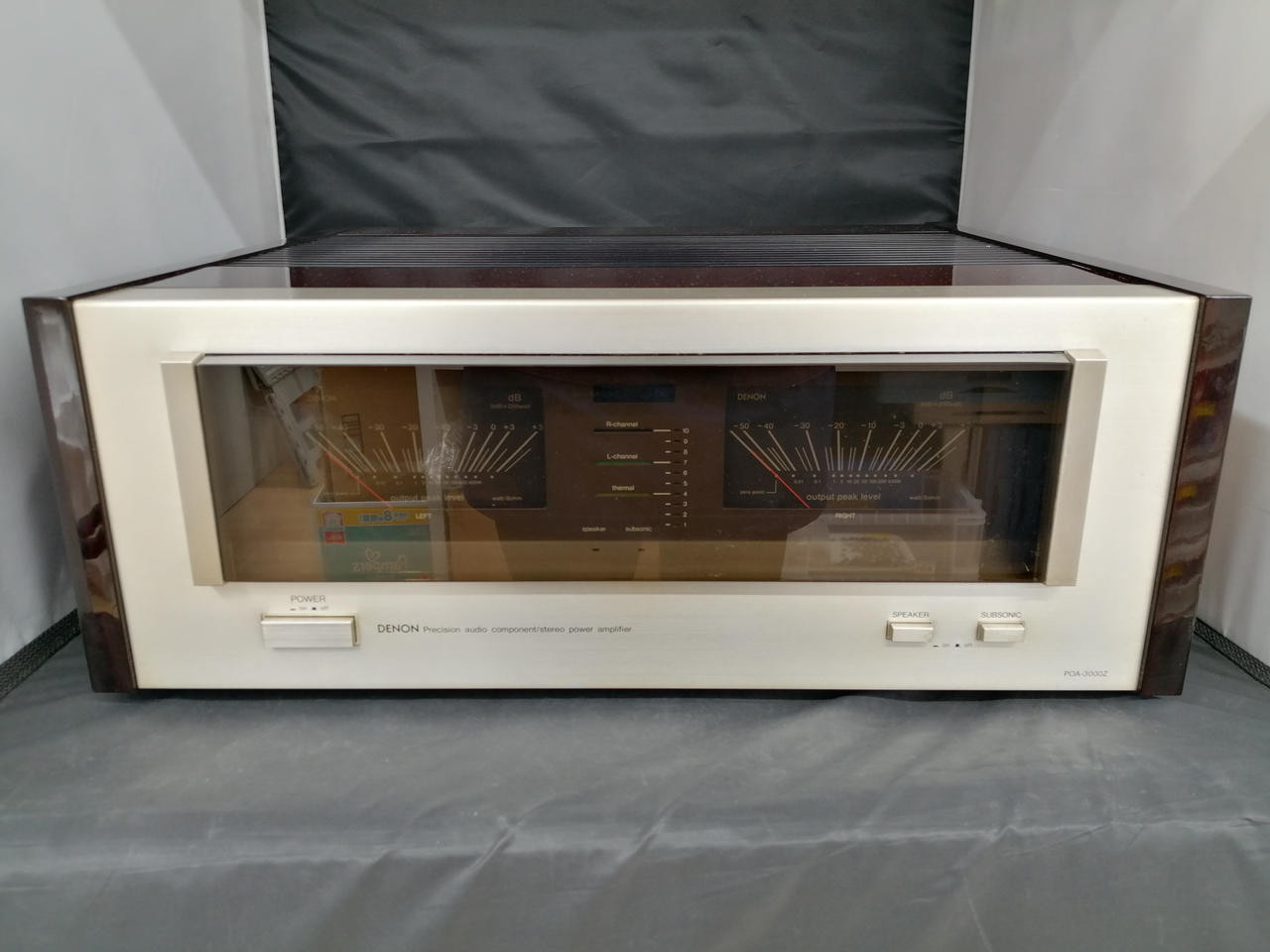
The Denon POA-3000 is a stereo power amplifier released in 1979 as part of Denon’s push into high-current, high-fidelity amplification during a pivotal moment in Japanese audio engineering. Marketed under the banner of "REAL TIME AUDIO," the POA-3000 was among the first Denon components built around this guiding philosophy, emphasizing speed, transparency, and minimal signal degradation. It stands as a bold expression of Denon’s ambition to reconcile the inefficiencies of Class A operation with practical high-power output—achieved through a proprietary "real bias" circuit that reportedly cuts power consumption to about one-fifth of conventional Class A designs. The result is an amplifier that runs cooler and smaller than expected for its class, yet still delivers the sonic benefits of true Class A operation across its entire output range. At launch, it carried a price of ¥350,000, positioning it firmly in the luxury tier of audiophile equipment.
Key Features
DENON Class A with Real Bias Circuit
The core innovation of the POA-3000 is its "DENON Class A" operation, enabled by a unique real bias circuit designed to maintain Class A performance without the typical drawbacks of excessive heat and power draw. Unlike conventional Class A amplifiers that waste energy as heat, this system dynamically adjusts bias to sustain linear operation while improving efficiency. Audio (September 1981, p.33) described the POA-3000 as a "180W/ch. Class-A power amplifier," confirming its rated output and topology in period literature.
High-Speed Output Stage with Five Parallel Transistors
Each channel employs five parallel push-pull connections of a newly developed high-speed power transistor rated at 100 MHz (fT) and 150W (Pc), ensuring robust current delivery and exceptional high-frequency linearity. This parallel configuration increases current capacity and reduces thermal stress on individual devices, contributing to long-term reliability. The driver stage uses small-signal transistors (400 MHz fT, 400 mW Pc) in parallel, connected in a cascode arrangement with the output transistors to extend bandwidth and improve stability. The pre-driver stage is balanced via a twin complementary differential circuit, further enhancing symmetry and reducing distortion.
Dual-Mono Power Supply with Floating Toroidal Transformer
The power supply is a dual-mono design, with separate systems for the output stage and preceding stages. The output stage is fed by a large toroidal transformer rated at 1000 VA—approximately twice the capacity of a typical 200W Class B amplifier’s supply—featuring independent left and right windings to prevent crosstalk. This transformer is mounted in a 2 mm thick non-magnetic aluminum chassis to isolate it from magnetic interference, a rare and meticulous touch. The output stage also benefits from a 100,000 μF high-capacity, low-impedance capacitor bank that maintains stable voltage even at high frequencies. A separate EI-type transformer powers the front-end stages, shielding them from load fluctuations in the output section.
Low-Noise FET Input Stage with DC Servo
The first stage uses a low-noise FET differential amplifier paired with a direct DC servo system operating in parallel, minimizing offset voltage and eliminating the need for coupling capacitors. This design preserves low-frequency integrity and ensures a flat response down to 1 Hz. The same configuration appears in the Denon PRA-2000 control amplifier, indicating a shared engineering lineage between the two flagship components.
Integrated Peak Power Meters with Illuminated DENON Logo
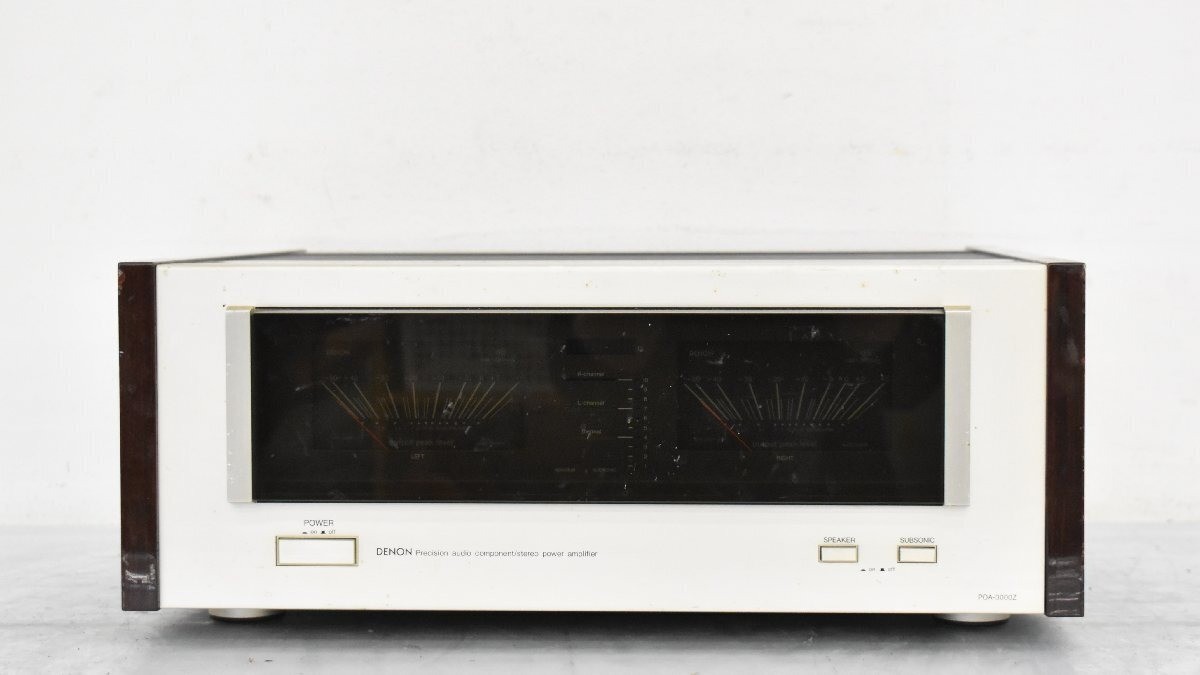
A large, centrally mounted output level meter provides real-time readings in both dB and watts (0 dB = 200W/8Ω), using a peak detection method for accurate transient response. When powered on, the front panel briefly displays a glowing DENON logo for five to six seconds before activating the meter. The meter is covered with thick flat glass to create a mirror-like overlay effect, and the side panels feature a mirror finish, giving the unit a striking, high-end aesthetic. The internal layout is symmetrical, reinforcing the dual-mono philosophy and simplifying service access.
High-Speed Protection and Muting Circuit
A fast-acting protection circuit guards against overcurrent, DC offset, and thermal runaway, while also functioning as a muting circuit to eliminate turn-on/off pop noise. If a fault occurs, a protection indicator LED behind the front glass flashes to alert the user. An inrush current limiter is included in the power supply to prevent fuse blowouts during startup—a known weak point, as user reports note instances of burned main fuses under fault conditions.
Historical Context
The POA-3000 emerged in 1979 as Denon’s answer to the challenge of high-power Class A amplification. At a time when most manufacturers avoided Class A due to its inefficiency, Denon invested heavily in solving its thermal and electrical limitations. The POA-3000 was part of a broader "Advanced Engineering Series" that included the PRA-2000 preamplifier, signaling a shift toward no-compromise, modular high-end design. While not explicitly positioned above or below other Denon amplifiers, its inclusion in the "Legendary Products" section alongside the L-550 series and early CD players underscores its significance in the brand’s heritage.
Collectibility & Value
Collectibility data is sparse, but user experiences suggest the POA-3000 is both respected and physically demanding—a Facebook owner noted it was “a real monster that gives you back pain just from moving it around.” Failures do occur; one Reddit user reported sudden power loss and severe distortion in both channels, while others cite blown main fuses as a recurring issue. There is no verified market price data, though one forum commenter remarked that “price is too high—that’s the whole point of a market,” indicating active but niche demand. No official service bulletins or spare parts availability is documented, making repairs reliant on skilled technicians and donor units.
eBay Listings


As an eBay Partner, we earn from qualifying purchases. This helps support our independent vintage technology research.
Related Models
- Denon POA-800 (1978)
- Denon DA-1000 (1982)
- Denon DL-160 (1979)
- Denon PMA-717 (1997)
- Denon AU-310 (1975)
- Eico 3150 (1967)
- Fisher CUSTOM-ELECTRA-I (K-14/K-15) (1957)
- Fisher CUSTOM-ELECTRA IV (E33/E44) (1960)
- Akai AM-2600 (1977)
- Akai AM-2650 (1975)