Akai AM-2650 (1979–1980)
At 65 watts per channel, it was built to drive demanding speakers with authority—rare muscle for an integrated amplifier in the early 1980s.
Overview
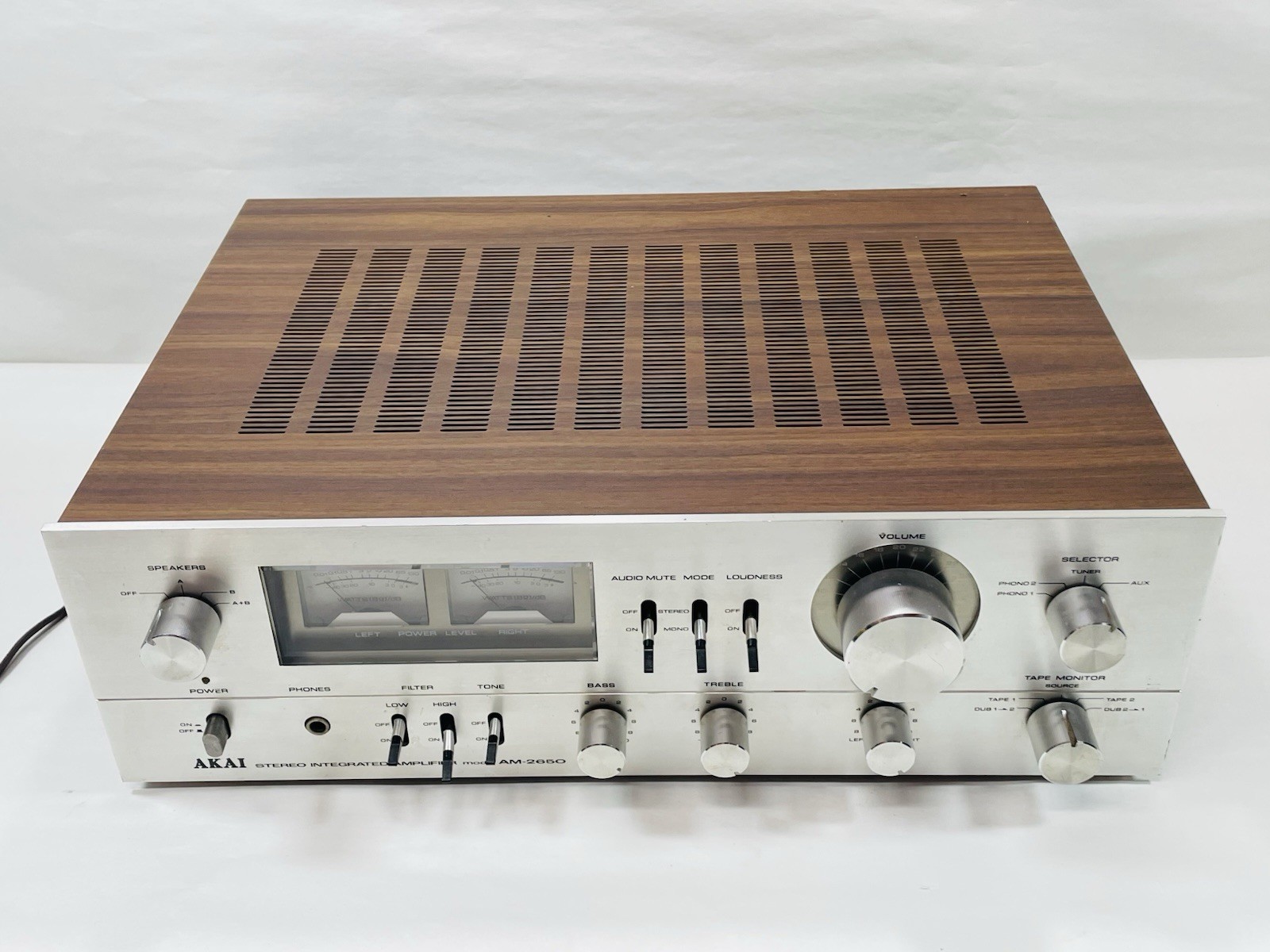
The Akai AM-2650 is a stereo integrated amplifier manufactured around 1979–1980, a time when Japanese audio companies were aggressively refining solid-state amplifier design to deliver higher power and lower distortion. While Akai’s reputation in the West was anchored in its reel-to-reel and cassette decks, the AM-2650 signals a focused effort to compete in the high-fidelity amplifier market. Made in Japan, it was positioned as a performance-oriented component, offering robust output and a feature set tailored to serious listeners. Owners report it delivers a clean, uncolored sound with strong dynamic control—qualities that suggest careful engineering over sonic embellishment. One Reddit user who restored the unit remarked, 'they definitely don’t sound “bad.”' Though not widely documented in period literature, its existence alongside models like the AM-2800 and AM-2900 indicates Akai viewed it as part of a tiered amplifier lineup aimed at discerning audiophiles. The availability of a shared service manual with the AT-2650 tuner hints at modular design practices, possibly to streamline production or support system matching, though no explicit confirmation of a coordinated receiver-tuner pair exists in available sources.
Key Features
65 Watts per Channel into 8Ω
The AM-2650 delivers 65 watts per channel into 8 ohms in stereo mode, a substantial output for an integrated amplifier of its era. This places it competitively against contemporaries from Pioneer, Sansui, and Sony, all of which were pushing similar power levels during the late 1970s and early 1980s. That kind of output suggests the AM-2650 was engineered to handle less sensitive or more complex speaker loads without strain, making it suitable for floor-standing models that demanded current and control. The amplifier’s ability to sustain this power across the frequency spectrum contributes to a dynamic, authoritative presentation, particularly in dense musical passages where lesser amplifiers might falter.
0.08% Total Harmonic Distortion
With a total harmonic distortion (THD) rating of 0.08%, the AM-2650 achieves a high level of signal purity, indicating careful attention to circuit design and component selection. This low distortion figure suggests the amplifier was intended to act as a transparent conduit between source and speaker, minimizing coloration and preserving the integrity of the original recording. At this level, any added sonic signature is negligible, making the AM-2650 well-suited for listeners who prioritize accuracy and neutrality over warmth or euphonic enhancement.
Damping Factor of 30
A damping factor of 30 indicates moderate control over speaker cone motion, particularly in the bass region. While not exceptionally high by modern standards, this value was respectable for an integrated amplifier of the early 1980s, especially one without extreme negative feedback or oversized power supplies. It implies a tight, well-defined low end, though bass authority may diminish with highly reactive or low-impedance speaker loads. The result is a balanced, controlled presentation rather than one that seeks to dominate with sheer slam.
Two Phono Inputs
The inclusion of two phono inputs suggests Akai targeted vinyl enthusiasts who might own multiple turntables or want to switch between different cartridges without rewiring. This feature was not universal among integrated amplifiers of the time, particularly at this performance tier, and reflects a thoughtful approach to system flexibility. It also aligns with Akai’s broader commitment to analog source compatibility, reinforcing the AM-2650’s role as a hub for high-quality analog playback rather than just a power delivery device.
VU Meters
Front-panel VU meters are a visual and functional highlight, providing real-time feedback on output levels. Beyond their aesthetic appeal—offering a retro-industrial look that many collectors appreciate—they serve a practical purpose in monitoring signal dynamics, especially during tape monitoring or when driving demanding sources. Their presence suggests Akai intended the AM-2650 for users who valued both performance visibility and precise level management, possibly including semi-professional or enthusiast applications.
Two Pairs of Speaker Outputs
The amplifier features two pairs of speaker outputs, allowing owners to switch between two sets of speakers or bi-wire compatible systems. This flexibility was a desirable feature in higher-end amplifiers of the era, enabling users to tailor their listening experience to different rooms or speaker types. While no details are available on whether the switching is front-panel or internal, the inclusion of dual outputs underscores the AM-2650’s positioning as a versatile, system-ready component.
Black Panel Variant (AT-2650)
The service manual for the AM-2650 also covers the AT-2650, explicitly noting “ALSO APPLICABLE TO BLACK PANEL MODEL. AT-2650.” This indicates the existence of a black-panel variant, likely offered to match different aesthetic preferences or system configurations. Given the shared documentation, internal circuitry and functionality are presumed identical, making the AT-2650 a cosmetic alternative rather than a performance upgrade. This practice of offering color variants was common among Japanese manufacturers of the period, allowing for coordinated system builds with matching components.
Historical Context
The AM-2650 emerged during a peak period for Japanese integrated amplifier design, when brands were locked in a quiet arms race to deliver higher power, lower distortion, and greater connectivity. It belongs to a broader series that includes the AM-2250, AM-2350, and AM-2450, suggesting a structured product family designed to span multiple performance and price tiers. The inclusion of the AM-2650 in listings alongside the AM-2800 and AM-2900 further implies it occupied a mid-to-upper position within Akai’s amplifier lineup, serving as a bridge between entry-level models and flagship offerings. Production appears to have been limited to 1979–1980, a narrow window that may contribute to its relative scarcity today.
Collectibility & Value
The Akai AM-2650 is not a mainstream collector’s item but maintains a quiet following among vintage audio enthusiasts, particularly those restoring classic Japanese gear. It is frequently described as underrated, with one Instagram user calling it “an extremely rare Akai AM-2650” and noting “these go for cheap.” eBay listings often emphasize its rarity, using terms like “RARE” in titles, while a Reddit user who restored one remarked, “they definitely don’t sound ‘bad,’” suggesting a competent, neutral performance that holds up reasonably well in modern systems. Despite its solid engineering and feature set, it remains undervalued compared to contemporaries from more celebrated brands, likely due to Akai’s stronger association with tape decks rather than amplification. No common failure modes or maintenance issues are documented, though the availability of a service manual and schematic supports restoration efforts for technically inclined owners.
eBay Listings


As an eBay Partner, we earn from qualifying purchases. This helps support our independent vintage technology research.
Related Models
- Akai AM-2600 (1977)
- Akai AM-2850 (1975)
- Akai AM-32 (1978)
- Akai AM-73 (1973)
- Akai AM-2400 (1978)
- Denon POA-800 (1978)
- Eico 3150 (1967)
- Fisher CUSTOM-ELECTRA-I (K-14/K-15) (1957)
- Fisher CUSTOM-ELECTRA IV (E33/E44) (1960)
- Denon DA-1000 (1982)