At 11kg, it doesn’t just sit on the shelf—it anchors the system, a hulking promise of rotational stability few turntables ever deliver. Modern-Recording (February 1980, p.41) noted the YP-D71 as a recent addition to high-fidelity systems, reflecting its contemporary reputation for precision.
Overview
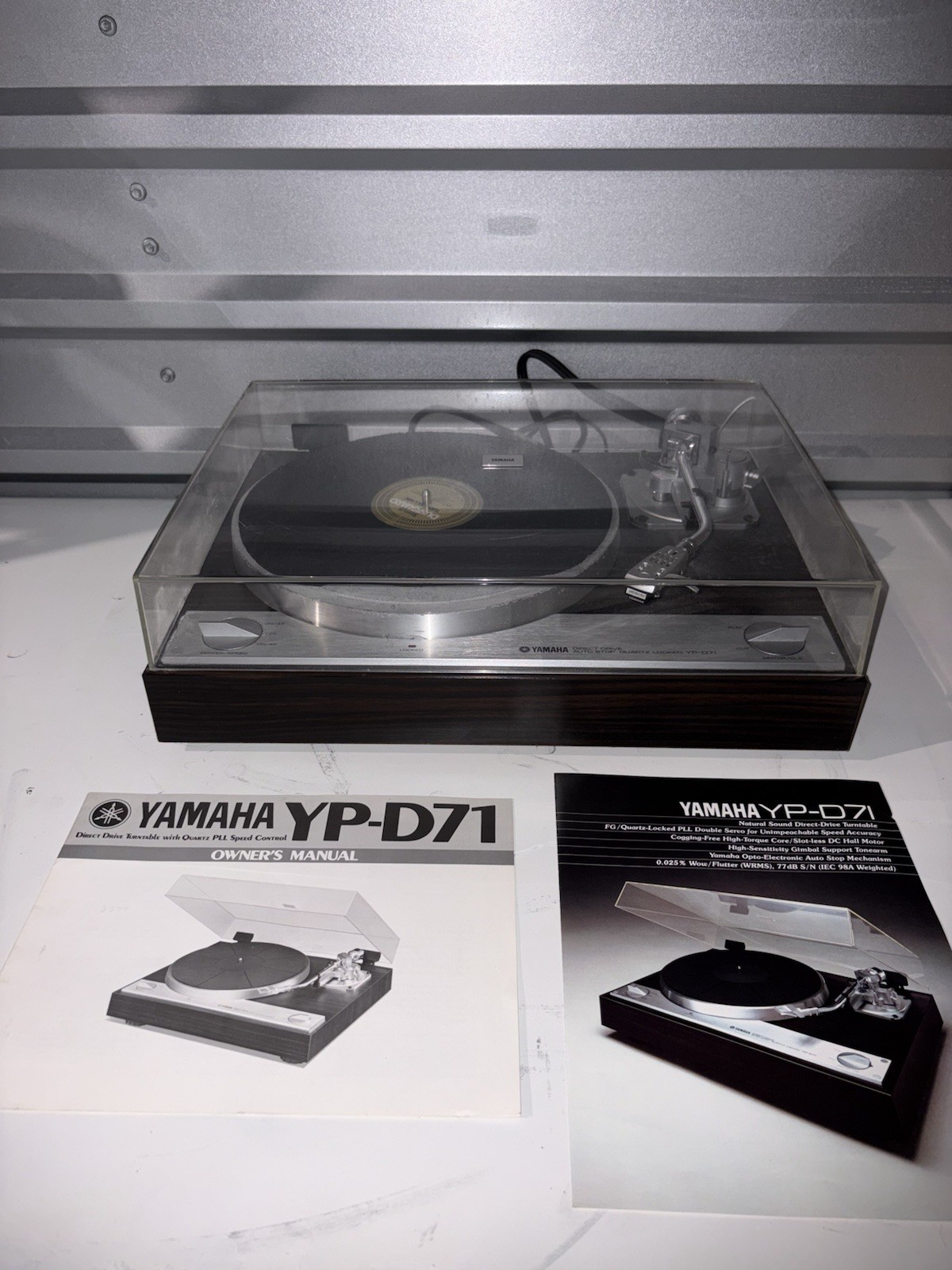
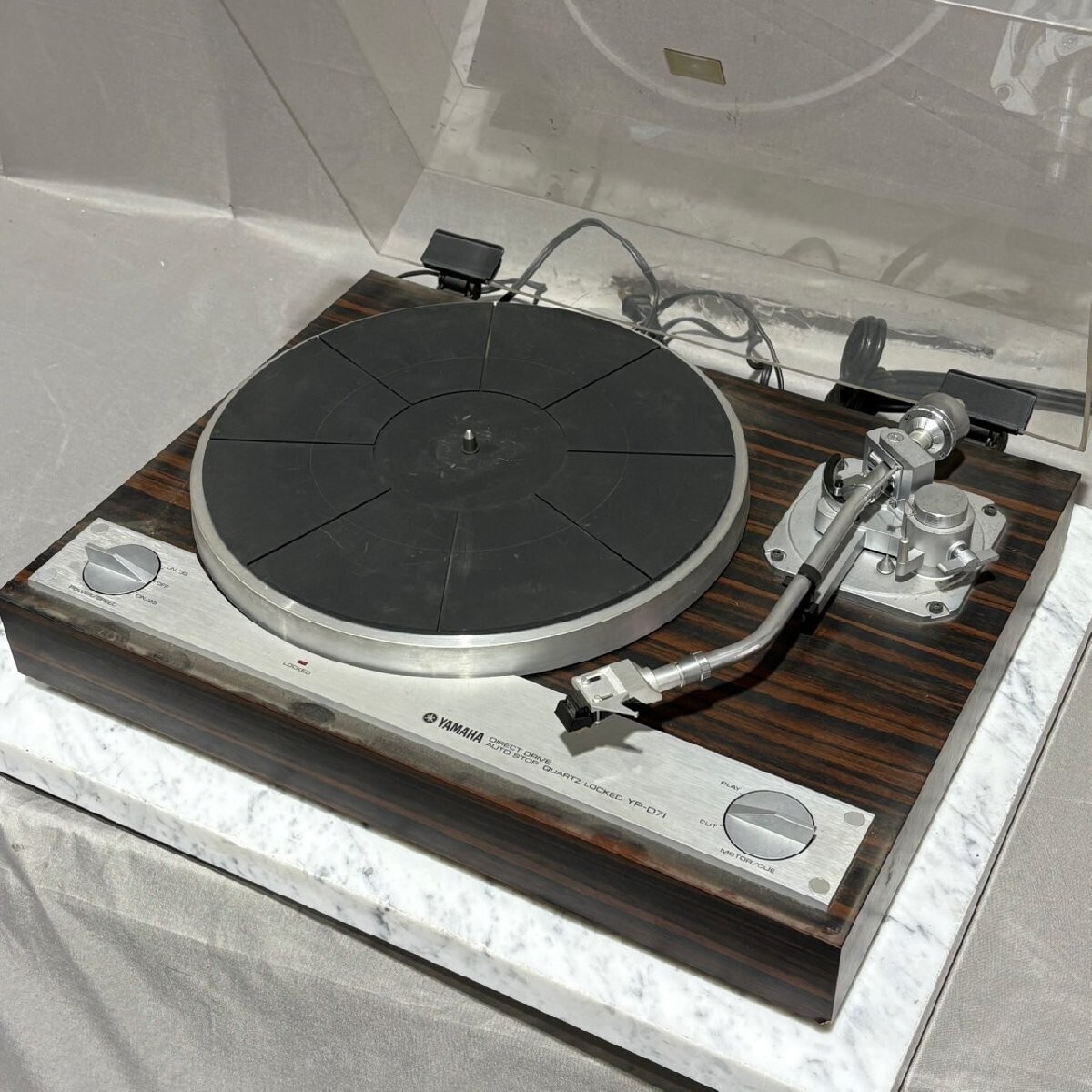
The Yamaha YP-D71 is a direct-drive turntable introduced around 1979, a period when Japanese manufacturers were aggressively redefining high-fidelity performance with precision engineering and advanced motor control. Marketed at ¥59,000—no small sum at the time—it targeted serious audiophiles who demanded laboratory-grade speed accuracy and mechanical rigidity. Unlike belt-drive decks that relied on tensioned rubber to transfer motion, the YP-D71 uses a direct-drive system built around a newly developed coreless, slotless DC Hall motor, eliminating slippage and long-term wear. Its 31 cm aluminum die-cast platter, weighing 1.8 kg with rubber sheet, delivers an extraordinary inertia mass of 230 kg/cm², a figure that speaks directly to its resistance against speed fluctuations. At 470 x 155 x 378 mm and 11kg, the YP-D71 occupies serious real estate, its particle solid board body finished in a PVC ebony decorative surface that keeps the aesthetic conservative but functional. The removable 1.1 kg acrylic dust cover hinges with a fleece-lined top, a small luxury that protects the platter without inducing static. Power draw is minimal at 9W, running on 100 VAC at either 50Hz or 60Hz, making it adaptable across regional power standards without internal modification.
Coreless DC Hall Motor with Quartz Lock PLL Servo
The heart of the YP-D71 is its coreless, slotless DC Hall motor, a design that reduces cogging and electromagnetic distortion by eliminating iron cores and stator slots. This motor runs on 24 VDC at 600 mA and delivers a starting torque of 1 kg/cm—strong enough to spin the massive platter up to speed almost instantly. More impressively, it maintains a lock-in torque of 500 g/cm, ensuring the platter resists external disturbances like record warps or stylus drag. Speed control is managed through a dual-stage servo system: first, an FG (frequency generator) servo monitors rotational speed via a frequency generator positioned around the motor’s circumference, minimizing errors from detector eccentricity. Then, a quartz lock PLL (phase-locked loop) servo further refines accuracy, holding pitch within ±20 ppm or less. This combination was cutting-edge in the late 1970s, and the result is a wow and flutter measurement of just 0.025% WRMS, a figure that rivals or exceeds many modern turntables and ensures pitch stability down to the finest detail. According to available documentation, the FG servo operates during startup—before quartz lock engages—and once constant speed is reached, a lock indicator lights up to confirm synchronization, giving users visual feedback on system readiness.
31 cm Aluminum Die-Cast Platter with 230 kg/cm² Inertia Mass
The 31 cm aluminum die-cast platter is not just large—it’s engineered for inertia. Weighing 1.8 kg including its rubber sheet, it contributes to a total inertia mass of 230 kg/cm², a spec that directly impacts speed stability. High inertia acts as a flywheel, smoothing out micro-variations in motor output and resisting external disruptions. This design choice reflects Yamaha’s understanding that consistent rotational momentum is as critical as electronic control. The platter’s mass, combined with the direct-drive motor’s high lock-in torque, creates a system that starts quickly, stops cleanly, and maintains near-perfect speed throughout playback. Unlike lighter platters that can flutter under load, the YP-D71’s heft ensures that even challenging records with eccentric centers or warps are tracked with minimal speed deviation. The rubber sheet likely serves both to protect records and to dampen high-frequency resonance within the aluminum casting, balancing rigidity with acoustic damping. Yamaha reportedly used its proprietary UR method to evaluate how materials, processing, and finishing influenced sound quality, suggesting a level of sonic tuning beyond mere mechanical function.
S-Shaped Long Arm with Full 4-Point Gimbal Support
The YP-D71 uses a 242 mm aluminum S-shaped tonearm—classified as a “long arm”—mounted on a full 4-point pivot gimbal support system. This design, derived from Yamaha’s Longspan engineering, improves tracking geometry and reduces bearing play. The arm’s pivot uses angular contact bearings supported by a rubber push mount, isolating it from cabinet vibrations and achieving an exceptionally low initial motion sensitivity of 7 mg both vertically and horizontally. This sensitivity level means the arm can respond to the finest groove modulations without being influenced by external movement. The offset angle is set at 21°15′, with a tracking error ranging from -1° to +2°30′, and an overhang of 15 mm—geometry optimized for minimal distortion across the record surface. The arm base is made of zinc die-cast with a brass shaft (Φ27), providing a rigid foundation, while the forged pure aluminum headshell (9g) keeps mass low at the business end. Cartridges weighing between 3g and 12g can be mounted, offering flexibility for a range of moving magnet and moving coil designs. The arm lifter is oil-damped, ensuring smooth, controlled descent and lift-off, and the internal arm tubing is filled with anti-vibration material to suppress resonances that could color the sound. Height adjustment is possible within a ±4 mm range via a brass shaft with a 3-point locking mechanism, allowing precise vertical alignment for a wide variety of cartridges.
Photo Sensor Auto-Up and Auto-Stop Mechanism
The YP-D71 features a photo sensor-based auto-up and auto-stop mechanism, a convenience feature that lifts the tonearm and stops the platter when the record’s lead-out groove is reached. This system eliminates the need for mechanical trip levers, reducing wear and improving reliability. The sensor detects the end of the program material and triggers the arm lifter—a thread-lifting type with roller—which smoothly raises the arm via a cable-and-pulley system. Rollers and thrust bearings are provided to reduce sliding friction, ensuring consistent performance over time. Because the mechanism is non-contact on the sensing side, it’s less prone to misalignment than physical trip arms. The auto-stop function disengages the motor, conserving power and reducing wear during idle periods. This system is described as an improved version of the one adopted in the earlier YP-D10, reflecting Yamaha’s iterative refinement of its mid-tier turntable line.
Signal Integrity and Vibration Control
Signal integrity is preserved through a 6φ NEGLEX2496 low-impedance double cylindrical cord, a cable type designed for minimal capacitance and resistance, ensuring that the delicate phono-level signal reaches the preamp with minimal degradation. The tonearm’s internal wiring is filled with anti-vibration material to further reduce microphonic effects and resonance. The entire turntable rests on W-type rubber insulators, which decouple the chassis from shelf vibrations. The particle solid board body, while not exotic in material, provides a stable, non-resonant platform, especially when combined with the PVC ebony decorative finish that adds surface damping. The 1.1 kg acrylic dust cover is noted for being resistant to howling, a subtle but meaningful detail in a high-gain analog system. Yamaha’s UR method is said to suppress and control vibrations throughout the player before they reach the cartridge stylus, addressing microscopic resonances that traditional measurements like wow and flutter cannot capture.
Historical Context
The YP-D71 emerged as a mid-tier but refined successor to the YP-D8 and YP-D10, models that helped establish Yamaha’s reputation in the direct-drive turntable market. It arrived during a period when Japanese engineering was rapidly advancing turntable performance, shifting perception of the turntable from a passive component to a precision instrument. Its photo sensor auto-stop system represented an evolution over earlier mechanical designs, while its quartz-locked PLL servo placed it among the more technically advanced decks of its class. Though not positioned as a flagship, the YP-D71 offered a highly balanced approach to playback, emphasizing rotational accuracy, tracing precision, and vibration suppression—three pillars that defined high-end analog performance in the late 1970s.
Collectibility & Value
Recent market activity shows the YP-D71 changing hands for around $250, a figure that suggests modest but steady collector interest. Owners report long-term reliability, with one noting over 25 years of ownership and calling it “a great turntable.” Others have praised its sound quality, with one user stating it performed “leaps and bounds better” than a modern Fluance RT82. However, common issues have been reported, including intermittent operation of the start/stop button—fixable by jiggling the mechanism—and occasional problems with the tonearm return function. No spare parts data or service manuals are widely available, and the weight of the anti-skate bias is not documented in any accessible source, posing challenges for precise setup. Despite these quirks, the YP-D71 remains a respected workhorse, valued for its robust build and analog transparency.
eBay Listings


As an eBay Partner, we earn from qualifying purchases. This helps support our independent vintage technology research.
Related Models
- Yamaha CT-710 (1976)
- Yamaha YP-D6 (1985)
- Yamaha CT-610 (1978)
- Yamaha CT-7000 (1978)
- Yamaha CT-810 (1978)
- Infinity RS-IIA (1977)
- Sony TC PB5 (1970s)
- Infinity RS-4.5 (1978)
- Sony TC-K333ESG (1989)
- Sony TC-K333ESJ (1991)