Marantz 2230B (1978–1980)
At 23.1 pounds, it carries the weight of late-’70s engineering confidence—solid, no-nonsense, and built to last.
Overview
The Marantz 2230B isn’t flashy, but it doesn’t need to be. This stereo receiver emerged in 1978 as part of Marantz’s pragmatic “B” series update—a line refined for reliability, clarity, and value during the peak of the home stereo boom. It wasn’t chasing the high-power arms race; instead, it focused on clean, musical delivery with a signal path that respected source material. Owners report a sound signature that’s warm without being thick, detailed without sounding clinical—the kind of balance that made Marantz a household name among discerning listeners.
Rated at 30 watts per channel into 8 ohms (RMS, 20Hz–20kHz), the 2230B delivers modest power by modern standards, but with a damping factor of 45, it maintains control over demanding speakers. The direct-coupled, complementary symmetry output stage contributes to its stable, low-drift performance, a design choice that reduced the need for coupling capacitors in the signal path and preserved transient response. For its time, this was sophisticated engineering tucked into a mid-tier chassis.
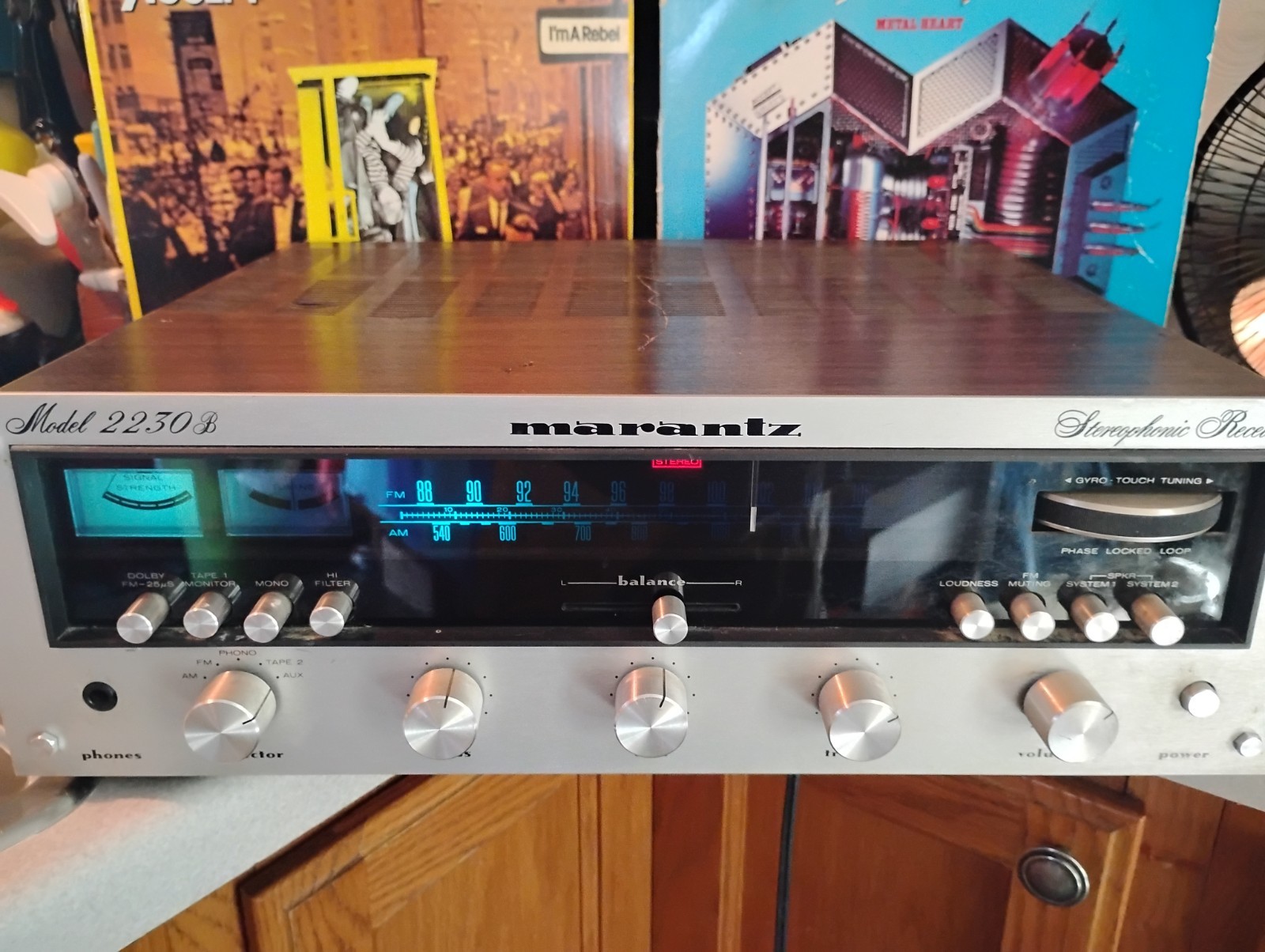
The front panel is classic late-’70s Marantz: brushed aluminum with a blue backlit tuning meter and large, tactile knobs. It feels industrial, not decorative. The PLL multiplex stereo decoder in the FM tuner section was a step above basic designs, offering stable stereo reception with reduced drift and crosstalk. Combined with a FET front end, the tuner remains a standout feature—many owners still praise its ability to pull in weak stations cleanly. The inclusion of a 15Hz subsonic filter also shows Marantz’s attention to real-world vinyl playback, helping to eliminate turntable rumble without muddying the bass.
Input sensitivity is 2.5 mV for phono and 250 mV for line-level sources, which aligns with typical moving magnet cartridges and standard preamp outputs of the era. The signal-to-noise ratio of 65 dB (phono) isn’t exceptional by today’s standards, but it’s sufficient for quiet listening environments, especially when paired with well-maintained records. The frequency response is flat across the audible spectrum—20Hz to 20kHz (±1dB)—a claim backed by service manual measurements and still respected by vintage audio enthusiasts.
Specifications
| Manufacturer | Marantz |
| Product Type | Stereo Receiver |
| Power Output | 30 watts per channel (minimum RMS into 8 ohms, 20Hz–20kHz with no more than 0.3% THD) |
| Total Harmonic Distortion (THD) | 0.3% (at rated power) |
| Frequency Response | 20Hz–20kHz (±1dB) |
| Signal-to-Noise Ratio (S/N) | 65 dB (Phono) |
| Input Sensitivity | 2.5 mV (Phono), 250 mV (Aux/Tape) |
| Damping Factor | approximately 45 |
| Dimensions (W x H x D) | 18-3/4" x 5-3/4" x 14-1/4" |
| Weight | 23.1 lbs (10.5 kg) |
| Production Years | 1978–1980 |
| Original Price | Approximately $380 USD |
Key Features
FM/AM Tuner with FET Front End and PLL Stereo Decoder
The tuner section is one of the 2230B’s strongest assets. Equipped with a field-effect transistor (FET) front end, it offers low-noise amplification for both AM and FM bands. But the real standout is the phase-locked loop (PLL) multiplex stereo decoder—a more stable and accurate alternative to the standard discrete transistor decoders of the time. PLL decoding reduced stereo crosstalk and improved channel separation, especially on weaker signals. Collectors note that this feature was typically reserved for higher-end models, making its inclusion here a mark of Marantz’s commitment to performance across the lineup.
Direct-Coupled Complementary Symmetry Output Stage
Marantz engineers avoided coupling capacitors in the amplifier’s signal path by using a direct-coupled design. This meant the audio signal passed from driver to output transistors without capacitive blocking, preserving low-frequency phase integrity and transient response. The complementary symmetry configuration—using matched NPN and PNP transistors in push-pull—delivered balanced current delivery to the speakers. This topology contributed to the receiver’s reputation for tight, articulate bass and a smooth midrange, even under load.
15Hz Subsonic Filter
Turntable owners quickly appreciate this often-overlooked feature. The 15Hz subsonic filter engages to attenuate frequencies below the audible range, eliminating rumble from warped records, belt drive systems, or imperfect turntable isolation. Unlike some filters that roll off too early and dull the bass, this one is steep enough to target only infrasonic content. It’s a small switch with a big impact on system clarity, especially when paired with full-range speakers.
Brushed Aluminum Front Panel with Blue Backlit Dial
The 2230B wears its era proudly. The brushed aluminum faceplate resists fingerprints and glare, while the large blue-illuminated VU-style tuning meter adds a touch of drama without being gaudy. The backlighting is functional—allowing easy tuning in dim rooms—but also iconic. Over time, the lamps can fail or yellow, and replacement is a common part of restoration. The knob feel is precise, with detents that click firmly into place, a hallmark of Marantz’s build quality during this period.
Loudness Contour and Tone Controls
The loudness contour switch engages a bass and treble boost at lower volume levels, compensating for the human ear’s reduced sensitivity to extremes when listening quietly. It’s a simple but effective feature, and when used judiciously, it maintains tonal balance without artificial emphasis. The bass and treble controls offer ±10dB adjustment at 100Hz and 10kHz, respectively—enough to tailor the sound to room acoustics or speaker characteristics, but not so much that they encourage drastic over-correction.
Historical Context
The Marantz 2230B was introduced in 1978 as part of the “B” series refresh, which updated models like the 2215B, 2220B, and 2245B with improved reliability and modernized cosmetics. It succeeded the Marantz 2230 and was eventually followed by models in the next generation of “xx30” receivers, such as the 4230. Priced at approximately $380 at launch, it occupied a sweet spot between budget receivers and high-end separates, offering tuner, preamp, and amplifier functionality in one robust chassis. It arrived during a period of intense competition in the stereo receiver market—what some collectors refer to as the “1970s stereo war”—where brands like Pioneer, Sansui, and Sony pushed power ratings while Marantz emphasized fidelity and build.
Collectibility & Value
Today, the Marantz 2230B trades between $300 and $600 USD, depending on condition, originality, and whether it has been serviced. Units described as “serviced” or “recapped” often command prices at the higher end of the range. Some European listings have asked over €1,200, though these appear to be outliers or include rare accessories. The receiver’s durable construction and modular design make it a favorite among DIY restorers. Common issues include failing power switches, dim or dead backlighting, oxidized potentiometers, and degraded electrolytic capacitors—particularly in the power supply and amplifier boards. Recapping is considered routine maintenance, not a major repair, and replacement parts remain available through vintage audio suppliers.
Enthusiasts regard the 2230B as a “mouse that roared”—a modestly powered receiver that delivers a surprisingly full and engaging sound. When paired with efficient speakers like the JBL L100, it’s said to sound “perfect,” according to owner reports. Its reputation for reliability and classic Marantz warmth has solidified its status as a high-value entry-level vintage receiver, especially for those stepping into tube-free analog systems.
eBay Listings


As an eBay Partner, we earn from qualifying purchases. This helps support our independent vintage technology research.