Marantz 1090 (1977–1980)
At 9.5 kg, it sits on the rack like a promise kept — heavy with intent, dense with circuitry, built for those who demanded control.
Overview
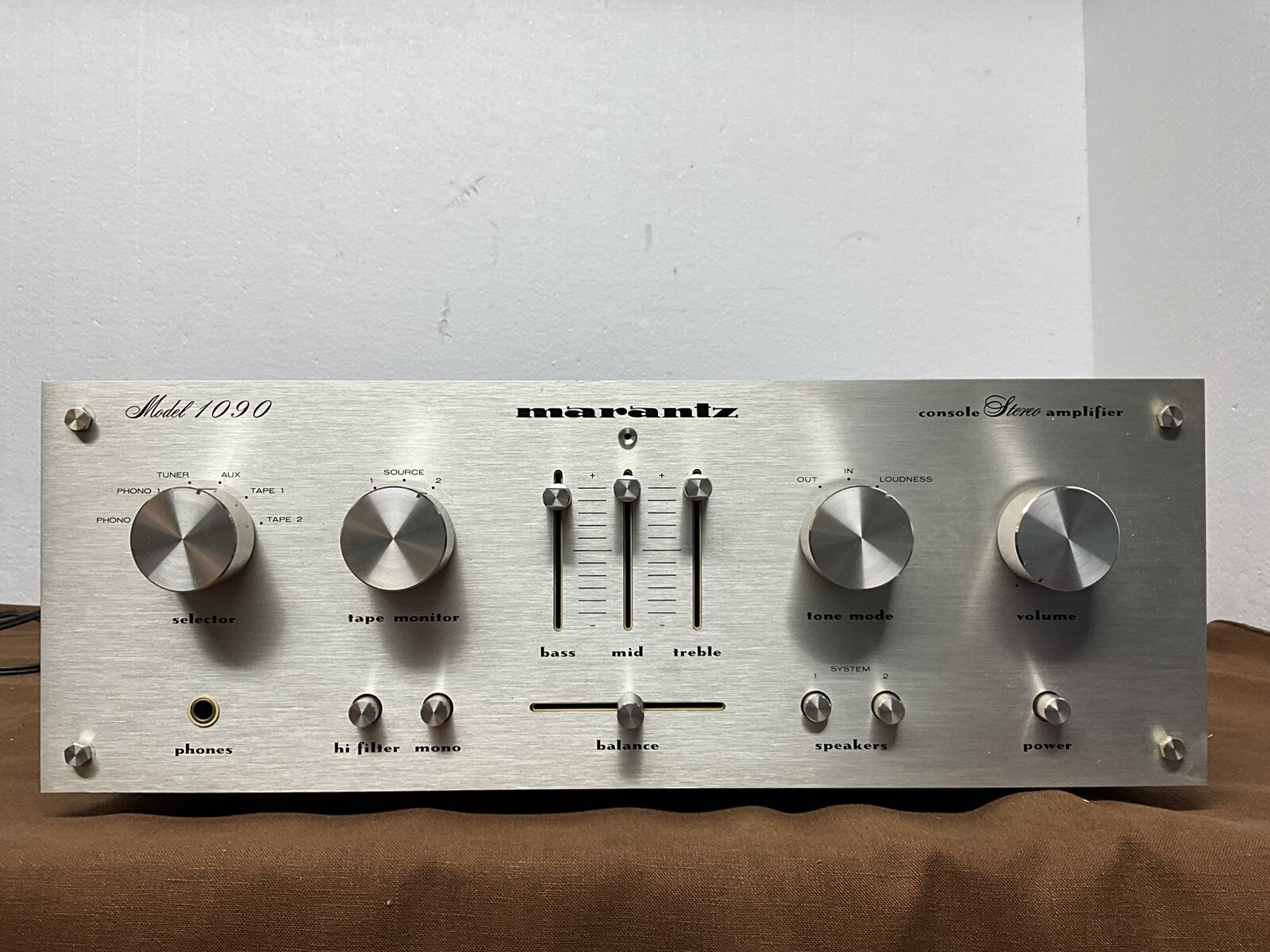
The Marantz 1090 Stereo Console Amplifier isn’t a showpiece of minimalist design or a stripped-down power brute. It’s a full-featured, no-compromise integrated amplifier from the late 1970s, built for users who wanted surgical control over their signal path and the confidence of a robust, serviceable design. Weighing in at 9.5 kg (20.9 lbs), this machine feels substantial — not just from its steel chassis and thick faceplate, but from the sheer density of its 45-transistor, 26-diode complement, laid out across a service manual that reads like an engineer’s roadmap. It was designed for flexibility: with dual phono inputs (PHONO 1 and PHONO 2), multiple high-level sources (TUNER, AUX, TAPE 1, TAPE 2), and both TAPE OUT and PRE OUT jacks, it functioned as a central hub in a complex analog chain.
Owners report a layout that prioritizes utility over elegance — six input selectors, a MODE switch, a TAPE MONITOR toggle, and a full set of tone controls including a rare Middle frequency adjustment alongside Bass and Treble. The inclusion of high-cut filter networks, selectable via front-panel switches, suggests Marantz anticipated use with less-than-ideal recordings or tape sources, giving users a way to tame brightness without sacrificing the top end entirely. The amplifier’s universal power transformer — compatible with 110, 120, 220, and 240 V AC at 50/60 Hz — points to its intended global market, a nod to both touring professionals and expatriate audiophiles.
Despite its comprehensive feature set, the 1090 doesn’t shout "high-end" in the way later Marantz models would. It lacks the discrete, hand-selected components of the Reference line, and its 45-watt-per-channel output (into 8 ohms) sits modestly against contemporaries pushing 100 watts. But its design philosophy is evident in the details: the phono stage, built around transistors Q401, Q403, and Q405, delivers a gain of 40 dB with an input sensitivity of 1.8 mV and an input impedance of 47 kΩ — specs that align with standard MM cartridges of the era. The overload margin of 35 dB and a dynamic range of 96 to 100 dB (sources vary) suggest a forgiving front end, capable of handling variable record conditions without clipping.
What stands out is the level of testability baked into the design. The service manual specifies precise test conditions: a 180 mV input signal for maximum power output testing, an 8-ohm 100W load resistor, and even a 0.5 µF capacitor for instability testing. This isn’t gear built to be replaced — it’s built to be measured, adjusted, and maintained. The presence of current-limiting transistors Q713 and Q715 in the main amplifier stage further underscores a design focused on longevity and fault tolerance.
Specifications
| Manufacturer | Marantz |
| Product type | Stereo Console Amplifier |
| Power output | 45 watts per channel into 8Ω (stereo) |
| Frequency response | 10Hz to 60kHz ±1.25dB (High Level); 20Hz to 20kHz ±0.2dB (Power Amp); 20Hz to 20kHz ±0.3dB (Phono, RIAA) |
| Total harmonic distortion | 0.1% (IM distortion at 4Ω and 8Ω) |
| Damping factor | 45 |
| Input sensitivity | Main In: 1.5 V; Phono: 1.8 mV; Aux, Tape: 180 mV |
| Input impedance | Main In: 30 kΩ; Phono: 47 kΩ; High-level: 25 kΩ |
| Input capacitance | 100 pF (Phono) |
| Input overload | 100 mV (Phono, 1 kHz) |
| Output impedance | Tape Out: 300 Ω; Pre-Out: 200 Ω; Headphone: 4 Ω |
| Output level | Tape Out: 775 mV; Pre-Out: 1.5 V (ref. 180 mV Aux), 4.2 V (ref. 500 mV Aux, main amp disconnected) |
| Signal-to-noise ratio | Main In: 110 dB; Phono: 76 dB; High Level: 88 dB |
| Channel balance | 3.0 dB (Phono, Aux) |
| Interchannel crosstalk | Phono: 47 dB; Aux: 62 dB; Tape: 62 dB (at 1 kHz) |
| Hum and noise | 2.0 mV (volume min); 20 mV (volume max) |
| Power consumption | 14 W (idle); 160 W (rated output, both channels driven) |
| Power requirement | 110, 120, 220, 240 V AC, 50/60 Hz |
| Dimensions | 416 mm (W) × 146 mm (H) × 301 mm (D) |
| Weight | 9.5 kg (unit alone); 11.5 kg (packed) |
| Transistor count | 45 |
| Diode count | 26 |
| Gain | 40 dB (phono-amplifier) |
| Overload margin | 35 dB (Phono) |
| Dynamic range | 96 dB (Phono) |
Key Features
Four-Band Tone Control with Middle Frequency Adjustment
Unlike most integrated amplifiers of its era that offered only Bass and Treble, the Marantz 1090 includes a dedicated Middle control — a rare feature that gives users precise shaping over the vocal and instrumental midrange. Combined with the Bass and Treble controls and the additional High-cut filter networks, this creates a four-layer tonal toolkit. The high-cut filters, selectable via front-panel switches, allow attenuation of frequencies above 10 kHz, useful for taming harshness from worn tapes or over-bright recordings. This level of control suggests the 1090 was aimed at critical listeners and semi-professional users who needed to adapt their system to variable source material.
Dual Phono Inputs with RIAA-Corrected Stage
The inclusion of both PHONO 1 and PHONO 2 inputs indicates Marantz anticipated users with multiple turntables — a luxury at the time. The phono stage, built around transistors Q401, Q403, and Q405, delivers a gain of 40 dB with an input sensitivity of 1.8 mV and an input impedance of 47 kΩ, matching standard moving magnet cartridges. Input capacitance is fixed at 100 pF, which may limit compatibility with certain high-capacitance cables or cartridges, but ensures stability. The stage’s 35 dB overload margin and dynamic range of 96 dB suggest a design that prioritizes headroom and low noise, with a reported equivalent input noise of 0.5 µV — respectable for a solid-state design of this period.
Pre-Out and Tape Out Connectivity
The presence of both PRE OUT and TAPE OUT jacks transforms the 1090 from a standalone amplifier into a modular component. The PRE OUT jacks, with an output level of 1.5 V (referenced to 180 mV at Aux inputs) or 4.2 V (with main amp disconnected), allow connection to an external power amplifier for bi-amping or future upgrades. The TAPE OUT jacks, fixed at 775 mV and 300 Ω output impedance, ensure clean signal routing to a recorder without level fluctuations from the volume control. This flexibility was a hallmark of high-end separates, and its inclusion here underscores the 1090’s positioning as a near-high-end integrated.
Class 'A' Driver Stage with Current Limiting
The main amplifier stage uses class 'A' drivers Q707 and Q709, which contribute to low distortion and smooth clipping behavior. The design also includes direct-coupled drivers Q717 and Q719, eliminating coupling capacitors in the signal path for improved transient response. Transistors Q713 and Q715 act as current limiters, protecting the output stage from short circuits or reactive loads — a practical safeguard that reflects Marantz’s focus on reliability. The entire amplifier is built around a differential pre-amplifier (Q701, Q703), a topology known for common-mode noise rejection and stability.
Universal Power Supply with Multi-Voltage Compatibility
The Marantz 1090 is equipped with a universal power transformer, allowing operation on 110, 120, 220, or 240 V AC at 50 or 60 Hz. This global compatibility was not standard in consumer audio gear of the late 1970s and suggests the 1090 was marketed internationally, possibly to expatriates, travelers, or dealers in multiple regions. The idling power consumption of 14 W and 160 W at rated output reflect a linear power supply and conservative thermal design — efficient enough for continuous use, but not as power-hungry as some contemporaries.
Collectibility & Value
The Marantz 1090 occupies a niche in the vintage audio market — respected for its build quality and feature set, but not as iconic as the Model 15 or 2270. Listings suggest a range of values: a "totally restored" unit sold for 370€ in 2023, while a "Mint" example on Reverb carried a price tag of $1,230.40. More typical used prices fall between $150 and $525, with forum discussions questioning whether $150 is fair for an untested unit. A replacement volume control potentiometer is listed on eBay for $75, indicating that at least some parts are still available. Owners note that capacitor replacement ("recapping") is a common restoration step, given the age of the unit. With no widespread reports of catastrophic failure modes, the 1090 appears to be a durable design — one that, when serviced, can still perform reliably.
Market Value
┌──────────────────────────────────────────────────────────────────────────┐
│ MARANTZ 1090                                                    May 2026 │
├──────────────────────────────────────────────────────────────────────────┤
│ High      $1,847                                  Latest            $619 │
│ Median    $586                                    Trend           ▼ Down │
│ Low       $501                                    Volume           ~4/mo │
├──────────────────────────────────────────────────────────────────────────┤
│ $2,000 ┤                                                                 │
│        │                  .                                              │
│        │                                                                 │
│ $1,357 ┤                                                                 │
│        │                                                                 │
│        │                                                                 │
│        │                                                                 │
│   $500 ┤.           .      .                              .             .│
│        ├─────────────────────────────────────────────────────────────────│
│    vol │▄           █     ▄▄                              ▄             ▄│
│        └─────────────────────────────────────────────────────────────────│
│         2026-03                      2026-04                      2026-05│
└──────────────────────────────────────────────────────────────────────────┘
eBay completed sales. Excludes accessories, parts, and non-working units. Hover points for details.
eBay Listings



As an eBay Partner, we earn from qualifying purchases. This helps support our independent vintage technology research.