Fisher 440-T Receiver (1965)
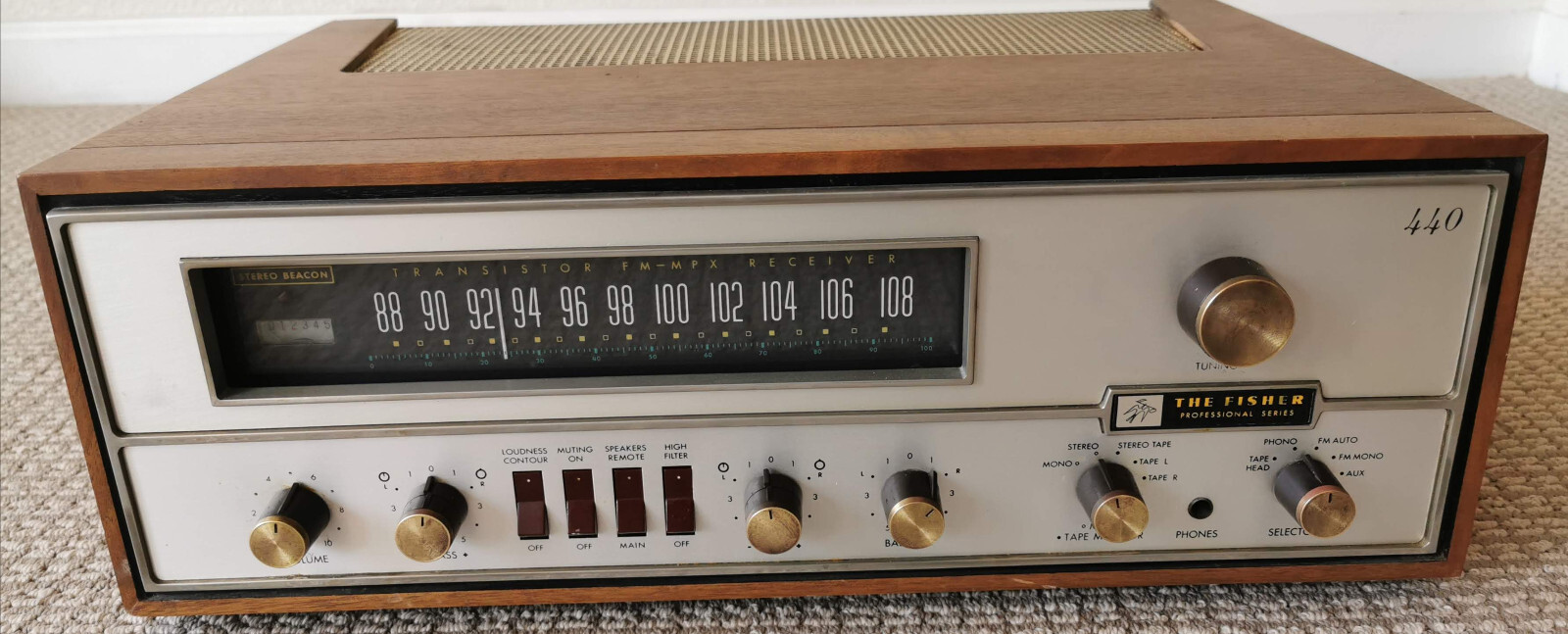
At 28 pounds, the Fisher 440-T lands in the rack with the quiet authority of a mid-century engineering statement—solid-state muscle wrapped in warm walnut and precision slide-rule tuning.
Overview
The Fisher 440-T Receiver emerged in 1965 or 1966 as Fisher’s deliberate step into transistorized audio, marking a calculated pivot from the tube-based designs that had defined the brand’s earlier reputation. It wasn’t just another receiver; it was a declaration that solid-state could deliver both reliability and musicality. Positioned as a premium component in Fisher’s mid-tier lineup, the 440-T combined a full-function FM tuner, preamplifier, and power amplifier in one chassis, targeting serious listeners who wanted integrated convenience without sacrificing performance. Its real walnut wood veneer cabinet and illuminated slide-rule analog dial gave it the upscale aesthetic expected of Fisher, while the internal shift to transistors promised cooler operation and reduced maintenance compared to tube counterparts. Owners report that the 440-T avoided the brittle, fatiguing sound that plagued some early solid-state gear, instead delivering a balanced, warm presentation that remained true to Fisher’s high-fidelity philosophy.
Key Features
20 Watts Per Channel RMS Output into 8 Ohms
Rated at 20 watts per channel (RMS, 8 ohms, stereo), the 440-T wasn’t built to shake walls, but to drive efficient vintage speakers with control and clarity. This power rating—modest by later standards—was sufficient for most living-room setups of the era, especially when paired with high-sensitivity speakers. The amplifier section used silicon output transistors, conservatively rated to minimize distortion and thermal stress, a design choice highlighted in Audio (January 1966, p.29) for enabling long, trouble-free operation. While not as powerful as Fisher’s flagship tube receivers, the 440-T’s output was well-matched to its intended role as a refined, reliable centerpiece for stereo systems transitioning into the transistor age.
Switchable 4, 8, and 16 Ohm Impedance Outputs
Owners appreciate the flexibility of switchable impedance settings (4, 8, and 16 ohms)), allowing the 440-T to interface cleanly with a wide range of vintage speakers. This feature, common in higher-end receivers of the period, ensured optimal power transfer and damping, reducing the risk of amplifier strain or speaker damage. The presence of A/B speaker taps further enhanced usability, letting listeners switch between two pairs of speakers—a practical touch for those experimenting with different sonic signatures or room placements.
Slide-Rule Analog Tuning with Illuminated Scale
The FM tuner’s slide-rule analog dial is a standout feature, both functionally and aesthetically. Unlike rotary dials, the linear scale offered precise station placement and easy readability, while the illuminated face made tuning in dimly lit environments straightforward. The tuner included a front-panel switch for selecting either “broad” mode—delivering the widest frequency response—or “sharp” mode, which prioritized selectivity to reject adjacent stations in crowded bands. This level of user control was a hallmark of Fisher’s engineering ethos, treating the listener as a participant rather than a passive consumer.
Phono, Tape, and Auxiliary Inputs with Full Monitor Path
Equipped with phono (magnetic), tape, and auxiliary inputs via RCA connectors, Tape, Auxiliary (via RCA)), the 440-T accommodated the source components typical of a 1960s stereo system: turntables, reel-to-reel decks, and external tuners. The inclusion of a tape monitor function allowed users to switch between live and recorded sources seamlessly, a feature increasingly important as tape gained popularity. Outputs included tape out, preamp out, and switchable speaker taps, providing flexibility for system expansion.
Historical Context
The 440-T arrived at a turning point in audio history, as manufacturers shifted from vacuum tubes to solid-state technology in pursuit of greater reliability and lower maintenance. Fisher, already respected for its high-performance tube receivers and tuners, faced the challenge of translating its sonic signature into the transistor realm. The 440-T was part of that effort—a mid-tier model that signaled Fisher’s commitment to innovation without abandoning its core values. While not as iconic as the Fisher TX-200 or XR-1000 series, the 440-T holds significance as one of the brand’s earlier solid-state receivers, embodying the transitional period between eras. HiFi-Stereo noted it as “the first solid-state stereo receiver of Fisher quality under $330,” underscoring its role in making high-fidelity technology more accessible.
Collectibility & Value
Collectors rate the Fisher 440-T at approximately 6/10 for desirability—moderate, but steady. It lacks the legendary status of Fisher’s top-tier models, but its solid build quality, historical relevance, and pleasing sound keep it in demand among enthusiasts restoring period-correct systems. Units in excellent cosmetic and working condition typically sell for $150–$300, with fully restored examples commanding premiums. Common issues include aging electrolytic capacitors in the power supply and signal path, which should be replaced before extended use to prevent failure. Oxidized potentiometers and switches can cause crackling or dropouts, remedied with contact cleaner and repeated actuation. While the silicon transistors are generally reliable, testing is advisable if channel imbalance or distortion occurs. Tuner alignment may also be needed after decades of storage or transport. A full restoration should include visual inspection, recapping, cleaning of controls, verification of voltage rails, and a cautious power-up using a variac.
eBay Listings


As an eBay Partner, we earn from qualifying purchases. This helps support our independent vintage technology research.
Related Models
- Fisher 700-t (1962)
- Fisher C-55 (1959)
- Fisher 400-R (1963)
- Fisher 400-T (1964)
- Fisher 500-B (1959)
- Teac A-460 (1975)
- Akai AM-16 (1975)
- Realistic STA-47 (1976)
- Teac A-3300 (1972)
- Teac A-3300S (1975)