EICO HF-81 (1959)
It doesn’t look like much, but this humble kit-built amp delivers a sound that’ll stop you in your tracks—warm, alive, and shockingly detailed.
Overview
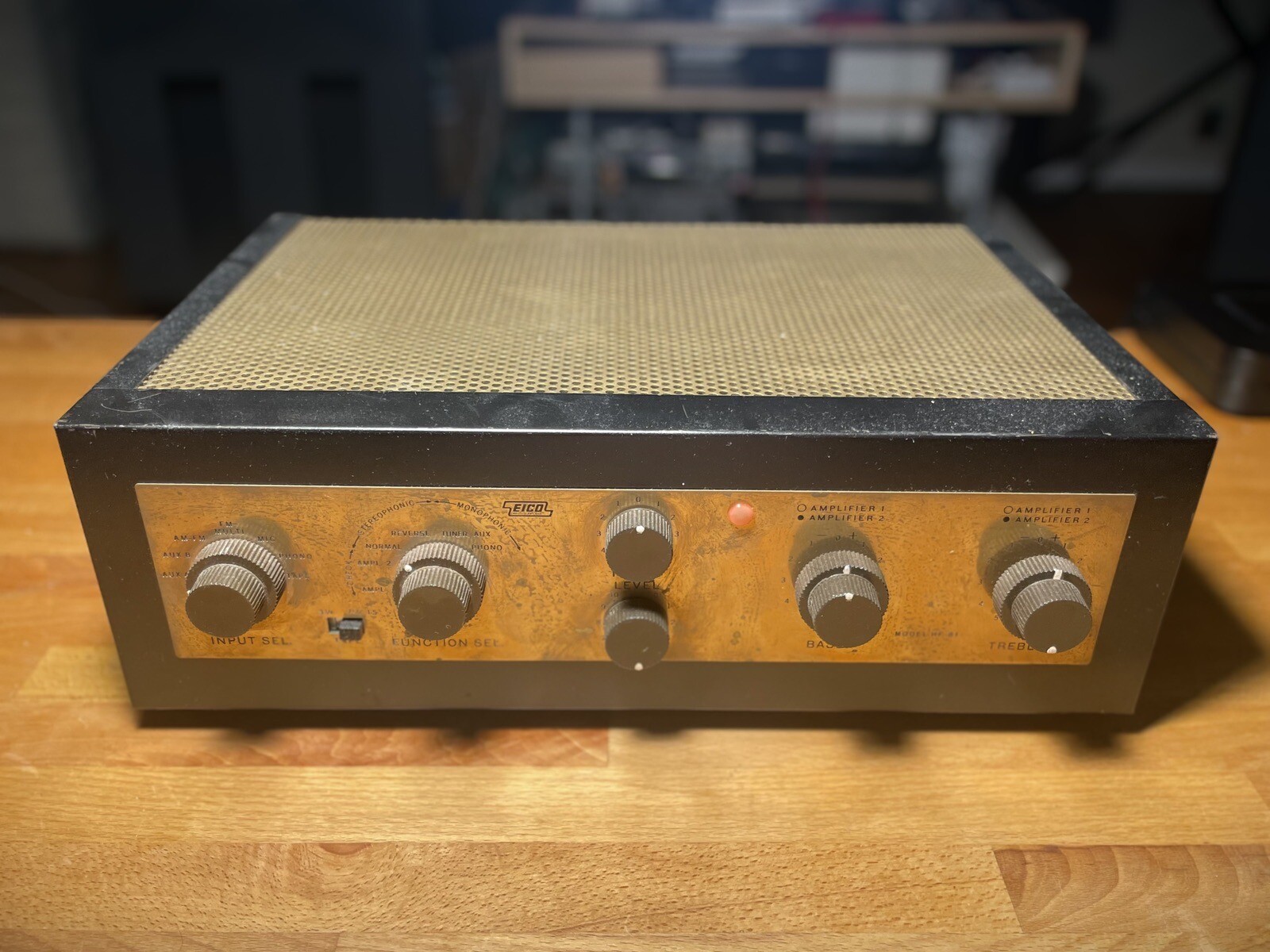
At first glance, the EICO HF-81 doesn’t impress. The chassis is bare metal, the layout industrial, the wiring point-to-point and unapologetically exposed. There’s no veneer, no polished faceplate—just a brass front panel and a forest of tubes waiting to glow. But that’s the point. Introduced in 1959 by EICO of Long Island City, NY, this stereo integrated amplifier kit wasn’t sold as a finished luxury item. It was sold as a project, a hands-on entry into high-fidelity audio for the hobbyist willing to solder, align, and troubleshoot. For $69.95 as a kit (or $109.95 assembled), buyers got a complete tube amplifier with phono stage, tone controls, and 14 watts per channel—serious performance at a fraction of the cost of comparable factory-built units.
Owners report a sound that defies its modest power rating: smooth, natural, and dynamically expressive, with a midrange bloom and soundstage depth that some say rivals solid-state amplifiers costing far more. One period reviewer put it bluntly: “I literally could not BELIEVE the sound!” Another called it “too good” for its price—a sentiment that still echoes in restoration forums today. The HF-81 wasn’t flashy, but it delivered where it mattered: in the music. That performance, combined with its DIY accessibility, made it a cornerstone of EICO’s move into the hi-fi market and one of the most collectible tube-era kits today.
It wasn’t without flaws. The build quality, while functional, has been described as “the most homely chassis you have ever seen,” resembling “an elementary school electronics project gone awry.” But that rawness is part of its charm. This was electronics before the boutique finishes—just tubes, transformers, and wire, laid bare for anyone willing to learn. And learn they did. EICO had been a leader in kit-based electronics since 1945, starting with test equipment, and the HF-81 carried that educational mission into the hi-fi world. It wasn’t just an amplifier; it was a lesson in vacuum tube circuitry, grounding, and signal flow.
Key Features
Williamson-Inspired Push-Pull Output
The HF-81’s design draws from the Williamson amplifier topology, a benchmark for high fidelity in the late 1940s, known for low distortion and wide bandwidth. While not a pure Williamson, it follows the philosophy: a push-pull output stage using pairs of EL84/6BQ5 tubes, triode-wired for a sweeter, more natural midrange. Each channel delivers 14 watts RMS into the rated load, a conservative but honest rating that reflects real-world performance. The frequency response, measured at 1W into 8 ohms, spans 10Hz to 100kHz with ±0.5dB tolerance—exceptionally wide for its time and a testament to careful transformer design.
Full Tube Preamp with Phono Stage
Four ECC83/12AX7 tubes handle preamplification duties, including a dedicated magnetic phono input with full RIAA equalization—essential for vinyl playback in the late 1950s. Sensitivity is set at 4mV for the phono input, 2mV for tape head, 5mV for mic, and 500mV for aux and tuner sources, allowing compatibility with a range of contemporary gear. The tone controls offer ±15dB adjustment at 50Hz and 10kHz, giving users flexibility without muddying the signal path. Harmonic distortion remains under 1% at 8W across 30Hz–10kHz, and intermodulation distortion is 2% at 14W—solid numbers for a tube amp of this class.
Twin EZ81 Rectification and Point-to-Point Wiring
Power is supplied via twin EZ81 rectifier tubes, a design choice that contributes to the amp’s soft startup and characteristic “sag” under load—something many tube enthusiasts still chase. The chassis, while visually dense, is well laid out with ample spacing between components, making servicing more approachable than expected. The point-to-point wiring, though not elegant, reflects EICO’s commitment to repairability and transparency. Inside, coupling capacitors, a 50 µF and a 100 µF cap, and CRL couplets in the tone network were standard for the era but are now known failure points—especially the CRL couplets, which many restorers replace with modern PCBs.
Brass Faceplate and Output Flexibility
The front panel features a brass faceplate, a small but notable upgrade over painted steel, offering durability and a touch of refinement. Speaker connections include taps for 4, 8, 16, and 32 ohms, allowing safe matching with a wide range of speakers—though the amp performs best with efficient models. The “SEP, COM Switch” circuit, intended for channel separation control, is often modified or removed in modern restorations, and a phono grounding lug is typically added for compatibility with contemporary turntables.
Historical Context
EICO didn’t start in hi-fi. Founded in 1945, the company built its reputation on test equipment and amateur radio kits, selling to hobbyists and technicians who valued clarity and learnability. By the late 1950s, as stereo audio gained popularity, EICO saw an opportunity to expand. The HF-81 was part of that push—a direct response to the growing demand for affordable, high-performance audio gear. It entered a market crowded with competitors like Dynaco, Heathkit, Fisher, Scott, and LEAK, all vying for the DIY and entry-level segments. But the HF-81 stood out not just for its price, but for its performance. It wasn’t just a product; it was an extension of EICO’s philosophy—making high-fidelity audio accessible to tinkerers, students, and music lovers who wanted quality without the premium price tag.
Collectibility & Value
Today, the EICO HF-81 is one of the most collectible of all vintage tube-era kits. A fully restored unit can command prices from $800 to $2,990, with SkyFi Audio listing one at the top end as of mid-2025. Sold examples show a broad range: $650, $950, $1,050, and $1,600 (reduced from $1,750). The spread reflects condition, restoration quality, and whether tubes are included. As one owner warned: “avoid those sky-high priced, unrefurbed beater HF-81's with no tube set.”
Restoration is almost a given. These units are over 60 years old, and the original capacitors—especially the multi-section can and coupling caps—degrade over time. Common maintenance includes full capacitor replacement, tube socket replacement, select resistor changes, and adding a modern 3-prong power cord for safety. Chassis and transformer covers are often repainted due to rust, discoloration, and pitting—common issues noted by collectors. The balance control may drift, requiring slight adjustment off-center for optimal performance, and channel imbalances in the volume control have been reported. Despite these quirks, many HF-81s are still in service today. If carefully restored, owners say they sound superb—detailed, musical, with that classic “tubey” character, capable of driving large floorstanding speakers.
eBay Listings
As an eBay Partner, we earn from qualifying purchases. This helps support our independent vintage technology research.
Related Models
- Eico 3200 (1970)
- Eico 3570 (1972)
- Eico HF-65A (1958)
- Eico HF-94 (1955)
- Eico 3440 (1975)
- Quad 44/405-COMBINATION (1976)
- Braun AUDIO-1 (1965)
- Braun AUDIO-250 (1965)
- Braun AUDIO-310 (1965)
- Magnavox Component Systems (1972)