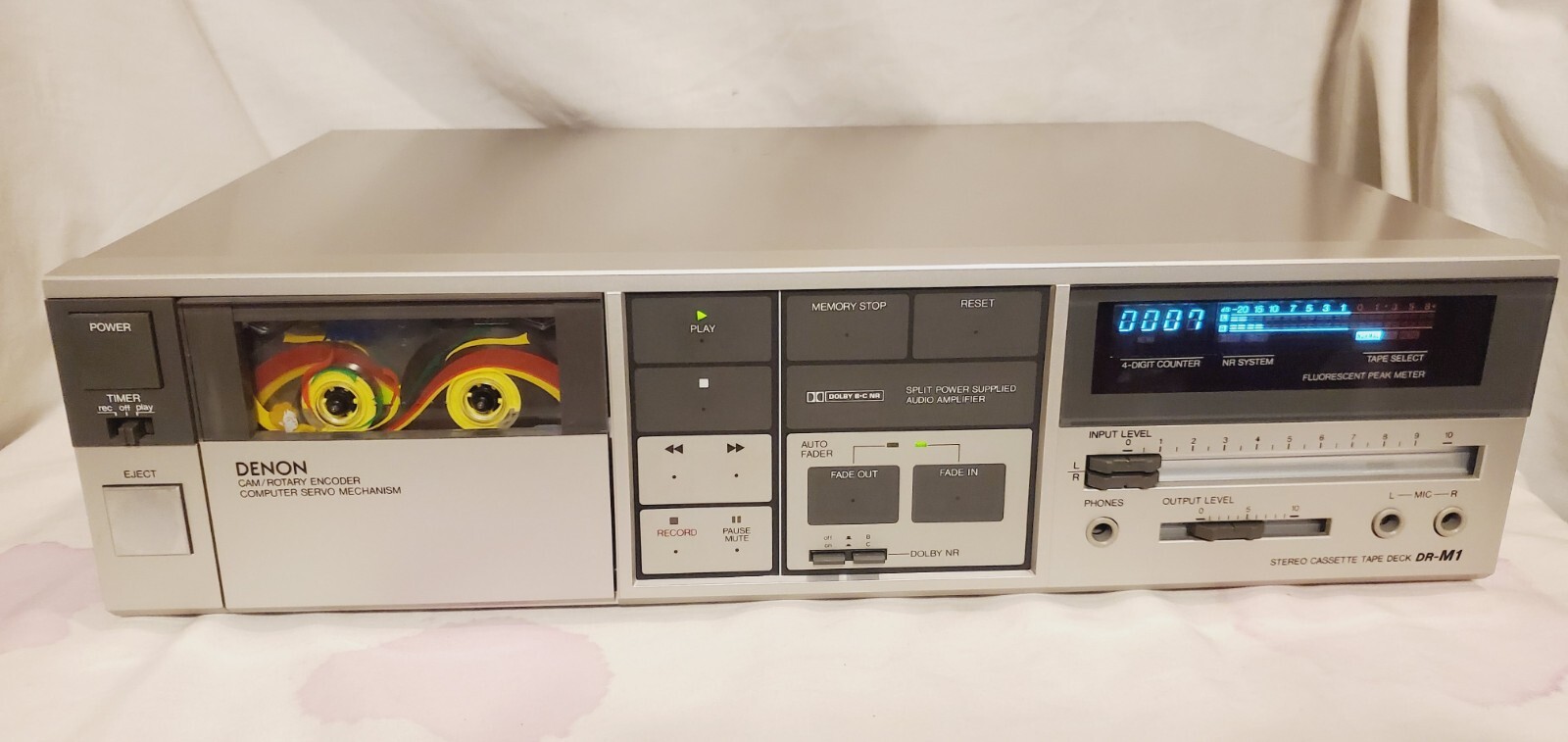
Denon DR-M1 (1983)
A heavy-duty cassette deck with servo-controlled transport, Dolby C NR, and a rare auto-fader that actually works
Overview
At 5.5 kg, the Denon DR-M1 lands in your rack like a declaration: this is not another flimsy auto-reverse deck from the early '80s. Released in 1983, the DR-M1 was part of a four-model series (DR-M1 through DR-M4) that represented Denon’s no-compromise approach to cassette technology—engineering that prioritized transport stability, signal purity, and long-term reliability over flashy gimmicks. The deck handled all tape types via a 3-Level Auto Tape Selector (Normal, CrO2, Metal), and its SF (Super Frequency) combination head was tuned to extract maximum fidelity from Type II and Type IV formulations. With a frequency response of 20 Hz to 20 kHz on metal tape (at -20VU input), it achieved full-range playback capability that few decks could match at the time.
According to HiFI-Stereo (June 1983, p.47), the DR-M1 exceeded Denon's previous sonic performance levels while adding significant technological and convenience features. The DR-M1’s signal-to-noise ratio was rated at ≥73 dB with Dolby C NR engaged, measured using the CCIR/ARM standard—a rigorous method that made the figure credible among critical listeners.
It carried both Dolby B and Dolby C noise reduction systems, giving users flexibility depending on tape type and recording level. Input sensitivity was 77.5 mV for line and 0.35 mV for microphone (both unbalanced), while output delivered 775 mV into a 10 kΩ load. The headphone amplifier could drive impedances from 8 Ω to 2 kΩ, delivering 2.1 mW into an 8 Ω load—adequate for most portable headphones of the era. Power draw was modest at 19W, running on 100 VAC at 50/60 Hz, and the chassis measured 434 mm wide, 115 mm high, and 286 mm deep, fitting standard 19-inch racks with ease.SF (Super Frequency) Combination Head with Dual-Gap Erase
The heart of the DR-M1’s performance was its SF (Super Frequency) combination head, a single assembly handling both recording and playback with optimized pole geometry for extended high-frequency response. Unlike cheaper decks that used separate record and playback heads, the SF head minimized azimuth misalignment and improved channel separation. Paired with a double-gap ferrite erase head, it ensured complete erasure across all tape types, reducing print-through and crosstalk. The head design contributed directly to the deck’s ability to reproduce 20 kHz on metal tape—a benchmark few contemporaries reached without significant roll-off.
Electronic Servo DC Motor with Non-Slip Reel Drive
The DR-M1’s transport was built for precision. A dedicated electronic servo DC motor drove the capstan, maintaining constant tape speed with minimal variation. Two additional DC motors handled reel movement and mechanical control functions, ensuring smooth winding and responsive operation. A non-slip reel drive mechanism was adopted to prevent tape slippage during fast-forward or rewind, a common failure point in lesser decks. This system, combined with the servo-controlled capstan, delivered the ±0.08% wow and flutter rating that placed the DR-M1 among the upper tier of consumer cassette decks. The early winding time for a C-60 tape was approximately 90 seconds—fast but not extreme—suggesting a balance between speed and tape stress.
Computer-Controlled Silent Mechanism with Memory Stop
Denon equipped the DR-M1 with a computer-controlled silent mechanism, a phrase that in practice meant microprocessor-managed tape transport logic with reduced mechanical noise and smoother transitions between modes. One standout feature was the memory stop mechanism, which allowed the deck to resume playback from a previously marked position—a rare convenience in 1983. The transport also included a 4-digit digital counter and an FL peak meter, giving users visual feedback on signal levels and tape position. According to available documentation, the internal logic was designed to reduce wear and improve long-term reliability, a reflection of Denon’s focus on durability.
Auto-Fader Mechanism for Seamless Transitions
One of the DR-M1’s more unusual features was its auto-fader mechanism, which allowed users to automatically fade in or fade out audio after approximately four seconds by pressing a button—though the original documentation’s phrasing, “after approximately four illnesses,” is almost certainly a mistranslation of “four seconds.” When engaged, the fader provided smooth amplitude transitions, useful for recording radio programs or creating seamless edits between tracks. This feature, uncommon in consumer decks, hinted at semi-professional aspirations. The fader operated in conjunction with the deck’s DC amplifier configuration, which avoided coupling capacitors in the signal path to prevent sonic degradation—a design choice Denon claimed preserved transient detail and low-frequency coherence.
Historical Context
The Denon DR-M1 emerged in 1983 as part of a coordinated series that included the DR-M2, DR-M3, and DR-M4, all built with Denon’s precision engineering philosophy. While the higher-end models in the series offered more advanced features, the DR-M1 served as a fully capable entry into Denon’s high-fidelity cassette lineup. At a time when many brands treated cassette decks as disposable electronics, Denon positioned these units as serious audio components, comparable in build and intent to their high-end turntables and amplifiers. The DR-M1’s combination of servo control, metal tape support, and Dolby C NR
Collectibility & Value
Today, the DR-M1 is seen as a durable, serviceable deck with a loyal following among analog enthusiasts. Used units appear intermittently on auction sites, with recent listings showing prices around $85 plus $40 shipping for units in very good condition, and European listings asking DKK 2,495 (~$360). Some refurbishers, like spencertified.com, list the DR-M1 as “Refurbished, Serviced, and High-Quality,” suggesting it responds well to restoration. Given its solid build and serviceable design, the DR-M1 remains a practical choice for those digitizing tape collections or maintaining a vintage high-fidelity system.
eBay Listings

As an eBay Partner, we earn from qualifying purchases. This helps support our independent vintage technology research.
Related Models
- Denon DL-303 (1980)
- Denon DN-302F (1982)
- Denon DR-M44 (1985)
- Denon DRA-1000 (1978)
- Denon SC-5000 (1978)
- Quad 44/405-COMBINATION (1976)
- Braun AUDIO-1 (1965)
- Braun AUDIO-250 (1965)
- Braun AUDIO-310 (1965)
- Magnavox Component Systems (1972)