Akai GXC-46 (1973–1975)
A 2-head cassette deck from Akai’s early 1970s lineup, built in Tokyo with wear-resistant GX heads and a reputation for solid serviceability.
Overview
The Akai GXC-46 is a stereo cassette deck manufactured in Tokyo, Japan, during the early 1970s, with the GXC-46D variant confirmed in production from 1973 to 1975. It was designed as a mid-to-high-tier recorder for serious audio enthusiasts, offering a two-head configuration (one erase head and one combined record/playback head) in monaural form—standard for quality decks of the era. Measuring 440 mm wide, 130 mm high, and 250 mm deep, and weighing 8.5 kg net, the GXC-46 has a heft that suggests industrial-grade construction, not cost-cutting. Its 4-pole synchronous motor is FG servo-controlled, a design choice aimed at stabilizing tape speed and minimizing wow and flutter, which Akai measured at 0.07% WRMS—a strong figure for its time.
The deck supports a tape speed of 4.76 cm/sec and delivers a frequency response of 30 Hz to 14,000 Hz on standard LH (Type I) tapes, extending to 17,000 Hz with special LH (Type II) tapes. Signal-to-noise ratio is rated at 47 dB, typical for non-Dolby-equipped models, though some sources suggest the GXC-46D may have included Dolby B—no such claim is confirmed for the base GXC-46. Input sensitivity is 100 mV for line and 0.5 mV for microphone inputs, with output levels of 400 mV on line and an 8Ω headphone output. It runs on 180–260 VAC at 50/60 Hz, consuming 20 watts, making it suitable for international use without voltage conversion.
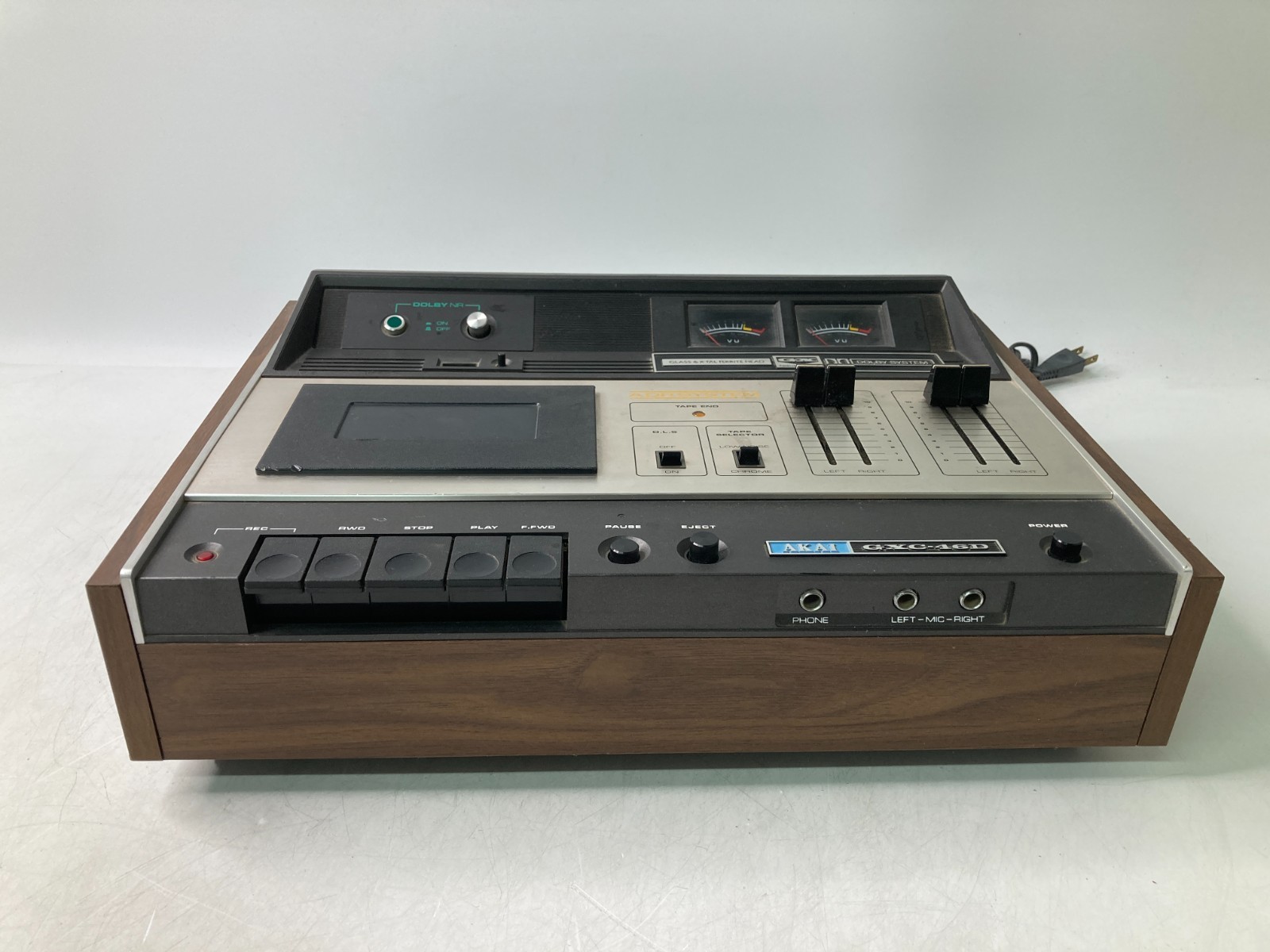
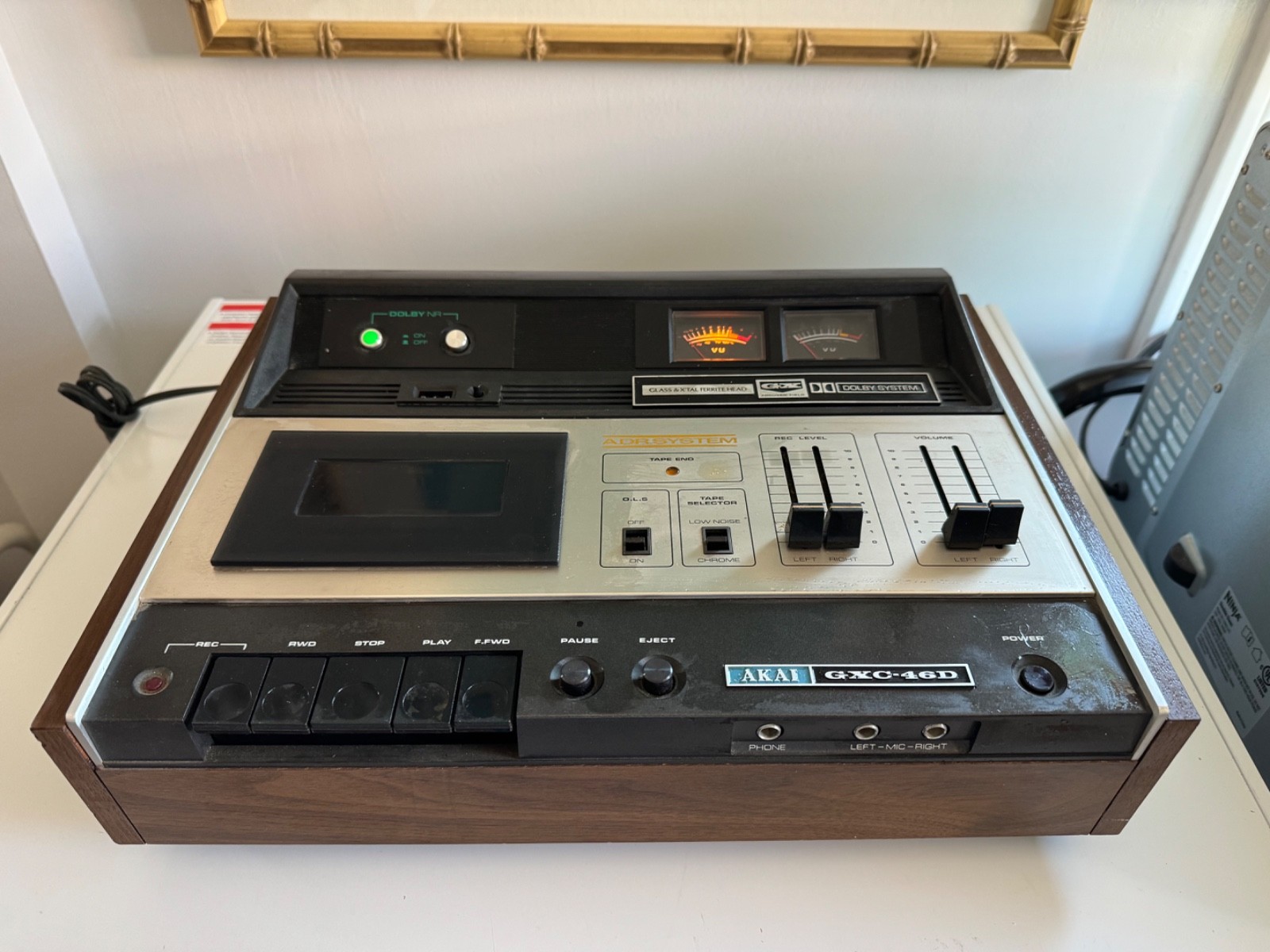
Owners report that the GXC-46 was marketed with two original AKAI microphones, suggesting it was intended for direct recording applications. The front panel features a black faceplate with soft-touch buttons and two large VU meters, providing clear visual feedback during recording. Wood side panels add a touch of warmth to its otherwise utilitarian design, a common aesthetic in Japanese electronics of the period.
Key Features
GX Heads with Glass and Crystal Ferrite
The GXC-46 uses Akai’s proprietary GX heads, constructed with glass and crystal ferrite materials. These were promoted as “wearless” due to their resistance to abrasion from repeated tape contact—a significant advantage over standard ferrite heads, which degrade faster with use. The two-head layout (separate erase and combined record/playback head) allows for immediate playback of newly recorded material, a feature valued by users making live recordings or dubs. The head design reflects Akai’s broader engineering philosophy during this period: prioritize durability and serviceability over flash.
4-Pole Synchronous FG Servo Motor
Powered by a 4-pole synchronous motor with FG (frequency generator) servo control, the GXC-46 maintains precise tape speed by locking to the AC line frequency while using feedback to correct minor fluctuations. This system was more stable than basic synchronous motors and less complex than full direct-drive mechanisms, striking a balance between performance and reliability. Combined with a capstan and pinch roller system, it ensures consistent tape-to-head contact, critical for maintaining frequency response and minimizing wow and flutter.
Wood-Clad Chassis with Soft-Touch Controls
The cabinet features wood side panels, a design element common in 1970s audio gear that added rigidity and visual appeal. The black front panel houses soft-touch buttons for transport functions—an improvement over mechanical levers in terms of longevity and user experience. Two large VU meters dominate the center, allowing precise monitoring of input levels, a necessity when recording from microphones or line sources without automatic level control.
Historical Context
The GXC-46 emerged during a pivotal moment in cassette history—when the format was transitioning from portable dictation to high-fidelity home audio. Akai positioned the GXC-46 within this shift, focusing on build quality and head technology rather than flashy automation. It was sold alongside models like the GXC-500 and GXC-500D, though no direct lineage or tier relationship is documented. One owner on AudioKarma noted using it specifically for archiving live cassette recordings, a testament to its perceived reliability for long-term use. While not a flagship model with Dolby or auto-reverse, it served a practical niche: a durable, serviceable deck for users who valued repairability and consistent performance.
Collectibility & Value
Today, the GXC-46 is not a high-value collectible, but it retains quiet respect among cassette deck enthusiasts for its robust construction and serviceable design. Common maintenance issues include deteriorating belts, worn capstan idler tires, and aging electrolytic capacitors—typical of any deck from this era. A post on Facebook documented a repair involving a faulty internal wire and the replacement of the EC514743 MP/C capacitor, underscoring the importance of preventive servicing. The GX heads’ wear-resistant design is a plus, with HiFi Engine noting their longevity compared to standard heads. While no current market pricing data is available, decks in excellent condition—verified in YouTube reviews as “good” and “runs well”—are likely to appeal to users restoring vintage systems rather than speculators.
eBay Listings

As an eBay Partner, we earn from qualifying purchases. This helps support our independent vintage technology research.
Related Models
- Akai AA-5200 (1978)
- Akai AP-001 (1975)
- Akai AP-003 (1980)
- Akai AP-007 (1985)
- Akai BT-500 (1978)
- Infinity RS-IIA (1977)
- Sony TC PB5 (1970s)
- Infinity RS-4.5 (1978)
- Sony TC-K333ESG (1989)
- Sony TC-K333ESJ (1991)