Akai GX-365D (1970)
At 25.5 kg, it doesn’t just sit on the rack—it anchors it, a full-size reel-to-reel deck built like a broadcast machine for those who demanded studio-grade fidelity at home.
Overview
The Akai GX-365D is a professional-grade stereo tape deck introduced around 1970, designed for serious audiophiles and semi-professional users who required precision, flexibility, and durability. Unlike consumer cassette decks or compact recorders, the GX-365D operates in the realm of open-reel analog—handling tape speeds up to 38 cm/s with stability and clarity that rival contemporary studio machines. Priced at ¥146,000 at launch, it was a premium product, clearly aimed at those unwilling to compromise on performance. Its engineering reflects Akai’s commitment to high-end audio during a period when Japanese manufacturers were pushing the boundaries of what analog tape could achieve.
With support for four tape speeds—4.75, 9.5, 19, and 38 cm/s, the latter enabled via an attached adapter—the GX-365D offers versatility across formats and applications, from extended-play home recordings at 4.75 cm/s to near-master-quality playback at 38 cm/s. The deck uses a 4-track, stereo/mono recording system with focus field recording, a technique that improves high-frequency response and reduces crosstalk. Its three dedicated heads—record, playback, and erase—are all inline and built using Akai’s proprietary Glass & Crystal Ferrite formulation, a technology heavily promoted in period literature for its durability and sonic performance. The result is a machine capable of delivering frequency response up to 28 kHz (±3 dB) at 19 cm/s, with wow and flutter as low as 0.04% RMS—specifications that placed it among the upper echelon of consumer reel-to-reel decks of its time.
Three Inline Glass & Crystal Ferrite Heads
The GX-365D uses separate inline heads for recording, playback, and erasing, each constructed with Akai’s proprietary Glass & Crystal Ferrite material. This formulation, developed in-house, was advertised as "dust free" and "wear free," with Studio-Sound (July 1971, p.7) describing it as “the first of its kind in the world.” The recording head presents a low impedance of 15 Ω at 1 kHz, optimized for driving tape with precision, while the playback head has a much higher impedance of 3,000 Ω at 1 kHz, tuned for maximum signal retrieval from the tape. The erase head, rated at 330 Ω at 100 kHz, ensures complete signal removal across all tracks. This three-head configuration allows for monitoring during recording via the playback head, a critical feature for accurate level setting and performance evaluation. The heads are aligned for 4-track, stereo/mono operation, supporting standard consumer reel formats with professional-grade head contact and gap accuracy.
Four Tape Speeds with Precision Motor Control
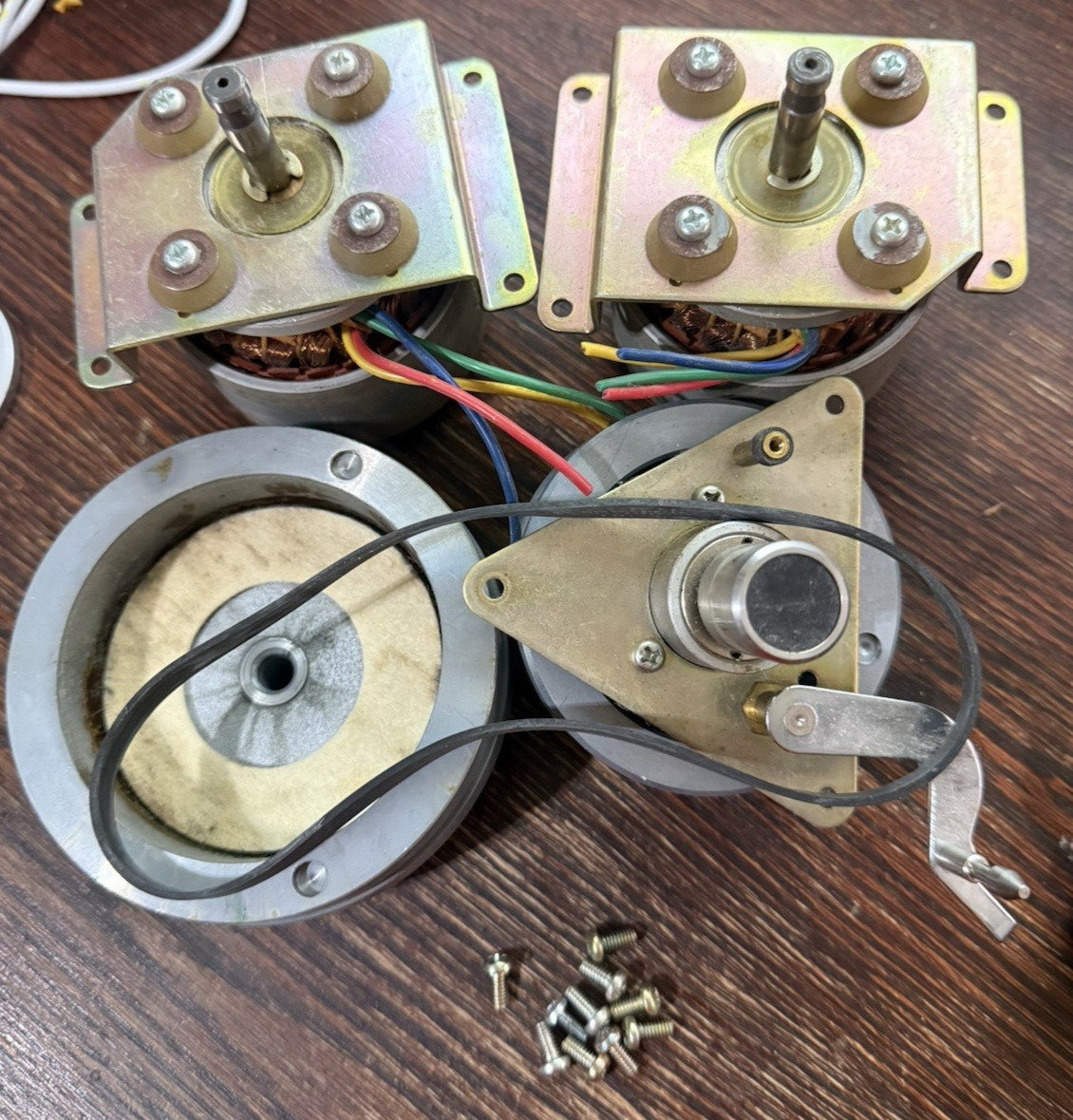
One of the GX-365D’s defining capabilities is its support for four tape speeds: 4.75, 9.5, 19, and 38 cm/s, with the highest speed requiring an attached adapter. This range enables everything from economical 4-hour stereo recordings on a 370m tape (at 4.75 cm/s) to high-fidelity playback approaching studio master quality. Speed accuracy is maintained by a hysteresis synchronous motor for the capstan, ensuring minimal deviation—±0.5% or less at 19 cm/s. The reel motors are a pair of 6-pole outer rotor types, providing consistent torque and tension across the spool. Fast-forward and rewind times are approximately 75 seconds at 50 Hz and 60 seconds at 60 Hz for a full 370m reel, reflecting robust motor performance. The capstan motor operates at variable speeds depending on frequency: 3,500/1,500/750 rpm (50 Hz) or 3,600/1,800/900 rpm (60 Hz), synchronized to line frequency for stability. This motor system, combined with the deck’s heavy chassis, contributes to the machine’s exceptional speed consistency and low wow and flutter, especially at higher speeds where analog fidelity is most critical.
Studio-Grade Signal Performance
The GX-365D delivers measurable performance that aligns with professional expectations. At 19 cm/s, frequency response extends from 30 Hz to 28 kHz (±3 dB), capturing nearly the full audible spectrum with authority. Distortion is rated at 1.5% or less at 1 kHz and 0 VU, a conservative figure that suggests clean headroom under normal operating conditions. Signal-to-noise ratio is 55 dB or more at 19 cm/s, 50 dB or more at 9.5 cm/s, and 50 dB or more at 4.75 cm/s, while crosstalk remains below 45 dB in stereo mode—adequate for consumer use but not matching the isolation of high-end studio decks. The erase ratio is impressively deep at -70 dB or less, minimizing residual signal and ensuring clean over-recording. Input sensitivity is 70 mV for line (150 kΩ impedance), with a mic input requiring only 0.7 mV (10 kΩ), making it compatible with a wide range of sources. Output is rated at 1.23 V (0 VU) into 100 Ω, suitable for driving downstream preamps without additional gain. All recording and playback equalization follows NAB standards, the North American norm at the time, with a 100 kHz bias frequency ensuring optimal high-frequency response during recording.
Robust Chassis and Electrical Design
Housed in a chassis measuring 410 mm wide, 470 mm high, and 280 mm deep, the GX-365D weighs a substantial 25.5 kg—mass that contributes to mechanical stability and vibration resistance. The internal circuitry relies on 46 transistors, 21 silicon diodes, and 11 germanium diodes, reflecting a hybrid design approach common in high-end Japanese gear of the era. Power requirements are flexible, accepting 100–240 VAC at either 50 or 60 Hz, suggesting international market intent. Power consumption ranges from 70W to 200W depending on operation, consistent with the demands of dual reel motors and constant-speed capstan drive. The deck supports Reel 7 size spools, the standard for full-size open-reel tapes, and includes DIN and line-level I/O options alongside a stereo headphone monitor output (30–40 mV into 8 Ω). Insulation resistance is rated at 50 MΩ or more, with dielectric strength tested to 500 V for one minute, indicating robust electrical isolation and safety compliance. These design choices reflect a machine built not just for sound quality, but for long-term reliability in demanding environments.
Historical Context
The Akai GX-365D emerged during a pivotal moment in audio history—the early 1970s—when reel-to-reel tape was transitioning from a niche professional format to a high-fidelity consumer option. Akai positioned the GX-365D as part of a new "GX generation" of decks, a term used in High-Fidelity (July 1971, p.24) to describe models like the GX-220D and GX-280D that shared the Glass & Crystal Ferrite head technology.
Collectibility & Value
Owners report that the GX-365D remains a respected machine among reel-to-reel enthusiasts, with one Reddit user calling it “definitely a nice deck” and another Facebook post praising its “excellent sound.” However, practical ownership today comes with caveats. A known issue involves the right RCA input, with at least one documented case of signal drop-out. Another recurring problem, noted on Tapeheads.net, is the failure of the motor start capacitor—a common aging component that can prevent the reel motors from engaging properly. Replacement parts, including reel motor assemblies and tape-source switches, do appear on eBay, suggesting a modest support ecosystem. Despite its weight and complexity, the GX-365D continues to attract attention from collectors drawn to its build quality, auto-reverse functionality, and the allure of Akai’s proprietary head technology.
eBay Listings


As an eBay Partner, we earn from qualifying purchases. This helps support our independent vintage technology research.
Related Models
- Akai AA-5200 (1978)
- Akai AP-001 (1975)
- Akai AP-003 (1980)
- Akai AP-007 (1985)
- Akai BT-500 (1978)
- Infinity RS-IIA (1977)
- Sony TC PB5 (1970s)
- Infinity RS-4.5 (1978)
- Sony TC-K333ESG (1989)
- Sony TC-K333ESJ (1991)