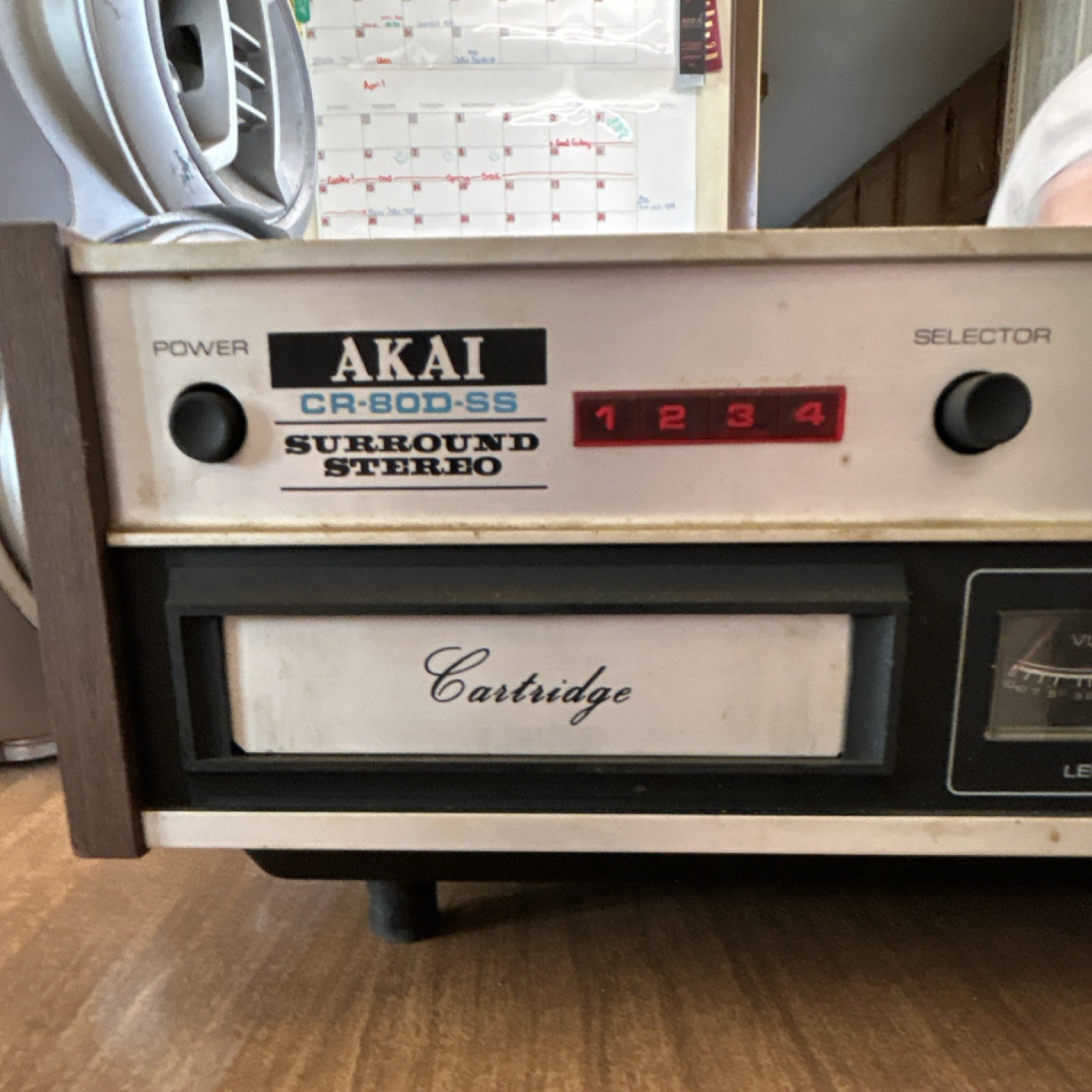
Akai CR-80D
A compact 8-track stereo cartridge deck from the dawn of consumer quadraphonic audio, built when magnetic tape still ruled the living room
Overview
The Akai CR-80D is a single-deck 8-track stereo cartridge tape player manufactured during the early 1970s, a period when the format was peaking in popularity for both home and automotive use. Marketed as a serious audio component rather than a car-only novelty, the CR-80D was engineered for reliable 2-channel stereo playback and recording, positioning Akai as a builder of capable, no-nonsense tape decks. It features a 2-head configuration—one combined record/playback head and one dedicated erase head—allowing for clean overdubbing and minimizing residual signal carryover, a hallmark of mid-tier 8-track decks aimed at enthusiasts. With a tape speed of 9.5 cm/s, the unit maintains the standard transport rate for 8-track cartridges, ensuring compatibility across the era’s pre-recorded and user-dubbed tapes. While it lacks 4-channel capability, its design anticipates the quadraphonic wave—Akai would later release the CR-80D-SS variant to support discrete and matrixed quad formats, though the relationship between the models is not documented. As noted in HiFI-Stereo (July 1971, p.12), the CR-80D was part of Akai’s pursuit of revolutionary, precision-made audio equipment.
Key Features
2-Head Configuration with Dedicated Erase Function
The CR-80D employs a two-head system: one combined record/playback head and a separate erase head. This setup enables true erase-before-record functionality, a step above playback-only decks and essential for users making custom recordings. By erasing the existing signal immediately before the record head lays down new audio, the design reduces crosstalk and improves fidelity during dubbing. This configuration was typical of higher-end 8-track units of the era, balancing performance and cost, and suggests Akai targeted semi-professional or audiophile-leaning users despite the format’s mass-market reputation.
9.5 cm/s Tape Transport
Operating at the industry-standard 9.5 cm/s (3-3/4 inches per second), the CR-80D ensures full compatibility with commercially released 8-track tapes and home-recorded cartridges. This speed was the norm across the format, allowing consistent frequency response and dynamic range expectations across decks. While no official frequency or distortion specs are documented, the use of a precision 1-micron gap head—implied by Akai’s marketing language for the CR-80 series—suggests an emphasis on high-frequency clarity and head longevity, critical for maintaining signal integrity over repeated passes.
Single-Deck 8-Track, 2-Channel Stereo Design
As a single-deck unit, the CR-80D is dedicated solely to 8-track cartridges, with no cassette or reel-to-reel functionality. It supports 2-channel stereo playback and recording, aligning with the dominant consumer audio standard of the early 1970s. The lack of 4-channel decoding distinguishes it from later quadraphonic models, but its clean signal path and dual-head layout make it a solid foundation for stereo tape enthusiasts.
Historical Context
Produced around 1970–1975, the CR-80D arrived during the golden age of 8-track cartridges, just before compact cassettes began their ascent in fidelity and portability. Though 8-track would fade by the late 1970s, the CR-80D remains a snapshot of a format taken seriously by engineers at a time when magnetic tape still defined home audio convenience.
Collectibility & Value
The Akai CR-80D has seen modest interest among vintage tape enthusiasts, particularly those restoring 1970s-era living room systems or exploring pre-cassette magnetic media. A listing on Cassette Comeback priced a reconditioned unit at $138.70, described as “fully functional, sounding real good and exceptionally clear”—a testament to the deck’s potential when properly maintained. However, no widespread reputation for durability or failure modes exists in the documentation, and parts availability for internal components like solenoids or rubber drive belts is not confirmed. Given the format’s obsolescence, usability today depends heavily on sourcing working tapes and periodic alignment checks, but for collectors of audio archaeology, the CR-80D represents a clean, functional example of Akai’s early 1970s tape engineering.
eBay Listings



As an eBay Partner, we earn from qualifying purchases. This helps support our independent vintage technology research.
Related Models
- Akai AA-5200 (1978)
- Akai AP-001 (1975)
- Akai AP-003 (1980)
- Akai AP-007 (1985)
- Akai BT-500 (1978)
- Infinity RS-IIA (1977)
- Sony TC PB5 (1970s)
- Infinity RS-4.5 (1978)
- Sony TC-K333ESG (1989)
- Sony TC-K333ESJ (1991)