Akai AM-32 (1987–1989)
At 11.2 kg, it rests on the rack like a no-nonsense workhorse—dense, Japanese-built, and wired for duty.
Overview
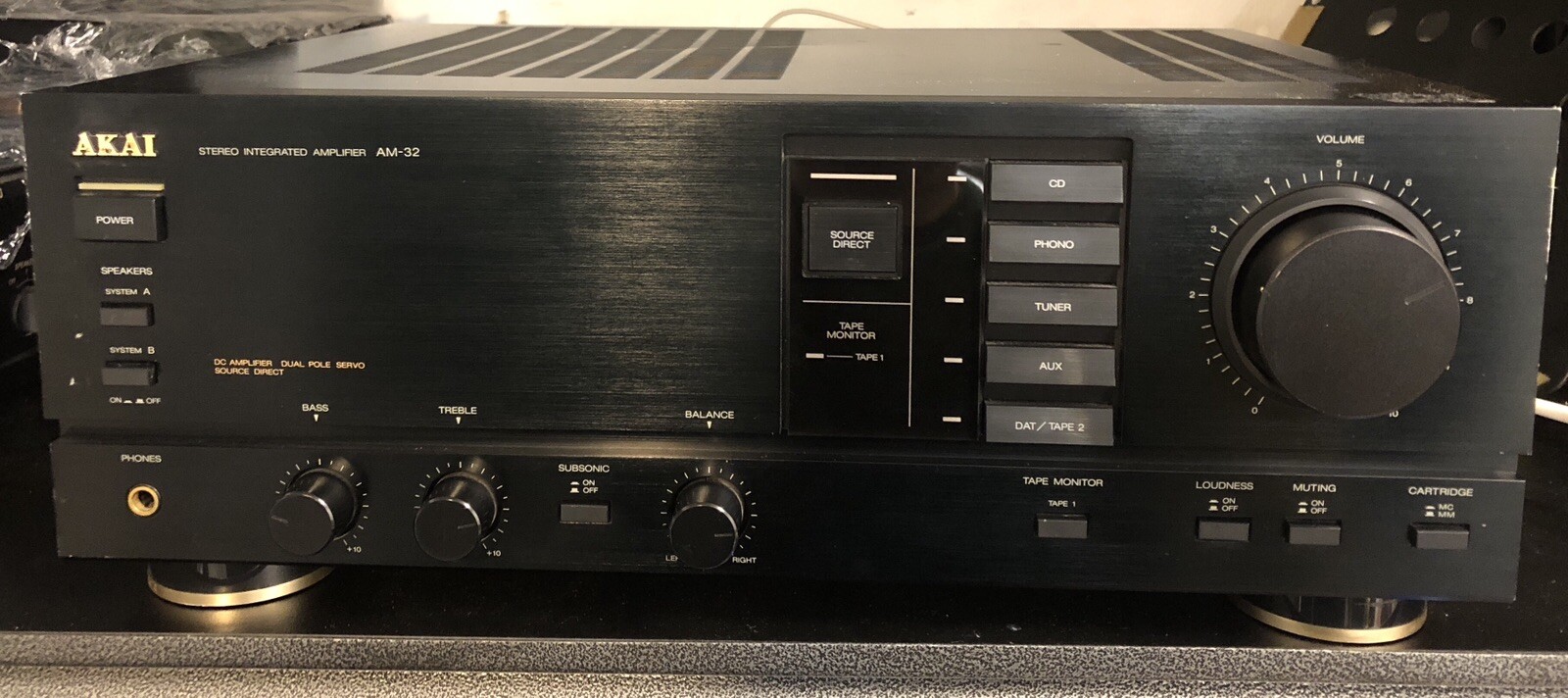
The Akai AM-32 is a stereo integrated amplifier from Akai, the Japanese electronics company better known for its reel-to-reel tape decks and later digital samplers than for amplification. Produced between 1987 and 1989, with some sources narrowing the run to 1988–1989, the AM-32 emerged during Akai’s late-1980s effort to offer a complete audio chain, including the AT-52 and AT-93 tuners and CD-32 CD player, as noted on hifi-wiki.com. It was built in Japan and marketed primarily in Europe, where it carried an original price of approximately 599 DM—positioning it as a mid-tier component for serious listeners who valued reliability over showmanship. HiFi-Stereo (1989, p.78) included the AM-32 in its survey of integrated amplifiers from the era, confirming its presence in the mainstream European high-fidelity market.
Measuring 425 × 156 × 377 mm (W×H×D) and weighing 11.2 kg, the AM-32 has the substantial feel of a well-damped chassis, suggesting a robust power transformer and deliberate internal layout. It delivers 50 watts per channel, a conservative but serviceable output for driving 4Ω to 16Ω speaker loads, making it adaptable to a range of vintage speakers without risk of impedance mismatch. Inputs include a phono stage switchable for both moving magnet (MM) and moving coil (MC) cartridges—a notable feature for a mid-tier unit—allowing direct connection of a wide range of turntables without external preamplification. A dedicated CD input is also present, reflecting the format’s growing dominance in the late 1980s. The unit features four speaker outputs, though their exact function—whether for bi-amping, A/B switching, or zone control—is not documented. An eBay listing confirms “TESTED AND ALL FUNCTIONS WORKING,” suggesting straightforward operation and functional integrity in surviving units.
Owners report a neutral sound character, ideal for accurate monitoring. One HiFi Engine user described it as “a really solid middle class amplifier” and noted, “I use two of these to digitize analog music because they a so reliable,” highlighting its stability and transparency in critical playback and transfer applications. The amplifier’s design appears focused on longevity and signal integrity, with no frills or exotic circuitry advertised. While no details on internal topology or component count are available, its construction aligns with Akai’s reputation for overbuilt, repairable electronics from the period.
Collectibility & Value
The Akai AM-32 has not emerged as a sought-after collector’s item. A Reverb listing recorded 21 views and no watchers over two years, with no visible asking price, indicating limited market demand. An eBay listing remained active without disclosed pricing, and a Facebook user noted a unit was “in pretty good condition for the age … It was serviced some time ago but I haven't tested it,” a common refrain among owners of uncelebrated but durable Japanese gear from the era. Its value likely lies in utility rather than rarity. Given its reputation for reliability and neutral sound, it may appeal to users building a vintage analog chain for listening or digitization, particularly those pairing it with other Akai components like the CD-32 or AT-93. However, with no documented failure modes, service notes, or spare parts availability, long-term maintenance remains uncertain.
eBay Listings
As an eBay Partner, we earn from qualifying purchases. This helps support our independent vintage technology research.
Related Models
- Akai AM-2600 (1977)
- Akai AM-2650 (1975)
- Akai AM-2850 (1975)
- Akai AM-73 (1973)
- Akai AM-2400 (1978)
- Denon POA-800 (1978)
- Eico 3150 (1967)
- Fisher CUSTOM-ELECTRA-I (K-14/K-15) (1957)
- Fisher CUSTOM-ELECTRA IV (E33/E44) (1960)
- Denon DA-1000 (1982)