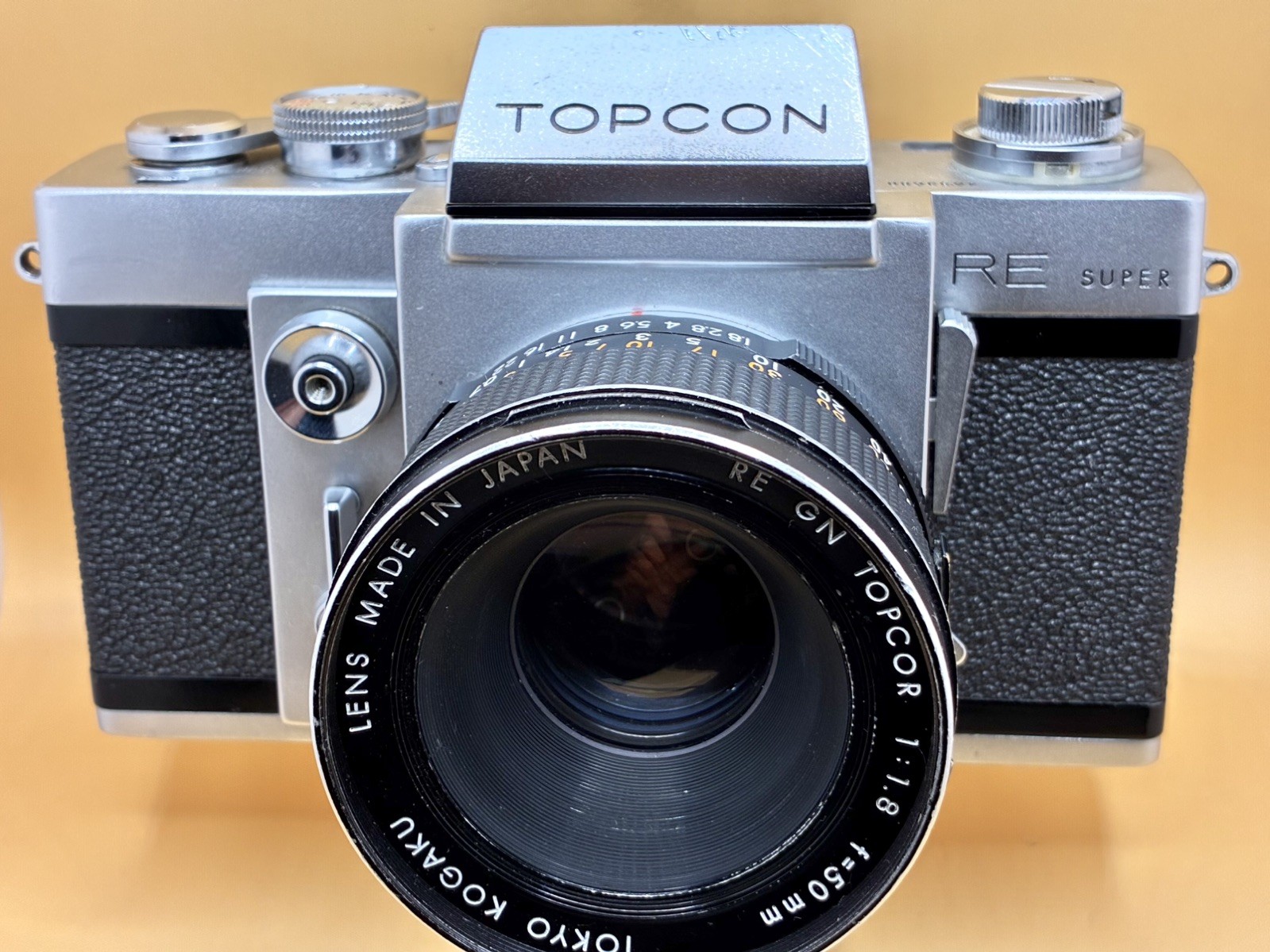
TOPCON RE SUPER
The Topcon RE Super is a 35mm single-lens reflex (SLR) camera introduced in 1963, widely recognized as the world’s first commercially successful through-the-lens (TTL) metering SLR. A landmark in photographic technology, it combined precision engineering with advanced exposure control, establishing a new standard for professional and advanced amateur photographers.
Overview
Introduced by Tokyo Kogaku (later Topcon Corporation), the RE Super was a pivotal development in the evolution of 35mm SLR cameras. At a time when handheld light meters and stop-down metering were the norm, the RE Super integrated a full-aperture TTL metering system, allowing photographers to compose and focus at maximum lens aperture while measuring exposure through the lens. This innovation drastically improved exposure accuracy, particularly with complex lens systems and variable lighting conditions. The camera was aimed at the professional and serious amateur market, offering robust build quality, a reliable vertical-travel metal focal-plane shutter, and compatibility with a growing range of high-performance Topcon lenses.
The RE Super succeeded the earlier Topcon R and R2 models, refining their design with the addition of TTL metering and a redesigned pentaprism housing. It was part of Topcon’s push to compete with German and American SLR manufacturers like Zeiss Ikon and Kodak, while also positioning itself against emerging Japanese rivals such as Nikon and Canon. Despite its technical superiority, the RE Super remained a niche product outside Japan due to limited international distribution and the dominance of the Nikon F system. Nevertheless, it gained a loyal following among photojournalists and technical photographers who valued its optical quality and mechanical precision.
Key Features
- World’s first practical TTL metering system in an SLR, using a CdS cell mounted behind the reflex mirror to measure light through the lens at full aperture.
- Interchangeable focusing screens allowing customization for different shooting needs (e.g., split-image for critical focus, microprism for low-light).
- Precision mechanical shutter with durable vertical-travel design, offering reliable performance across all speeds.
- Topcon RE Auto lenses with automatic diaphragm and meter coupling, enabling full-aperture metering without manual stop-down.
- Robust all-metal construction with die-cast aluminum body and brass top plate, built for professional durability.
Historical Context
The Topcon RE Super was launched at a critical juncture in SLR development. In the early 1960s, SLRs were gaining popularity over rangefinders, but exposure metering remained an external or stop-down process. The RE Super’s TTL system, developed in collaboration with Japanese optical researchers, solved this by routing light reflected off the shutter curtain to a CdS meter cell via a secondary mirror and light pipe. This allowed real-time exposure reading without closing the lens diaphragm, preserving viewfinder brightness.
While the Hungarian Duflex II had demonstrated TTL metering earlier, it was not commercially viable. The Topcon RE Super was the first to bring the technology to a mass-produced, reliable platform. Despite its innovation, it faced stiff competition from the Nikon F (1959), which had already captured much of the professional market with its extensive lens ecosystem and F-mount compatibility. Additionally, Topcon’s limited marketing outside Japan and the eventual shift toward open-aperture metering with electronic shutters reduced the RE Super’s long-term influence. Nevertheless, it directly inspired later TTL designs from Minolta, Pentax, and Olympus.
Collectibility & Value
Today, the Topcon RE Super is a sought-after collector’s item, particularly among vintage camera enthusiasts and historians of photographic technology. Its status as the first practical TTL SLR gives it significant historical value. Well-maintained bodies with original lenses (especially the RE Auto 58mm f/1.4 or 55mm f/1.8) can command $400–$800, depending on condition and rarity. Fully functional meters with working CdS cells are rare due to aging components and the discontinuation of mercury batteries, which affects meter accuracy.
When purchasing an RE Super, collectors should check for mirror lubrication issues (a known flaw where grease migrates onto the mirror), shutter accuracy at slow speeds, and the condition of the meter coupling lever. The viewfinder screens are prone to delamination, and replacement parts are scarce. Cameras that have been serviced by specialists familiar with Topcon mechanics are preferable. While not as widely supported as Nikon F or Pentax Spotmatic models, the RE Super occupies a unique niche for those interested in the evolution of exposure automation.
Similar Cameras
- Nikon F (1959) – Professional SLR with extensive lens system; required external or stop-down metering.
- Pentax Spotmatic (1964) – Introduced TTL metering shortly after the RE Super, using stop-down metering rather than full-aperture.
- Minolta SRT-101 (1966) – Featured full-aperture TTL metering with CLC system, more commercially successful internationally.
- Canon FX (1964) – Canon’s first 35mm SLR with built-in meter, though not TTL.
- Konica Autoreflex (1965) – Early Japanese TTL SLR with open-aperture metering, similar technological trajectory.
Repair & Maintenance
The RE Super requires a 1.35V mercury PX625 battery for accurate meter operation; modern alkaline or silver-oxide replacements (1.5V) can cause overexposure due to higher voltage. Users often employ Wein Cell zinc-air batteries (1.35V) or adapters with step-down circuits. The mechanical shutter is generally robust but may require cleaning and lubrication after decades of inactivity, particularly the slow-speed governor. The meter system relies on a delicate CdS cell and light pipe; dirt or haze in the pentaprism housing can impair readings. Common issues include sticky self-timer mechanisms, worn film advance levers, and degraded light seals. Repair parts are limited, and expertise is specialized, making servicing challenging outside Japan or among dedicated vintage camera technicians. Regular inspection and professional CLA (Clean, Lubricate, Adjust) are recommended for active use.
eBay Listings


As an eBay Partner, we earn from qualifying purchases. This helps support our independent vintage technology research.
Related Models
- Topcon R (1957-1963)
- Topcon Super D (1973-1978)
- Topcon Uni (1964-1969)
- Topcon Unirex (1969-1973)
- Agfa Agfaflex
- Agfa Ambiflex
- Agfa Easy
- Agfa Futura Af zoom
- Agfa Isoflash-Rapid C
- Agfa Mini