Kodak Brownie Target Six-16 (1946–1951)
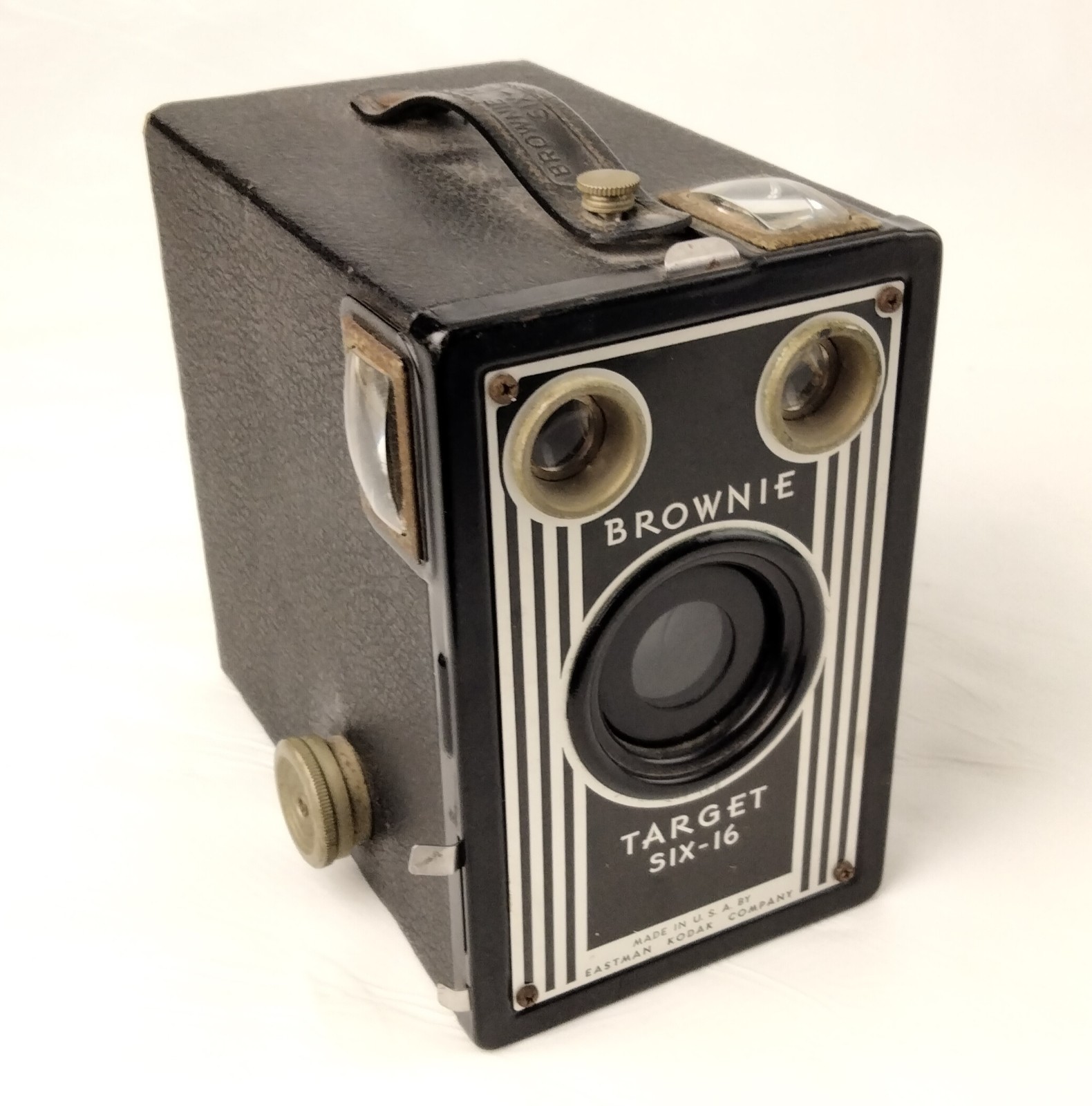
A compact box-type camera using 616 rollfilm to produce 2 1/2" x 4 1/4" exposures, introduced by Kodak in July 1946.
Overview
The Kodak Brownie Target Six-16 is a box-type camera designed for 616 rollfilm, producing negatives sized 2 1/2" x 4 1/4". Introduced in July 1946 and discontinued in November 1951, it was built with a metal box body and featured a rotary shutter with two settings: T (Time) and I (Instant, approximately 1/50 second). The camera was marketed at an original price of $4.00, positioning it as an affordable option for amateur photographers. It shares nearly identical design and specifications with the Kodak Brownie Target Six-20, differing primarily in film spool compatibility.
Specifications
| Film Format | 616 rollfilm |
| Picture Size | 2 1/2" x 4 1/4" |
| Shutter | Rotary |
| Shutter Speeds | T, I (1/50 sec) |
| Body Material | Metal |
| Dimensions (w x h x d) | 90 x 138 x 141 mm |
| Weight | 635 g |
| Years Produced | 1946–1951 |
| Original Price | $4.00 |
Design
The Brownie Target Six-16 is a manually operated box-type camera with a fixed-focus design and no interchangeable lens. Its construction centers on a rigid metal body, contributing to its durability and straightforward operation.
Context
The Kodak Brownie Target Six-16 was part of Kodak’s strategy to offer simplified, low-cost photography options in the postwar consumer market. It was functionally equivalent to the Brownie Target Six-20, allowing Kodak to reuse tooling across models while adapting only the film spool chamber for different formats.
Market
Current collector value for the Brownie Target Six-16 is estimated between $10 and $15 in typical condition. One listing noted a complete example with original box priced at $52.99 plus $10.00 shipping, reflecting higher value for well-preserved sets.
eBay Listings



As an eBay Partner, we earn from qualifying purchases. This helps support our independent vintage technology research.