Yamaha YP-511 (1977)
Overview
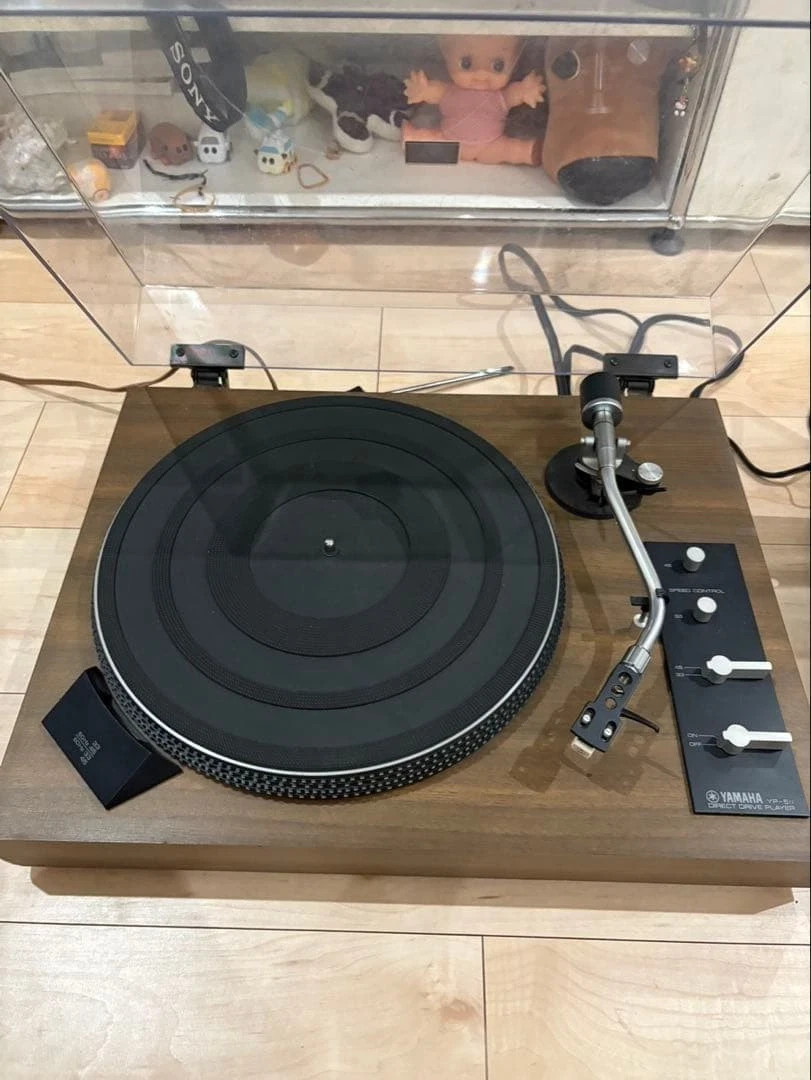
The Yamaha YP-511 isn’t a flashy relic, but a serious turntable built during the peak of Japan’s high-fidelity surge. Released in 1977, it arrived when direct-drive technology was being refined to near-obsessive levels by brands pushing the limits of rotational stability and mechanical isolation. Yamaha positioned the YP-511 as a precision instrument, not just a record player — a machine engineered to extract the most accurate playback possible from vinyl, with minimal coloration and maximum reliability.
It was part of a broader wave of audiophile-grade turntables from Japanese manufacturers who treated turntable design as much a mechanical science as an audio pursuit. While not explicitly documented as a flagship, its construction choices — from the brass main shaft to the lead-alloy arm base — suggest a no-compromise mindset. Owners report it was built to last, with robust materials and thoughtful damping solutions integrated at nearly every mechanical junction.
Despite its technical ambition, the YP-511 remained grounded in usability. It came equipped with a Shure M75BM moving magnet cartridge out of the box, a solid mid-tier performer of the era, pre-mounted and ready to play. This made it accessible to serious listeners who wanted high performance without the hassle of cartridge alignment or setup complexity. The inclusion of fine speed control, a strobe, and a hydraulic arm lifter signaled Yamaha’s intent: this was a deck for those who valued both accuracy and convenience.
Specifications
| Manufacturer | Yamaha |
| Model | YP-511 |
| Type | Turntable |
| Drive System | Direct drive |
| Motor | 8-pole 24-slot DC servo motor |
| Platter Diameter | 30 cm / 300 mm |
| Platter Weight | 1.6 kg |
| Speeds | 33 1/3, 45 rpm |
| Wow and Flutter | 0.04% or less (WRMS) |
| Rumble | -70 dB (DIN B) |
| Tonearm Type | S-shaped static balance system |
| Effective Length | 222 mm |
| Overhang | 17 mm |
| Tracking Error Angle | Within 2° per 33 1/3 record |
| Tracking Force Adjustment | Direct Reading Type, 0 ~ 3 g (0.5 g step scale) |
| Cartridge Weight Range | 4 g ~ 13 g |
| Headshell | Interchangeable, EIA standard |
| Anti-Skate | Direct-reading scale |
| Cartridge (Stock) | MM Type, SHURE M75BM |
| Stylus (Stock) | SHURE N-75-6 |
| Recommended Tracking Force | 2.5 g |
| Optimum Load Resistance | 47 kΩ |
| Output Voltage (Cartridge) | 4 mV |
| Power Supply | 100 VAC, 50 Hz / 60 Hz |
| Power Consumption | 2.5 W (60 Hz), 3 W (50 Hz) |
| Dimensions | 470 × 143 × 378 mm |
Key Features
220 kg・cm Inertial Mass Platter
The 30 cm aluminum die-cast platter isn’t just heavy at 1.6 kg — it’s part of a system engineered for inertia. With a total inertial mass of 220 kg・cm, the YP-511’s rotating assembly resists speed fluctuations from external vibration or record eccentricity. This wasn’t just about mass for mass’s sake; Yamaha dynamically balanced the platter during manufacturing using precision metal processing, ensuring smooth rotation from the start. The rubber mat’s material and shape were even selected through listening tests, aiming for sonic neutrality and groove coupling.
Brass Main Shaft with Dual Rubber Dampers
Most turntables of the era used aluminum shafts, but Yamaha eliminated that material entirely in favor of brass. The reasoning was clear: brass reduces resonance and improves rigidity. The main shaft connects to the weight shaft via one rubber damper, and the bearing case to the main shaft via another. These dual-stage dampers decouple the spinning assembly from the chassis, minimizing the transmission of motor or bearing noise into the audio signal. It’s a subtle but deliberate anti-resonance strategy that reflects Yamaha’s focus on mechanical purity.
Lead-Alloy Die-Cast Arm Base (1.3 kg)
The tonearm doesn’t mount into a flimsy plastic housing. Instead, it’s anchored to a 1.3 kg lead-alloy die-cast base, a massive block designed to absorb micro-vibrations and prevent energy from feeding back into the arm. This kind of overbuilt foundation was rare outside of ultra-high-end decks, and its presence here signals Yamaha’s commitment to stability. Combined with the S-shaped static balance tonearm, it creates a rigid, inert platform for accurate tracking.
Resonance-Suppressed Light Alloy Tonearm Tube
The tonearm tube uses a twist-resistant light alloy, but what sets it apart is the internal filler — a special material packed inside to suppress the tube’s natural resonances. This damping technique prevents ringing or coloration that could smear transients or distort high-frequency detail. The result is a stiffer, quieter arm that tracks with authority, especially when paired with the stock Shure cartridge.
Specially Selected Angular Contact Bearing
The tonearm’s pivot point uses a specially selected angular contact bearing, chosen for its precision and low friction. These bearings allow smooth, controlled movement in both vertical and horizontal planes, critical for maintaining consistent tracking force and anti-skate performance. Unlike bushings, which can wear or bind, this type of bearing ensures long-term reliability and repeatable motion.
Hydraulic Arm Lifter with Silicon Oil Damping
The arm lifter isn’t a simple spring-loaded lever. It uses “oil dump queuing” — a hydraulic system powered by silicon oil — to raise and lower the tonearm with smooth, controlled motion. This prevents sudden drops or jerky lifts that could damage the stylus or record. It’s a small luxury, but one that speaks to the YP-511’s attention to user experience and component longevity.
48 mm Thick High-Density Particleboard Cabinet
The cabinet isn’t hollow or flimsy. It’s a solid 48 mm thick high-density particleboard, finished in American Walnut Dap makeup. This substantial enclosure resists flex and resonance, acting as a stable platform for the turntable’s sensitive mechanics.
Independent ±6% Fine Speed Control with Strobe
Both 33 1/3 and 45 rpm speeds can be independently adjusted by up to ±6%, allowing precise calibration using the built-in strobe. This level of control was aimed at critical listeners and broadcasters who demanded absolute speed accuracy. The servo circuit was reportedly refined for faster response, maintaining stable rotation even under load changes — a sign Yamaha tuned the electronics as rigorously as the mechanics.
Free-Stop Hinge Dust Cover
The dust cover uses a free-stop hinge mechanism, allowing it to stay open at any angle without slamming shut or requiring a separate prop. It’s a small but thoughtful ergonomic touch, preventing accidental damage to the tonearm during setup or record changes.
Collectibility & Value
The Yamaha YP-511 has quietly gained appreciation among vintage turntable enthusiasts, though it remains under the radar compared to more famous contemporaries. Listings suggest a range of values: one unit in excellent condition with original box sold for $510, while another in good used condition listed for $350 CAD. These prices reflect its build quality and desirability among collectors who value robust engineering over brand hype.
Functionally, reports are mixed. Some users confirm “no problems with rotation or gear shifting,” indicating long-term reliability when properly maintained. Others have reported failures, such as “it does not spin,” pointing to potential motor or servo issues after decades of use. As with any vintage direct-drive turntable, capacitor aging and lubrication breakdown are likely culprits. Servicing may require specialist knowledge, but the mechanical design suggests it’s worth the effort for a well-preserved unit.
Market Value
┌──────────────────────────────────────────────────────────────────────────┐
│ YAMAHA YP-511                                                   Apr 2026 │
├──────────────────────────────────────────────────────────────────────────┤
│ High      $416                                    Latest            $329 │
│ Median    $352                                    Trend           ▼ Down │
│ Low       $275                                    Volume           ~3/mo │
├──────────────────────────────────────────────────────────────────────────┤
│   $500 ┤                                                                 │
│        │                                                                 │
│        │.                                                                │
│   $371 ┤                                                               . │
│        │                 .          ..                           .      .│
│        │                                                          .      │
│        │                                                             .   │
│   $200 ┤                                                                 │
│        ├─────────────────────────────────────────────────────────────────│
│    vol │█                █          ██                           ██  █ ██│
│        └─────────────────────────────────────────────────────────────────│
│         2026-01                      2026-03                      2026-04│
└──────────────────────────────────────────────────────────────────────────┘
eBay completed sales. Excludes accessories, parts, and non-working units. Hover points for details.
eBay Listings



As an eBay Partner, we earn from qualifying purchases. This helps support our independent vintage technology research.
Related Models
- Yamaha YP-1000 (1978)
- Yamaha YP-D4 (1993)
- Yamaha YP-D8 (1985)
- Yamaha YP-701 (1985)
- Garrard SP (1975)
- Harman Kardon kardon-turntables (1975)
- Thorens TD-124 (1957)
- Thorens TD-150 (1965)
- Thorens TD-225 (1975)
- Akai AP-D2 (1979-1982)