Yamaha R-70 (1983)
Forty-five watts per channel of early '80s muscle, wrapped in a clean black front panel with just a hint of digital ambition.
Overview
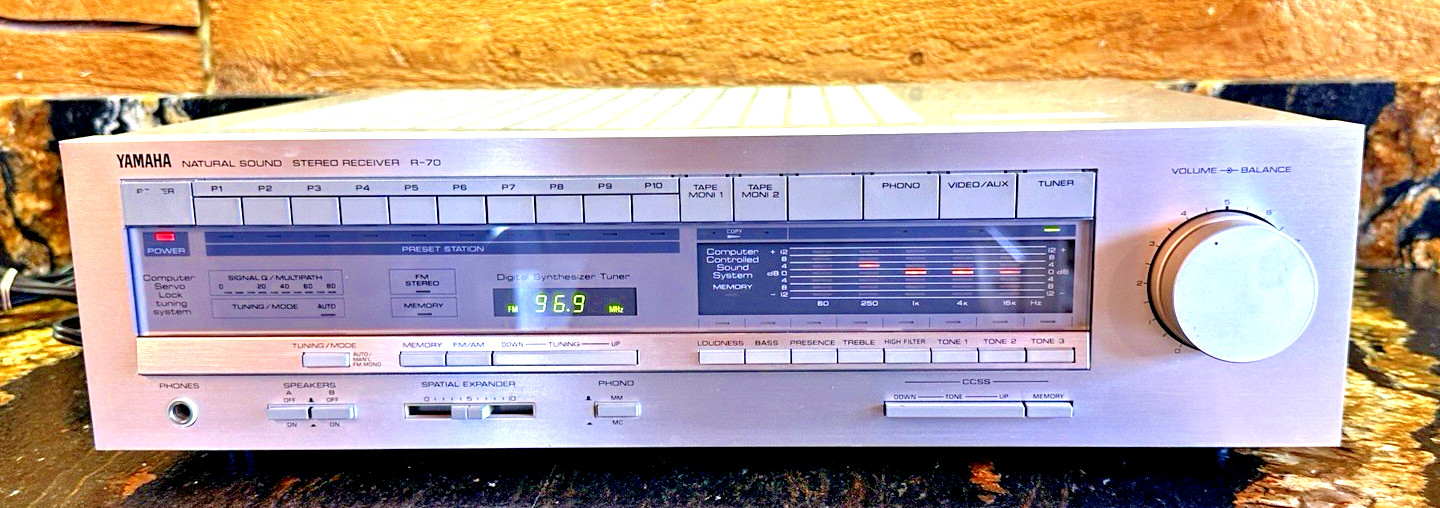
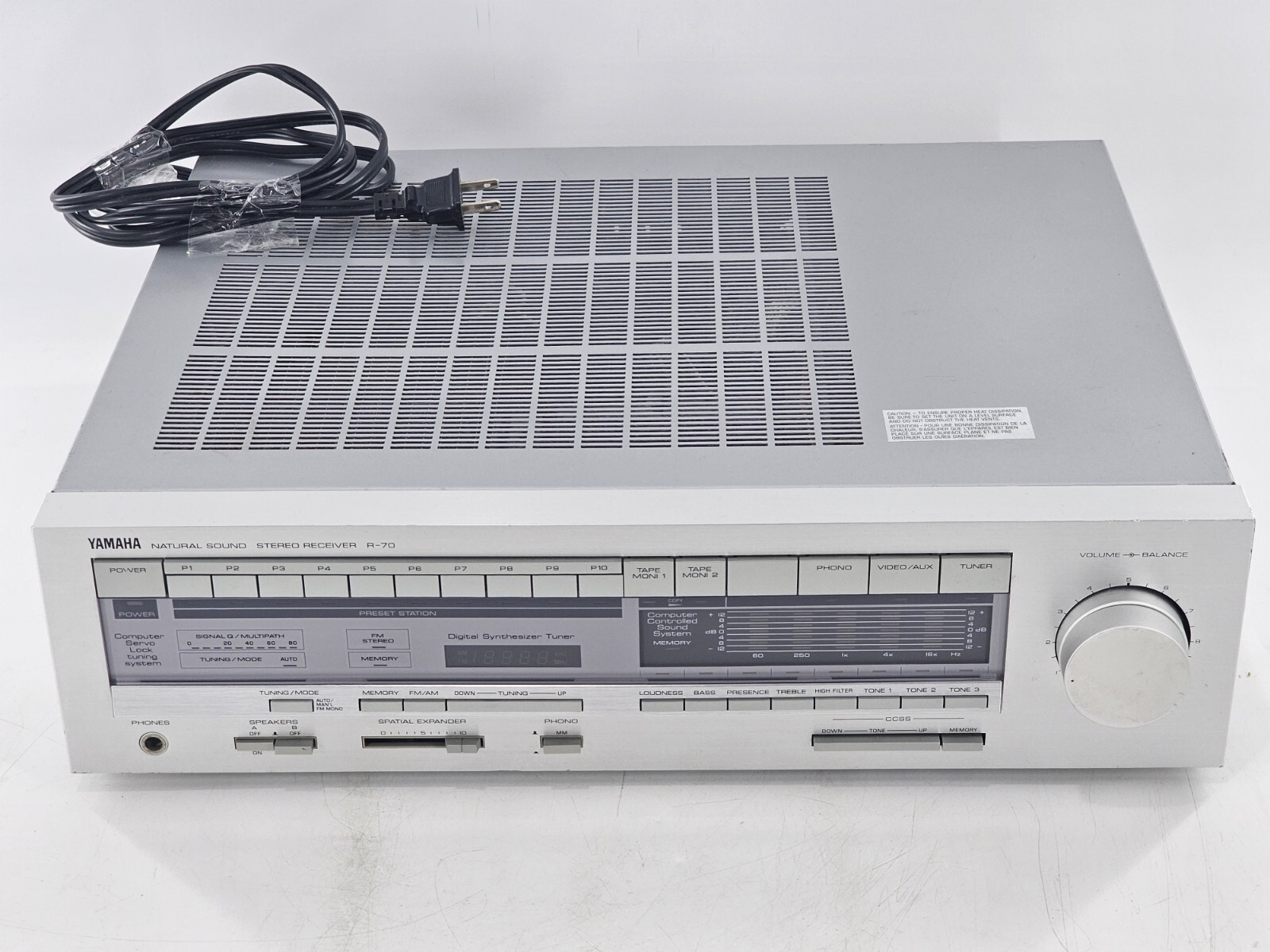
The Yamaha R-70 isn’t a passive preamplifier from 1975—it’s an AM/FM stereo receiver that hit the market in 1983, part of Yamaha’s push into the integrated amplifier space with a blend of analog power and emerging digital control concepts. Despite persistent myths floating in collector circles, the R-70 was never a passive component; it’s a fully functional receiver rated at 45 watts per channel into 8 ohms, designed to drive speakers directly while offering comprehensive source management. At 8.3 kg and measuring 435 x 122 x 386 mm, it occupies a mid-tier footprint—compact enough for shelf use, but substantial enough to suggest serious engineering inside. The finish is utilitarian: a black front panel with woodgrain side panels, toggles for input selection, and a prominent volume knob that, according to long-term owners, tends to loosen after years of use.
What sets the R-70 apart from simpler receivers of its era is the inclusion of Yamaha’s CCSS (Computer Controlled Sound System), a feature that allowed users to select from fixed tone curves rather than adjust bass and treble independently. This wasn’t full parametric EQ, but a step toward system tailoring that reflected Yamaha’s interest in making high-fidelity more accessible. It didn’t offer a mute function or a direct line-through mode, which purists might see as a limitation, but for the average listener in the early '80s, the feature set was robust: phono inputs for both MM and MC cartridges, tape monitoring, adjustable loudness compensation, and a fixed 15 Hz subsonic filter to protect speakers from ultra-low frequencies.
Key Features
CCSS (Computer Controlled Sound System)
The R-70’s most distinctive feature is its CCSS tone control system, which replaced traditional rotary knobs with selectable sound profiles. These fixed curves were designed to compensate for room acoustics or speaker deficiencies, offering a kind of preset equalization before DSP became commonplace. While not as flexible as manual tone controls, CCSS provided a more consistent and repeatable listening experience, especially for users who didn’t want to tweak settings constantly. Owners report that the system works reliably over time, with no common failures tied to the selector switch or associated circuitry.
45 Watts Per Channel into 8Ω
Rated output is 45 watts per channel in stereo mode, a figure that HiFi-Stereo (July 1981, p.54) noted was conservatively specified and generally trustworthy—unlike some contemporaries who inflated power ratings. This level of output was sufficient to drive most bookshelf and floor-standing speakers of the early 1980s without strain, and the damping factor of 40 suggests decent control over speaker cones, particularly in the bass region. The receiver powers two sets of speakers, with no A/B switching, and includes a standard 6.3 mm headphone jack on the front panel.
Phono Inputs for MM and MC Cartridges
Unlike many mid-tier receivers of the period, the R-70 includes dedicated phono inputs supporting both moving magnet (MM) and moving coil (MC) cartridges, with an input sensitivity of 2.5 mV for MM and a very low 0.16 mV for MC. This indicates a well-designed, low-noise phono stage capable of handling low-output MC cartridges without requiring an external step-up transformer in most cases. Signal-to-noise ratio is rated at 88 dB (MM) and 75 dB (MC), figures that suggest respectable performance, though not quite at the level of separates gear.
Gold-Plated RCA Jacks and Steel Chassis
The rear panel features gold-plated RCA jacks for all line-level connections, a premium touch for the time that helps resist corrosion and maintain signal integrity. Combined with a steel chassis and wood side panels, the construction feels solid and well-damped, minimizing microphonic effects and internal vibration. The input selector uses heavy-duty toggle switches, though after decades of use, some units exhibit looseness or intermittent contact—easily remedied by replacing them with modern equivalents like Clarostat or C&K.
Historical Context
Introduced in 1983 and produced through 1984, the Yamaha R-70 sat in the middle of a three-model series that included the R-30 and R-50, each offering progressively more power and refinement. It arrived during a transitional period when Japanese manufacturers were refining solid-state amplifier design while experimenting with digital control interfaces. The R-70’s use of CCSS reflects that trend—a nod to the future without abandoning analog fundamentals. While not part of a matched separates system like the earlier R-700, it was intended as a standalone solution for listeners who wanted quality sound without the complexity of individual components.
Collectibility & Value
Today, the Yamaha R-70 holds moderate to high collectibility among fans of early 1980s Japanese audio gear, particularly those interested in Yamaha’s evolution from analog purity to feature-laden integration. Units in working condition typically sell between $150 and $300, though prices can rise for fully serviced examples or those with original packaging and documentation. The most commonly reported issue is a loosening volume knob—a mechanical flaw noted by users with over a decade of ownership—but otherwise, the design proves durable. Because it contains active circuitry and power supplies, aging electrolytic capacitors may require replacement, especially in units that have been stored for long periods. However, there are no widespread reports of catastrophic failures or obsolete ICs that can’t be sourced.
eBay Listings


As an eBay Partner, we earn from qualifying purchases. This helps support our independent vintage technology research.
Related Models
- Yamaha A-720 (1975)
- Yamaha CA-1000 (1975)
- Yamaha CA-410 (1967)
- Yamaha HP-1 (1974)
- Yamaha R-700 (1975)
- Denon POA-800 (1978)
- Eico 3150 (1967)
- Fisher CUSTOM-ELECTRA-I (K-14/K-15) (1957)
- Fisher CUSTOM-ELECTRA IV (E33/E44) (1960)
- Akai AM-2600 (1977)