Yamaha CR-840 Stereo Receiver (1979–1981)
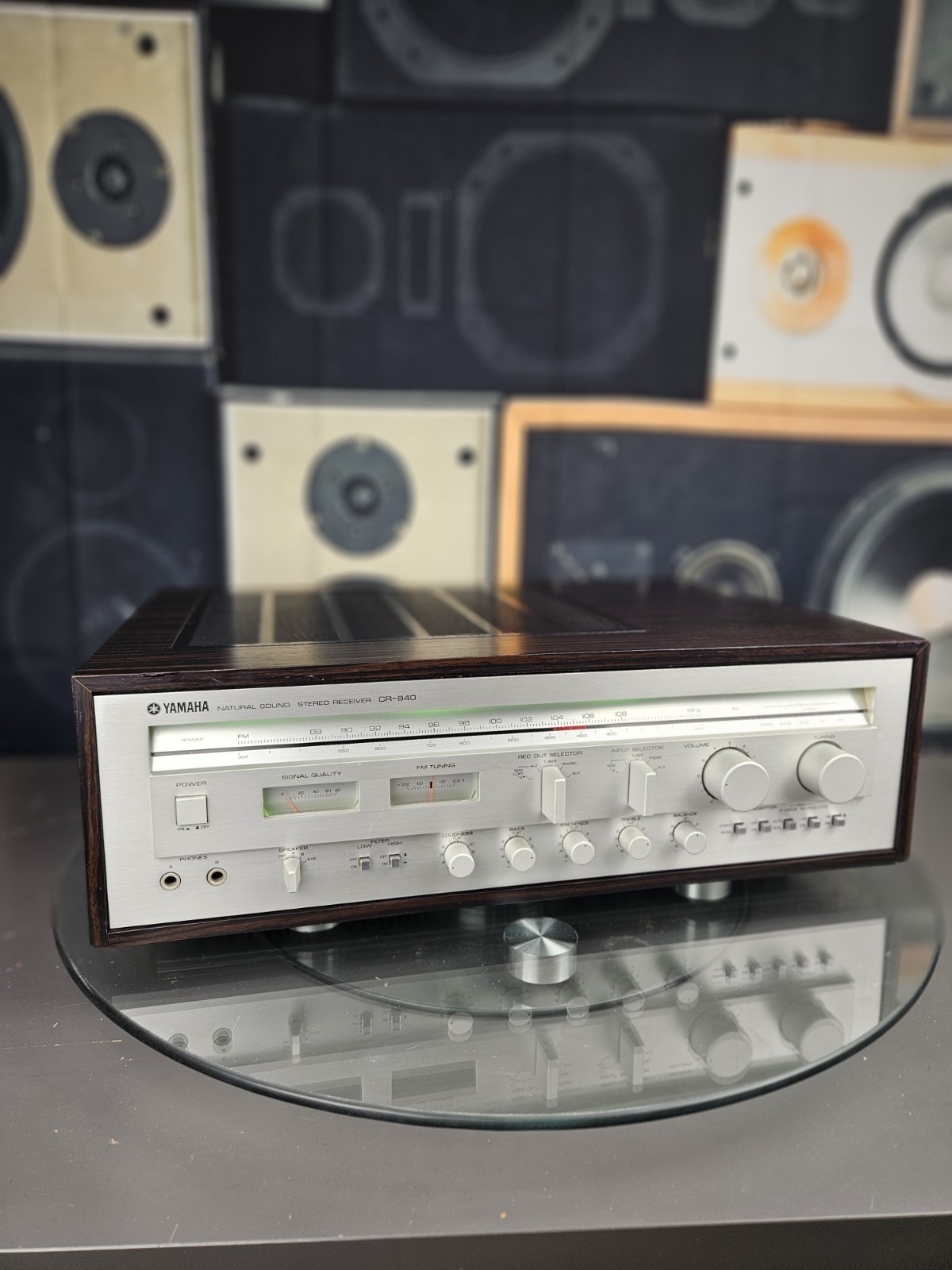
The Yamaha CR-840 is an AM/FM stereo receiver from Yamaha's "natural sound" CR-series, the family of integrated receivers Yamaha sold through the late 1970s and early 1980s. The line ran from the modest CR-220 up through the flagship CR-3020, and the CR-840 sat in the upper-middle of the lineup — between the 50-watt CR-640 and the 100-watt CR-1040. Rated power is 70 watts per channel into 8 ohms, both channels driven, 20 Hz–20 kHz, at no more than 0.05% THD.
Like the rest of the CR series, it bundles an integrated amplifier, an FM/AM tuner, and a phono stage into a single chassis. It is not, as the model number "CR" might suggest to anyone reading the page-source text and skimming, a cassette deck — Yamaha's cassette decks of the era used the "TC-" and later "K-" prefixes. The CR series is receivers.
Specifications
| Type | AM/FM stereo receiver |
| Production | 1979–1981 (approx.) |
| Power output | 70 watts/channel into 8 Ω, 20 Hz–20 kHz, ≤0.05% THD |
| Tuner bands | FM (87.5–108 MHz), AM (MW) |
| Phono input | MM (moving magnet) |
| Speaker outputs | Two pairs (A / B), switchable |
| Tone controls | Bass, treble, with defeat |
| Tape monitor | Yes |
| Loudness | Switchable |
| Tuning aids | Signal-strength meter, center-tune meter |
| Finish | Brushed aluminum face; black or silver variants |
This table covers the specifications we can verify from Yamaha's own service literature and contemporaneous reviews. Distortion and frequency-response numbers below the rated values varied across sources, so they are not listed here. If you have an original owner's manual or service guide for the CR-840, the values above can be filled in more completely.
Place in the line
The CR-### series was Yamaha's mainstream receiver lineup at the time the higher-end CR-2020 / CR-3020 had already established the "natural sound" reputation. The CR-840 inherited the styling — a relatively flat front panel, recessed knobs, the characteristic Yamaha typography — and most of the circuit topology, scaled down. Yamaha's separates of the period (the C-2 preamp, B-2 power amp, NS-1000M speakers) were the more frequently-reviewed gear; the CR-### series was the line you bought if you wanted one box.
Among the CR receivers, the CR-840 is worth knowing about specifically because it sits at a sweet spot: enough power to drive almost any home speaker reasonably (70 wpc is comfortable), a competent phono stage, and a build standard close to the more expensive models in the line. It's not an audiophile collector's piece in the way the CR-2020 has become, but it shows up regularly in the used market in working condition.
Common service issues
- Electrolytic capacitors — power supply and signal-path electrolytics in receivers of this era are typically past their service life. A recap is often the difference between a unit that works fine and one that hums, drops a channel intermittently, or has dim meters.
- Speaker relay contacts — the CR-### series uses an output-protection relay whose contacts oxidize, producing intermittent or one-sided sound. Cleaning or replacing the relay (a standard repair) usually restores both channels.
- Dial bulbs — incandescent dial and meter lamps fail. LED replacements are an easy modernization but change the warmth of the dial light.
- Selector and tone-control switches — DeoxIT on the contacts clears most scratchy controls.
Market value
Working CR-840 units in clean cosmetic condition currently trade in roughly the $200–$400 range on the used market depending on whether the seller has serviced it. Recently-serviced examples with a paper trail run higher. Parts donor units (cosmetically rough, function unknown) appear under $100. The eBay listings below give a current snapshot — note the spread between a fully-serviced unit and a parts-only listing.
eBay Listings


As an eBay Partner, we earn from qualifying purchases. This helps support our independent vintage technology research.
Related Models
- Yamaha CR-440 (1977)
- Yamaha CR-1000 (1973)
- Yamaha CR-3020 (1975)
- Yamaha R-100 (1973)
- Yamaha CA-2010 (1972)
- Teac A-460 (1975)
- Akai AM-16 (1975)
- Realistic STA-47 (1976)
- Teac A-3300 (1972)
- Teac A-3300S (1975)