Sony TC-K555ES (1982)
At 6.1kg, it lands on the shelf like a declaration—this is not a machine for casual listeners, but for those who treated cassette tape as a medium worth mastering.
Overview
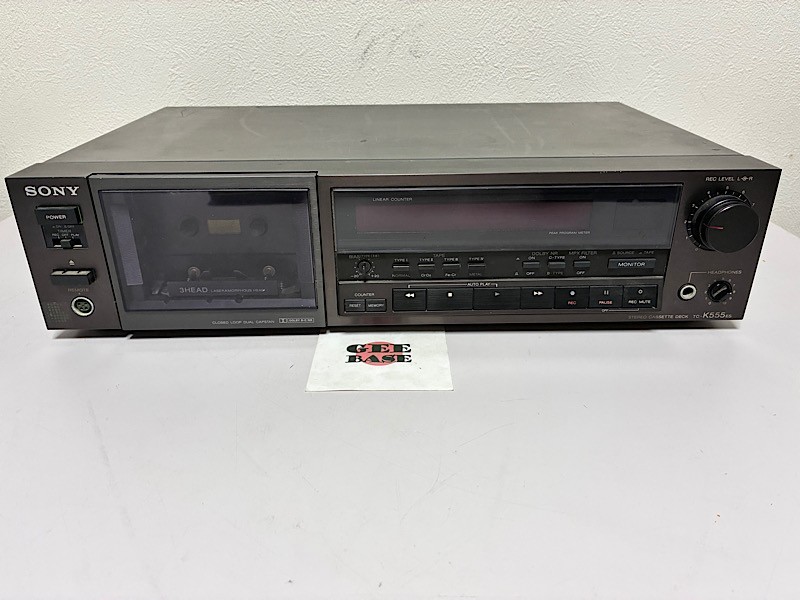
The Sony TC-K555ES is a high-fidelity cassette deck released in 1982 as part of Sony’s prestigious ES (Elevated Standard) series, engineered for audiophiles and serious tape enthusiasts seeking the highest possible fidelity from the compact cassette format. Marketed at ¥89,800, it was positioned as the flagship model in Sony’s ES line, designed to extract maximum performance from Type I (Ferric), Type II (Chrome), and Type IV (Metal) tapes. With its 3-head configuration—separate laser amorphous recording and playback heads, plus an F&F erase head—the TC-K555ES allowed for real-time monitoring during recording, a feature typically reserved for professional studio decks. from its closed-loop dual capstan transport to its twin-mono DC amplifier section, reflecting Sony’s intent to compete directly with the high-end Nakamichi market. The deck’s frequency response extends to 20 Hz – 20 kHz on metal tape, and with wow and flutter held to just 0.04% WRMS (EIAJ), it delivered stability and clarity that pushed the limits of analog cassette technology. While not widely reviewed in period publications, collectors note its engineering rigor and status as the core of the ES series, built to meet the challenges of the emerging digital audio age without compromise.
Key Features
Independent 3-Head System with Laser Amorphous Heads
The TC-K555ES employs a full 3-head layout: discrete laser amorphous heads for recording and playback, plus a dedicated F&F erase head. This configuration enables true monitoring of the recorded signal during taping, eliminating guesswork in level setting. The use of laser amorphous heads—uniquely suspended to minimize vibration—delivers exceptional high-frequency response and low distortion, critical for accurate reproduction of metal tapes. This setup also allows source/tape switching, so users can instantly compare input and recorded signals, a boon for critical recording work.
Closed-Loop Dual Capstan Transport with Linear BSL Motor
The transport system is a closed-loop dual capstan design, continuously monitoring and correcting tape speed for exceptional stability. The capstan is driven by a linear BSL motor, which eliminates the slot and brush found in conventional motors, reducing torque irregularities that contribute to wow and flutter. A high-torque DC motor independently drives the reels, ensuring tight tape control during winding and playback. This dual-motor system, combined with the closed-loop feedback, delivers near-reel-to-reel consistency in a compact cassette form factor.
Twin-Mono DC Amplifier with Direct Coupling
The amplifier section uses a twin-mono configuration for both left and right channels, with a DC amplifier design that avoids coupling capacitors between stages. The playback head and playback amplifier are directly coupled, preventing the high-frequency roll-off and phase shifts that capacitors can introduce. This results in a cleaner, more transparent signal path, preserving transient detail and spatial accuracy. According to available documentation, this design was part of Sony’s effort to achieve “completeness of recording and playback” in anticipation of digital audio standards.
4-Stage Tape Selector with Variable Bias Control
A dedicated 4-stage tape selector allows users to match bias and equalization settings to the tape type: Type I (Normal), Type II (CrO₂), Type III (Fe-Cr), and Type IV (Metal). The system simultaneously switches bias and EQ, and includes a ±20% variable bias control for fine-tuning on the three ferric-based tape types. This level of manual control was uncommon even among high-end decks, giving users the ability to optimize recording levels for different tape formulations and achieve the lowest possible distortion.
High Bias Frequency of 210 kHz
To improve linearity and reduce distortion during recording, the TC-K555ES employs a high bias frequency of 210 kHz—significantly above the norm for consumer decks of the era. This higher frequency helps suppress intermodulation distortion, particularly on high-output tapes like metal and CrO₂, resulting in cleaner highs and tighter bass. Sony shared this design choice with the Yamaha KX-1200U, another high-performance deck released concurrently, suggesting a shift toward studio-grade engineering in the consumer market.
Multi-Function Peak Program Meter and Electronic Counter
The front panel features a multi-function peak program meter with a double indication system: one needle shows the instantaneous peak level, while a second holds the peak for approximately four seconds, making it easier to catch transient overloads. A linear electronic counter displays tape position in minutes and seconds, allowing for precise cueing and editing. These features, combined with autoplay and memory play functions, made the TC-K555ES a serious tool for both recording and archival work.
Dolby B and C Noise Reduction
The deck includes both Dolby B and C noise reduction systems, with Dolby C providing effective noise reduction in the mid and high frequencies. According to available documentation, Dolby C (marketed as Dolby NF C type) effectively reduces the “hissing” common on tape, particularly with metal formulations. With Dolby C engaged and Type IV tape, the signal-to-noise ratio reaches 73 dB (EIAJ), approaching the performance of early digital formats.
Remote Control and Synchronization Capabilities
The TC-K555ES supports a range of optional remote controls, including the wireless RM-80 (¥18,000), wired RM-50 (¥6,000), foot-operated RM-51 (¥8,800), and the synchro control unit RM-65 (¥3,000). With the RM-65, users could perform synchronized recording with other Sony components equipped with remote terminals, such as the PB5 playback deck. This level of integration was rare in consumer gear and reflected Sony’s ambition to create a fully coordinated high-end system.
Historical Context
The TC-K555ES was released in 1982 at the height of the cassette era, a time when manufacturers were pushing analog tape to its technical limits in response to the rise of digital audio formats like CD and DAT. Sony positioned the deck as the centerpiece of its ES (Elevated Standard) series, a line reserved for components that met higher performance and build quality standards than typical consumer gear. It was engineered not just for playback, but for the “completeness of recording and playback of music,” suggesting a focus on mastering and archival. With its advanced transport, precision calibration tools, and support for metal tape, the TC-K555ES represented the pinnacle of cassette deck technology before digital formats began to dominate. Collectors note it was designed to compete with high-end Nakamichi models, offering comparable performance with a more refined industrial design and tighter integration with Sony’s ecosystem.
Collectibility & Value
The TC-K555ES is highly collectible, rated 8 out of 10 due to its build quality, performance, and status within the ES series. Fully functional units in good cosmetic condition typically sell for $200–$500, with mint, boxed examples commanding higher prices. eBay listings show tested units selling for $557–$560, while a refurbished example recently listed for $1,559, reflecting strong demand among analog enthusiasts. Owners emphasize the importance of maintenance: belts and idler tires should be inspected for stiffness or cracking, gears require synthetic lubrication, and the heads, capstan, and pinch roller should be cleaned regularly with 90%+ isopropyl alcohol. Demagnetization every 50–100 hours of use is recommended to prevent high-frequency loss. Electrolytic capacitors in the power supply may dry out over time, so a recap is advisable if the unit shows power issues or channel imbalance. Despite its age, the TC-K555ES remains a sought-after deck that exemplifies the peak of consumer tape technology.
eBay Listings


As an eBay Partner, we earn from qualifying purchases. This helps support our independent vintage technology research.
Related Models
- Sony TC PB5 (1970s)
- Sony TC-K333ESG (1989)
- Sony TC-K333ESJ (1991)
- Sony TC-K333ESX (1991)
- Sony TC-K555ESA (1989)
- Infinity RS-IIA (1977)
- Infinity RS-4.5 (1978)
- Aiwa AA-8700 (1981)
- Aiwa AD-1200 (1980)
- Aiwa AD-1250 (1982)