Sony ST-A35 (1980-1981)
At approximately 4.1kg, it sits in your rack like a quiet promise—solid, precise, and built to lock onto a signal and never let go.
Overview
The Sony ST-A35 AM/FM Stereo Tuner emerged at the dawn of the 1980s as a focused piece of radio engineering, designed not for show but for accuracy. Priced at ¥35,000 around 1980, it targeted serious listeners who valued stable reception and clean signal extraction over flashy features. This was a time when stereo broadcasting was maturing, and tuners had to balance sensitivity with selectivity—Sony’s answer was a design rooted in disciplined circuitry and smart feedback systems. The ST-A35 wasn’t trying to be an all-in-one amplifier; it was a specialist, built to pull weak stations from the noise floor and deliver them with clarity.
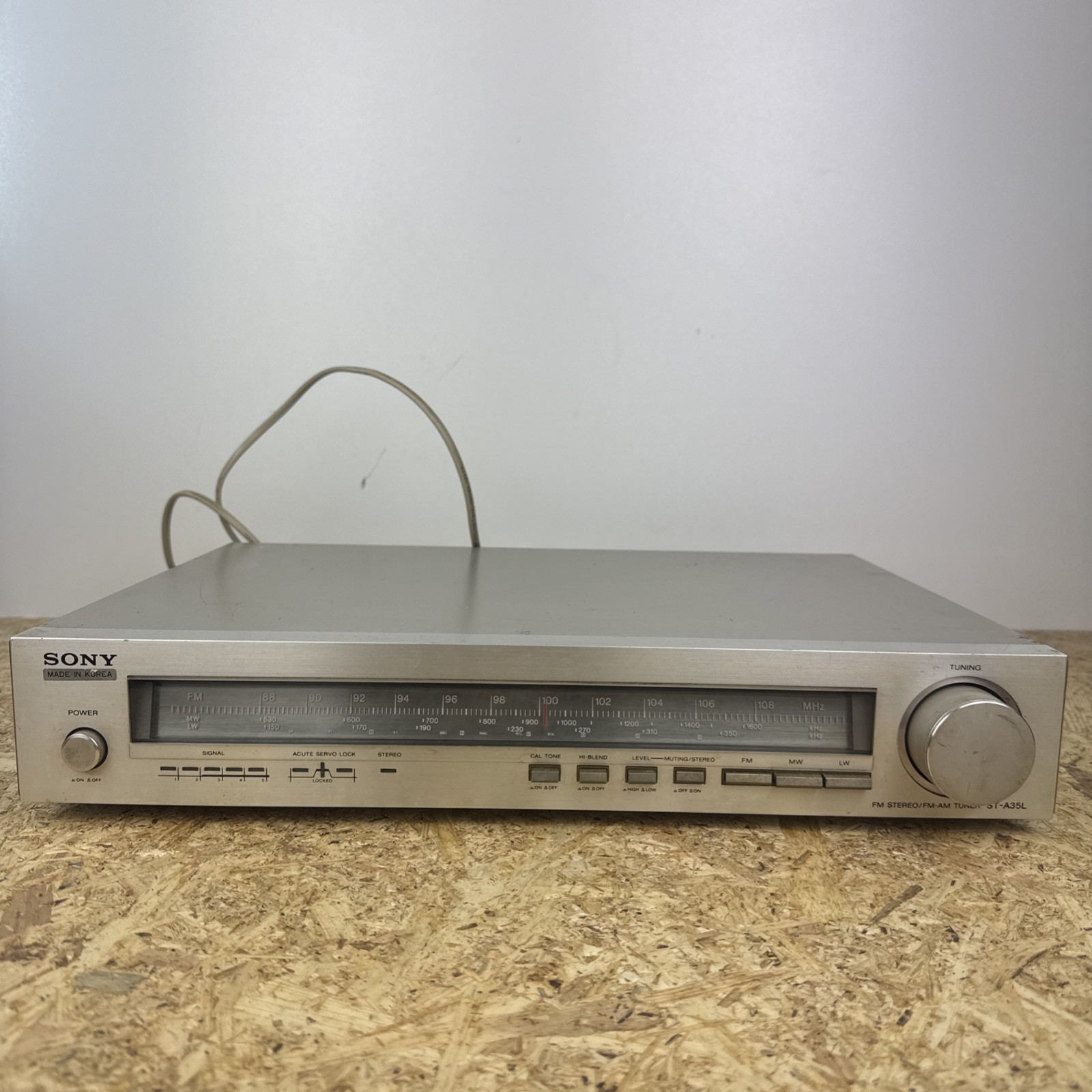
What sets the ST-A35 apart from simpler tuners of its era is its servo lock mechanism—a system engineered to find and hold the precise center of a station’s carrier frequency. When that green light glows, the signal is locked. This isn’t a vague needle wiggle or a vague hiss reduction—it’s a definitive visual confirmation of optimal tuning. That kind of confidence didn’t come cheap in 1980, and it’s part of why collectors still seek out units confirmed to be working.
Despite its age, listings note that many ST-A35 units remain functional, with smooth tuning dials, responsive indicators, and strong signal output. One tested unit was described as delivering “clear reception and strong signal,” a testament to the robustness of its front-end design. Still, collectors are reminded: even when working perfectly, these are machines approaching half a century old. Its survival rate speaks well of Sony’s build quality, but not immunity to time.
Specifications
| Manufacturer | Sony |
| Product type | AM/FM Stereo Tuner |
| Production years | 1980-1981 |
| Original price | ¥ 35,000 (around 1980) |
| Practical sensitivity | 1.9 μV |
| Stereo distortion factor | 0.15% |
| Effective selectivity | 80 dB |
| Spurious interference ratio | 80 dB |
| Separation | 50 dB |
| Power consumption | 8 W |
| Output | 750 mV |
Key Features
Servo Lock Tuning with LED Centering
The ST-A35’s most distinctive trait is its acute servo lock mechanism, engineered to pinpoint the lowest distortion point on a station’s carrier wave. Unlike analog meters that drift or peak detectors that hunt, this system uses feedback to stabilize tuning precisely. The result is shown in real time on the front panel: a central green LED illuminates at the optimal lock point, with red LEDs on either side indicating deviation. When the green light stands alone, the tuner is perfectly aligned—no guesswork, no overshoot. This wasn’t just convenient; it reduced distortion and improved stereo separation by ensuring the IF stage operated under ideal conditions.
4-Row Dual-Gate MOS FET Front End
To combat interference—especially in urban environments with strong adjacent signals—the ST-A35 employs a 4-row dual-gate MOS FET in its front end. This configuration enhances isolation between stations and improves dynamic range, allowing the tuner to reject nearby carriers without desensitizing the desired signal. Dual-gate MOS FETs were becoming popular in high-end tuners for their low noise and high input impedance, but Sony’s 4-row implementation suggests a deliberate push for superior rejection. It’s a subtle but meaningful upgrade over simpler bipolar front ends, particularly when dealing with crowded band conditions.
Quadrature Detection Transformer
Sony claims the SN ratio was improved through a newly developed quadrature detection transformer. While the exact design isn’t detailed, quadrature detection was a method used in FM demodulation to extract stereo difference signals with lower phase error and reduced noise. By refining the transformer at this critical stage, Sony likely achieved tighter channel matching and better immunity to phase drift—key factors in maintaining a stable stereo image over long listening sessions.
Uniphase Filter and PLL-IC in MPX Stage
The IF stage includes a uniphase filter, which helps maintain consistent phase response across the passband—critical for accurate stereo decoding. Paired with a PLL-IC (Phase-Locked Loop Integrated Circuit) in the MPX (multiplex) section, this setup ensures the 19 kHz pilot tone is tracked with high stability, minimizing crosstalk and wow/flutter-like artifacts in the decoded stereo signal. The use of a dedicated PLL chip, rather than discrete components, points to Sony’s move toward integrated solutions without sacrificing performance.
CAL-TONE Circuit and 5-Segment LED Indicator
The inclusion of a CAL-TONE circuit may suggest the ST-A35 was designed with alignment and servicing in mind, allowing technicians to verify internal signal levels without external gear. Paired with a 5-segment LED signal strength meter, users get a granular view of incoming signal intensity—not just a vague glow. This level of feedback was uncommon in mid-tier tuners and reflects Sony’s intent to offer professional-grade monitoring in a consumer chassis.
Muting Level High/Low Switch
A small but useful feature is the muting level switch, offering High and Low settings to control when the audio is silenced during weak signal conditions. This lets users balance noise suppression against the risk of cutting out during marginal reception—particularly helpful in fringe areas where signal strength fluctuates.
Collectibility & Value
The ST-A35 appears regularly on the secondhand market, typically listed as “vintage” and “fully tested.” While no official current market valuation exists in the documentation, recent listings describe units as working well with smooth controls and strong signal output. Given its age, potential buyers are cautioned that even functional units are decades old, and passive components may degrade over time. No specific failure modes are documented, but
eBay Listings



As an eBay Partner, we earn from qualifying purchases. This helps support our independent vintage technology research.
Related Models
- Sony apm-20av (1980s)
- Sony apm-22es (1984-1986)
- Sony apm-55w (1980s (exact years uncertain))
- Sony apm-66es (1983-1985)
- Sony apm-77 (1982-1984)