Sony PS-X600 (1980–1983)
At 8.5 kg, it rests with the quiet authority of a machine that knows exactly where the groove should be
Overview
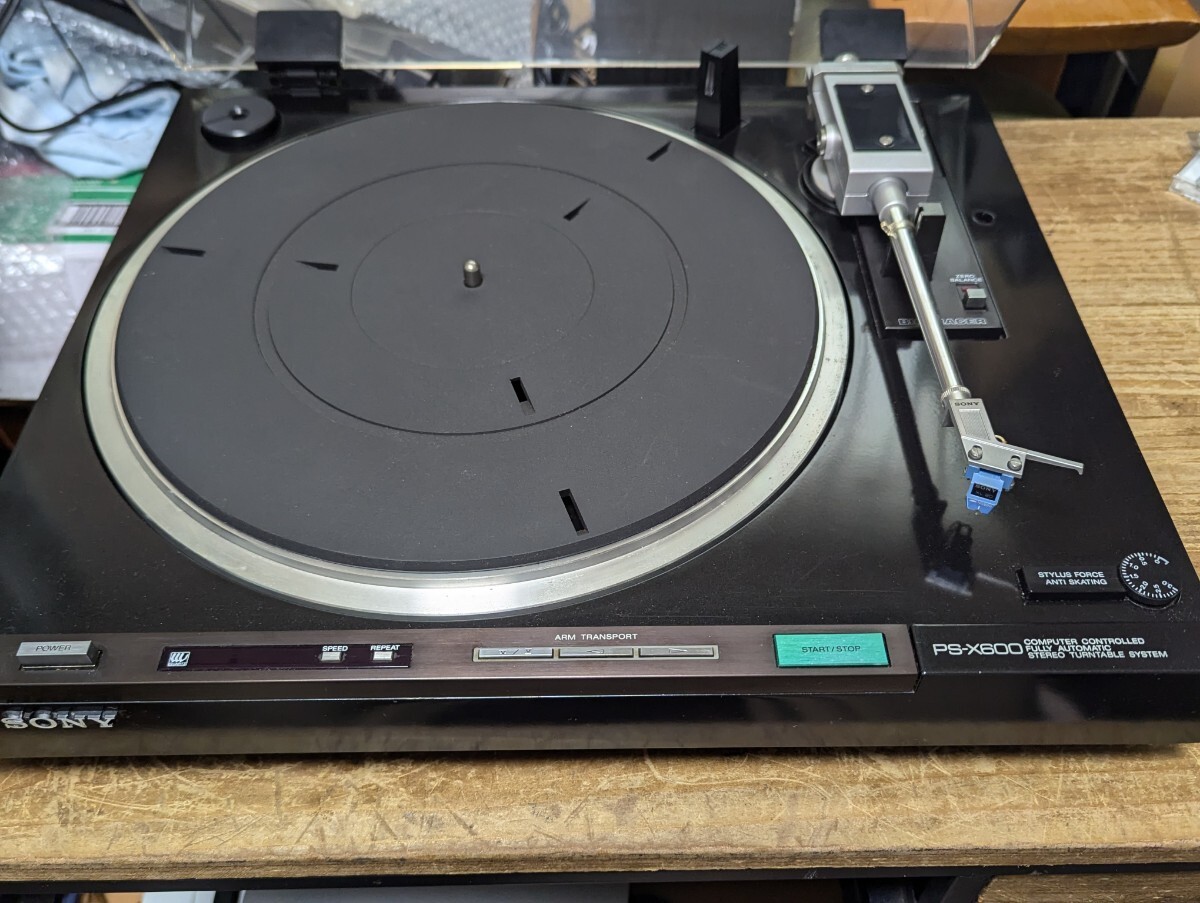
The Sony PS-X600 isn’t trying to win a beauty contest or mimic a turntable from some analog utopia. It’s a fully automatic direct-drive deck built during the last surge of high-end phonograph engineering before CDs began pulling attention away from spinning vinyl. Released in 1980 and produced through 1983, it sits below the PS-X700 and PS-X800 in Sony’s hierarchy, offering a more accessible entry into their servo-controlled Biotracer line. Marketed at ¥59,800 for the base model and ¥65,000 for the PS-X600C (which includes the MM XL-20 cartridge), this turntable doesn’t pretend to be minimalist or purist—it’s a tech-forward player with quartz-locked speed stability, electronic stylus pressure adjustment, and a microcomputer-guided tonearm that actively corrects tracking error. It came in three forms: the bare PS-X600, the PS-X600C with the moving magnet XL-20, and the PS-X600MC fitted with the moving coil XL-333E.
Key Features
BSL Direct-Drive with Quartz Lock
The PS-X600 uses a BSL (Brushless and Slotless) Direct-Drive Servo Control system, a design intended to eliminate cogging and deliver ultra-smooth rotation. Speed is locked via quartz reference, ensuring long-term stability that outperforms free-running AC motors. Measured velocity deviation is an exceptionally tight 0.0003%, while wow and flutter are rated at 0.015% WRMS and ±0.03% DIN45507—numbers that reflect serious engineering discipline. The platter, a 32 cm (310 mm) aluminum die-cast disc weighing 1.5 kg, reaches playing speed in less than half a rotation at 33 1/3 rpm, and These specs aren’t just marketing fluff; they translate to a rock-solid presentation that holds pitch even on complex orchestral swells.
Biotracer Bidirectional Tangential Tracking
The standout feature is the Biotracer system, a servo-controlled straight tonearm that uses optical sensors and linear motors to maintain near-perfect tangency across the record surface. Unlike conventional pivoted arms, this static-balanced straight pipe (effective length: 216.5 mm, total length: 295 mm) dynamically adjusts its path to minimize tracking error, which Sony claims stays within 2° per record radius. A microcomputer processes positional data hundreds of times per second, making real-time corrections. This isn’t just about geometry—it’s about reducing distortion and wear. Owners report that the system noticeably improves stereo separation and tightens bass response, though some find the servo’s precision clinical compared to the organic flow of high-end manual arms. The tonearm is made from a special aluminum alloy, suspended on a 4-point gimbal with a Longs pan bearing shaft, and guided by a low-friction design meant to suppress unwanted resonance.
Electronic Stylus Pressure & Anti-Skate
Setting tracking force isn’t done with a dangling weight or guesswork. The PS-X600 features electronic stylus pressure adjustment via a front-panel control, complete with a direct-reading gauge showing 0 to 3.0 grams. This eliminates the need for external tools and makes cartridge swaps far more repeatable. The system also includes electronic anti-skate correction, automatically compensating for lateral forces without manual calibration. According to available documentation, the load characteristic remains stable up to 150 grams of stylus force—though that’s more a testament to the motor’s torque than a user-relevant spec. Cartridges must fall within a strict weight window: 7.5–12.5 grams without the auxiliary weight, or 12–17 grams with it. The supplied SH-151 headshell weighs 5.0 grams, leaving little room for heavy aftermarket cartridges unless the optional weight is used.
SBMC Plinth with Gel-Filled Insulators
The chassis is built from SBMC (Sony Bulk Mould Compound), a dense, resin-based material designed to absorb vibrations and resist resonance. It’s not pretty—more industrial than luxurious—but it works. The entire assembly rests on four insulators filled with a gel-like damping compound, further isolating the platter and tonearm from external jolts and floor-borne noise. The dust cover is thick and rigid, reducing acoustic feedback that can plague lightweight lids. At 430 x 120 x 385 mm and 8.5 kg, the unit has substantial presence on a shelf, and its weight contributes to stability. Power requirements are flexible, supporting 110–120 V or 220–240 V AC at 50/60 Hz, making it adaptable to global voltages without modification.
Integrated Automation & Expandability
Fully automatic operation means the arm lifts, positions, and returns without intervention. An auto-disc selector detects record size, and an audio muting circuit prevents thumps during startup and shutdown. The PS-X600 is compatible with the RM-65 remote control unit (sold separately for ¥3,000), allowing users to start, stop, and cue playback from a distance—a rare luxury in 1980. While the remote adds convenience, it doesn’t change the fundamental character of the deck: this is a machine built for reliability and precision, not audiophile mystique.
Historical Context
The PS-X600 arrived at a turning point. High-end turntable design had matured to the point where mechanical limitations were no longer the primary bottleneck in vinyl playback—records themselves had become the weakest link. As noted in High Fidelity (September 1981, p.22), “turntables, tonearms, and cartridges have entered an age of maturity,” and the PS-X600 was part of that wave. It shared technology with higher-end siblings like the PS-X700 and PS-X800 but omitted some refinements to hit a lower price. The PS-X500, a related model, lacked auto-disc size detection, making the PS-X600 a step up in autonomy. Sony’s advertising emphasized technological superiority over tradition, positioning the Biotracer system as the future of tracking accuracy.
Collectibility & Value
Today, the PS-X600 is seen as simple, reliable, and surprisingly musical—especially when paired with a high-quality moving coil cartridge. While some owners praise its precision and consistency, others find the servo-driven arm lacks the warmth or immediacy of passive designs. Replacement parts are still available, including dedicated capacitor recap kits priced at $15.00, which helps maintain long-term reliability. On the secondary market, completed eBay sales from early 2026 show a wide spread: prices have reached as high as $500, dipped to $21, with a median around $60. The latest sale recorded was $150 in March 2026, and the trend appears to be rising. Active listings range from $314 for a PS-X600C in working condition to $875 for a unit listed as “test” (possibly unrestored or non-functional). Despite the variability, the PS-X600 remains a functional artifact of Sony’s engineering ambition at the tail end of the analog golden age.
eBay Listings


As an eBay Partner, we earn from qualifying purchases. This helps support our independent vintage technology research.
Related Models
- Sony apm-20av (1980s)
- Sony apm-22es (1984-1986)
- Sony apm-55w (1980s (exact years uncertain))
- Sony apm-66es (1983-1985)
- Sony apm-77 (1982-1984)