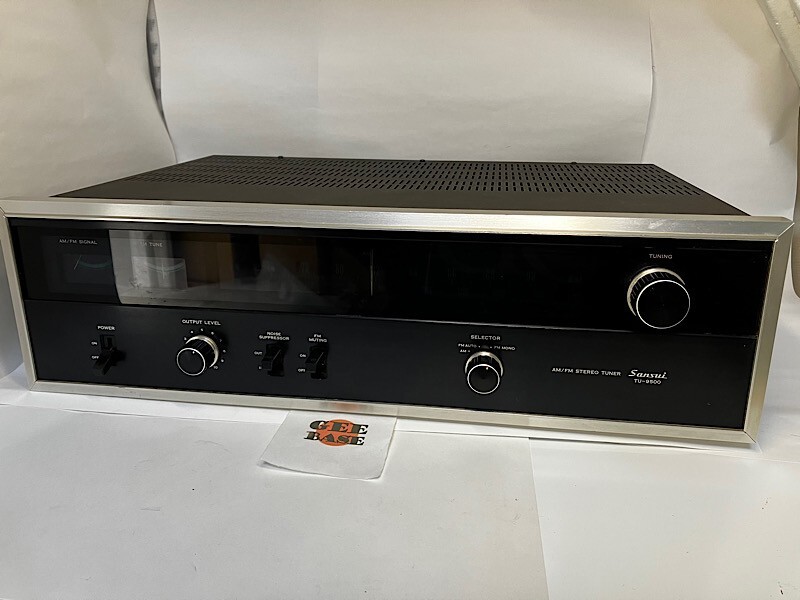
Sansui TU-9500 (1973)
At 9.5 kg, it lands on the rack like a declaration: this tuner means business.
Overview
The Sansui TU-9500 isn’t a subtle machine. From the moment it’s lifted, its 9.5 kg mass signals an era when high fidelity meant heft, density, and engineering packed into every millimeter of its 500 mm-wide chassis. Released in 1973, it was built as a high-end FM/AM tuner aimed squarely at audiophiles who demanded measurable performance and a no-nonsense approach to signal purity. Sansui positioned it as a component that eliminates "the causes of sound quality degradation such as distortion and phase disturbance," and the spec sheet backs that claim with numbers that were competitive even among the top-tier tuners of its day. It’s not flashy, but its presence commands attention—this was a statement piece in an era when tuners were still central to a serious audio system.
Owners report a machine built with deliberate intent, not for casual listening but for those who tuned in to the nuances of broadcast stereo with the same seriousness as a live performance. Its front panel is all function: large tuning and level meters dominate, flanked by switches for muting, noise suppression, and band selection. There’s no digital display, no remote, no gimmicks. What it does, it does thoroughly. The build reflects that ethos—industrial-grade potentiometers, heavy-duty switches, and a layout that suggests longevity, even if time has revealed some weak points in its design.
Still, it’s not without flaws. The weight, while reassuring, makes servicing a chore. And despite its robust construction, certain components have proven vulnerable over decades of dormancy. The power switch, in particular, has gained notoriety among restorers, with multiple forum threads citing contact degradation and intermittent operation. Recapping is almost expected in any unit pulled from storage, and sourcing schematics can be a hunt in itself. But for those willing to put in the work, the reward is a tuner that doesn’t just receive signals—it respects them.
Specifications
| Manufacturer | Sansui Electric Co., Ltd. |
| Model Rating Type | FM/AM Tuner |
| FM Sensitivity (IHF) | 1.7 μV |
| FM Total harmonic distortion factor | Mono: not more than 0.2% Stereo: 0.3% or less |
| FM Signal-to-noise ratio | 75 dB or more |
| FM Selectivity | 80 dB or more |
| FM Capture Ratio (IHF) | 1.5 dB |
| FM Image Frequency Rejection | 100 dB or more |
| FM IF Rejection | 100 dB or more |
| FM Spurious response rejection | 100 dB or more |
| FM Stereo separation | 40 dB or More (400 Hz) |
| FM Unwanted radiation | 34 dB or more |
| FM Frequency characteristic | 30 Hz ~ 15 kHz +0.5 -2dB |
| FM Antenna input impedance | 300 Ω (Balanced Type) 75 Ω (Unbalanced Type) |
| AM Sensitivity (bar antenna) | 46 dB/m |
| AM Selectivity | 25 dB or more |
| AM Image frequency rejection | 100 dB/m or more (1 MHz) |
| AM IF Rejection | 100 dB/m or more |
| Output voltage | 0 V ~ 1 V |
| Tape rec output | 0.4 V |
| Power consumption | 20 W |
| External dimensions | Width 500 x Height 140 x Depth 347 mm |
| Weight | 9.5 kg |
Key Features
Three Dual-Gate MOS FETs in FM Front-End
The TU-9500’s FM front-end relies on a design that was cutting-edge for 1973: two high-frequency amplification stages and a mixer stage built around three dual-gate MOS FETs. This configuration, paired with a newly developed frequency-linear FM5 series variable capacitor, was intended to minimize distortion and phase instability at the earliest point in the signal chain. Dual-gate MOS FETs offered superior gain control and reduced intermodulation compared to bipolar transistors of the era, giving the tuner a cleaner, more stable reception profile—especially in weak-signal conditions.
Four-Stage IF with Uni-Wafer Ceramic Filter
Selectivity and phase linearity are handled by a four-stage IF system centered on a newly developed uni-wafer-type 2-element ceramic filter. This filter provided a wide bandwidth and sharp selectivity, critical for rejecting adjacent channels without sacrificing stereo imaging. More importantly, Sansui implemented a unique circuit configuration to correct phase shift across the IF band—a deliberate move to preserve stereo coherence, which many tuners of the time compromised in favor of raw signal strength.
Differential Demodulation Circuit (D.D.C.) in MPX Section
The MPX (multiplex) section uses a differential demodulation circuit (D.D.C.), a design choice meant to electronically cancel the SCA (Subsidiary Communications Authorization) filter rather than relying on passive LC components. By doing so, Sansui avoided the phase shift typically introduced by the attenuation characteristics of those filters. The result was a more transparent stereo decode, especially in the upper mids and lower treble, where phase errors can smear imaging and reduce clarity.
Two-Element Ceramic Yaman Filter in AM Section
Even the AM band received serious attention. The AM tuner section features a 2-element ceramic Yaman filter, a wide-band high-selectivity coil, a single high-frequency amplifier stage, and a 3-row varicon tuning capacitor. This combination delivered strong sensitivity and rejection of image and IF interference, making AM reception unusually clean for its time. The 46 dB/m sensitivity with a bar antenna is respectable, and the 100 dB/m rejection figures suggest it could handle strong local stations without overload.
Transistor-Zener Diode Regulated Power Supply
Power supply noise is a silent killer in tuners, where even minor ripple can modulate the received signal. Sansui addressed this with a regulated supply using a transistor and zener diode to stabilize voltage and eliminate ripple and fluctuations. While not a full-blown linear regulator by modern standards, this approach was effective for its time and contributed to the unit’s low noise floor and consistent performance under varying line conditions.
MPX Noise Canceler and Whistle Filter via Noise Suppressor Switch
The noise suppressor switch serves dual duty. In FM mode, it acts as an MPX noise canceler, removing stereo demodulation noise without attenuating frequencies above 10 kHz—a common flaw in simpler noise reduction circuits that dull the top end. In AM mode, it functions as a whistle filter, suppressing beat notes above 7 kHz that often plague AM reception in urban environments. This dual functionality reflects Sansui’s focus on practical usability without compromising sonic integrity.
Muting Control with Adjustable Depth
Inter-station noise and sync pop—those abrupt thumps when switching between strong and weak stations—are eliminated by a muting circuit that also allows users to control the depth of muting applied. This isn’t just an on/off function; it’s a calibrated system that can be tailored to the listener’s preference, reducing annoyance without completely cutting off the signal during tuning.
Discriminator and Multi-Path Observation Terminals
For the serious tinkerer or technician, the TU-9500 includes a discriminator output terminal for 4-channel discrete broadcasting—a niche but forward-looking feature in 1973. It also provides a multi-path observation terminal, allowing users to monitor signal reflections on an oscilloscope and optimize antenna placement. These outputs aren’t just for show; they turn the tuner into a diagnostic tool, revealing the quality of the incoming signal in real time.
Historical Context
The TU-9500 belongs to an older generation than the later TU-9900 and is understood to succeed the TU-999, a model held in high regard for its performance. Positioned as a high-end offering in Sansui’s lineup, it arrived during a period when FM stereo broadcasting was gaining traction in Japan and the US, and manufacturers were pushing the limits of tuner design to match the fidelity of high-end preamps and amplifiers. It was part of a broader trend where tuners were no longer afterthoughts but critical components in a complete high-fidelity chain.
Collectibility & Value
The TU-9500 has developed a following among vintage audio enthusiasts, particularly those who pair it with contemporaneous high-end components like the AU-9500 amplifier—a combination often described in forums as a "legendary pair" from the golden age of hi-fi. Current market observations suggest it commands respect in the resale space, with listings referencing its original $350 price point as a benchmark for its stature. However, operational units often come with caveats: recapping is frequently noted as a prerequisite for reliable performance, and the power switch is a known failure point, with multiple forum threads dedicated to its repair. While exact current resale values vary, it is generally seen as more valuable than later mid-tier models like the TU-7900.
eBay Listings


As an eBay Partner, we earn from qualifying purchases. This helps support our independent vintage technology research.
Related Models
- Sansui sax-200 (Late 1970s)
- Sansui sax-600 (Late 1970s)
- Sansui sp-3000 (1970-1972)
- Sansui sp-7500 (1970s (circa 1972-1975))
- Sansui sp-x7 (Late 1970s (approximately 1977-1979))