Rogers Cadet (1958)
A humble name for a foundational British valve amplifier—the original Cadet arrived in 1958 as a compact, affordable alternative to Rogers’ more ambitious Senior series, setting the tone for a long-running line of no-frills hi-fi.
Overview
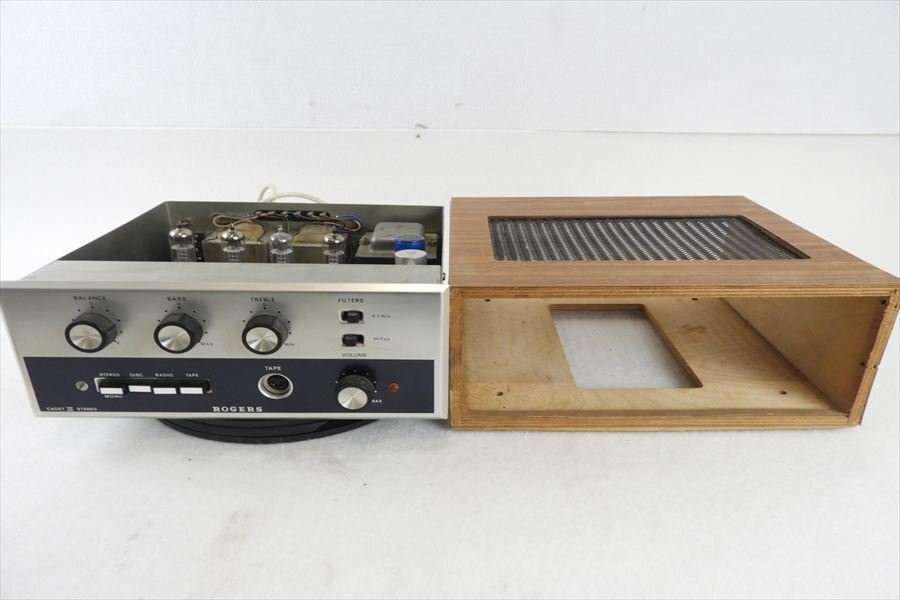
The Rogers Cadet wasn’t designed to dazzle—it was built to deliver. Introduced in 1958, it marked Rogers’ push into accessible valve amplification with a straightforward “amplifier and control unit combination” that prioritized reliability and simplicity over extravagance. Positioned as the budget-friendly sibling to the more powerful Senior models, the Cadet series carved out a niche for listeners who wanted Rogers engineering without the premium price. While details on the original Cadet’s circuitry or performance are sparse, its role in the lineup is clear: a no-nonsense entry point into British hi-fi during an era when valve technology was still king. Studio-Sound (Apr 1963, p.36) noted its use in high-fidelity setups paired with premium cartridges, highlighting its integration into serious audio systems of the time.
Unlike later iterations, the original Cadet wasn’t a single-box integrated unit in the modern sense—it was a two-part system, combining a control unit and amplifier in one package, though not necessarily in a single chassis. This modular approach allowed for easier servicing and better signal isolation, a design philosophy Rogers would refine in later models. The series evolved over the decades, with the Cadet III emerging as a 10-watt-per-channel valve design from the twilight of the tube era, and the Cadet V eventually pushing into 40–50 watts per channel with ultra-linear output stages. But the 1958 original set the template: a “simple circuit” built for durability and musicality, aimed squarely at the growing market of home listeners who valued clarity and build quality over raw power.
Key Features
Amplifier and Control Unit Combination
The original Cadet’s dual-function design—a single system housing both amplification and control circuitry—was practical for its time, offering users a complete solution without the need for external preamps or complex setups. This integration made it ideal for compact systems, particularly in living rooms where space and simplicity mattered. While later models like the Cadet III retained the valve-based architecture, the 1958 version established the core concept: a self-contained unit that could drive efficient speakers with minimal fuss.
Simple Circuit Design
Collectors note that the Cadet series favored straightforward engineering over complexity. The “simple circuit” approach minimized component count and signal path length, reducing the potential for noise and degradation. This philosophy aligned with British hi-fi values of the period—transparency, reliability, and ease of repair. While later models like the Cadet V adopted more advanced topologies such as Class AB2 push-pull with ultra-linear feedback, the original Cadet relied on proven valve configurations to deliver clean, warm sound without unnecessary embellishment.
Evolution Across Generations
The Cadet name persisted for decades, adapting to changing technologies. The Cadet III, described as “a 10W design from the final years of the valve era,” maintained the series’ commitment to tube-based amplification even as solid-state designs gained ground. By the time of the Cadet V, output had increased significantly, with reportedly 40 watts per channel in Class AB2 push-pull (ultra-linear) configuration, and peaks up to 50 watts. This progression reflects Rogers’ ability to evolve the Cadet line while retaining its core identity: accessible, well-built amplification for discerning listeners.
Historical Context
eBay Listings
As an eBay Partner, we earn from qualifying purchases. This helps support our independent vintage technology research.
Related Models
- Rogers LS1 (1976)
- Rogers LS5 (1975)
- Rogers LS5/8 (1975)
- Rogers Ravensbourne Speaker System (1970)
- Rogers COMPACT-MONITOR (1978)
- Quad 44/405-COMBINATION (1976)
- Braun AUDIO-1 (1965)
- Braun AUDIO-250 (1965)
- Braun AUDIO-310 (1965)
- Magnavox Component Systems (1972)