Pioneer SX-1500T (1968–1969)
Fire it up and you’re greeted with a deep, confident hum—the kind of sound only serious iron and decades-old silicon can make.
Overview
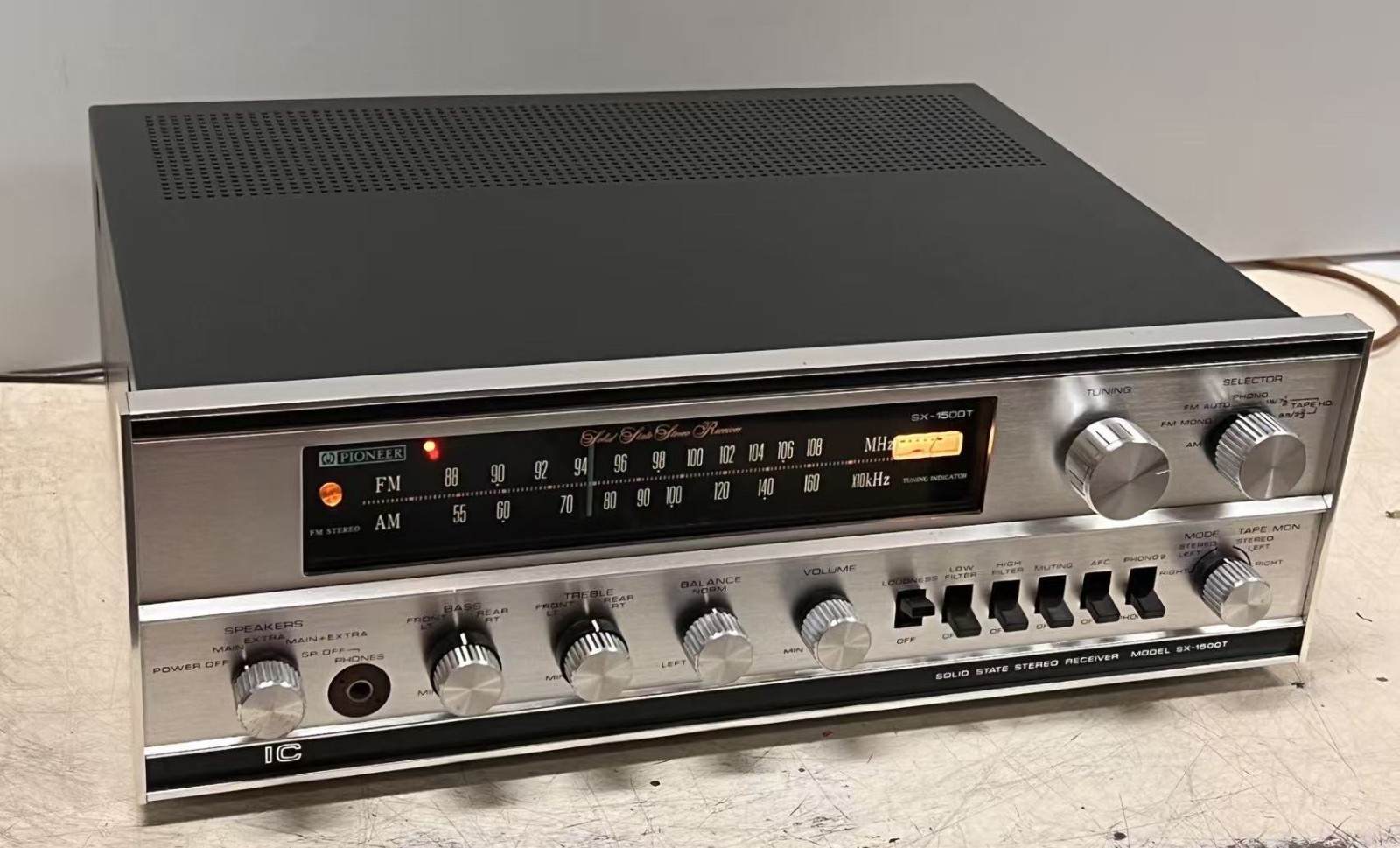
The Pioneer SX-1500T isn’t trying to impress with flashy specs or chrome trim. It’s a no-nonsense, solid-state AM/FM stereo receiver built during a brief but pivotal window—only sold in 1968 and 1969—when Pioneer was refining its transistorized audio architecture with serious engineering intent. This isn’t a receiver that chases headline numbers; it’s built for musicality, serviceability, and long-term reliability. With 35 watts per channel RMS into 8Ω, it delivers clean, stable power that was more than sufficient for the efficient speakers of the era. Owners consistently report a sound that’s warm, natural, and thick—smoother and more organic than many of its contemporaries, with a midrange presence that feels alive. Some even claim they’d part with higher-end models like the SX-939 before letting go of their 1500T. It’s described as “a very nice early receiver,” and while it lacks the pedigree of later flagships, its reputation among those who’ve heard a properly restored unit is quietly glowing.
Key Features
FET Front-End and IC-Based FM Tuner
The SX-1500T’s FM section stands out with a front-end that uses a FET (Field Effect Transistor)—a relatively advanced choice in 1968 that reduced noise and improved weak-signal reception. Paired with a 4-gang variable air capacitor, the tuner delivers smooth, precise dialing and strong station capture, backed by a 1dB capture ratio at 98 MHz. The IF amplifier uses integrated circuits (ICs), a sign of Pioneer’s move toward more compact, stable designs. With 76dB image rejection and 1.7µV usable sensitivity, it pulls in distant FM stations cleanly, especially when connected to a good outdoor antenna via its 300-ohm balanced input. The AM section uses a superheterodyne design with a built-in ferrite loopstick antenna, and at 20µV sensitivity, it handles weak AM signals respectably for its time. HiFi-Stereo (December 1968, p.21) noted that the SX-1500T was drawing “enthusiastic attention” across Pioneer’s dealer network due to its “no-compromise” design and highly sensitive front end.
Single-Ended Push-Pull Amplifier with Direct Coupling
The audio circuitry uses a single-ended push-pull configuration, a classic and reliable topology that balances efficiency with low distortion. Unlike later designs that relied on STK power modules, the SX-1500T uses discrete transistors in the output stage, making repairs more feasible for those who can source equivalents. Notably, the receiver features a directly coupled output, meaning there are no coupling capacitors between the driver and output stages—a design that improves low-frequency response and transient accuracy. This, combined with a wide 20Hz–70kHz frequency response and less than 0.5% harmonic distortion, contributes to its reputation for smooth, natural sound. The damping factor of 25 suggests moderate control over speaker cones—not as tight as modern high-feedback amps, but enough for a musical, forgiving presentation.
Full Schematics and Service-Oriented Design
One of the most appreciated aspects of the SX-1500T is that the owner’s manual included full schematics—a rarity that makes troubleshooting and restoration far more approachable than with many of its peers. With 42 transistors, 34 diodes, 4 ICs, and 1 FET on board, the circuit is complex but well-documented. This wasn’t a black box meant to be discarded when it failed; it was built to be repaired. The power supply uses transistors and diodes that may require modern equivalents today, but the availability of service documentation gives restorers a fighting chance. Combined with DIN tape jacks, RIAA phono equalization, and a full suite of tone controls—including a switchable loudness contour that boosts 12dB at 50Hz and 6.5dB at 10kHz when volume is low—it’s a receiver designed for real-world use, not just showroom appeal.
Historical Context
The SX-1500T emerged during a critical transition in audio engineering, as Japanese manufacturers moved decisively from tube-based designs to solid-state receivers. Built in Japan, the SX-1500T was positioned as an early high-end solid-state model, reflecting Pioneer’s commitment to quality construction and performance. It shared design philosophies with contemporary rebranded units like the Lafayette LR-1500T, indicating its role in broader distribution strategies. Its short production run—limited to 1968 and 1969—places it at the dawn of Pioneer’s SX series legacy, before the arrival of the more powerful receivers that would define the 1970s. HiFi-Stereo (November 1968, p.17) emphasized that the SX-1500T was “made for the thousands who wanted the finest receiver,” underscoring its aspirational positioning despite not being the most powerful unit on the market.
Collectibility & Value
The SX-1500T trades quietly in the vintage market, often overlooked in favor of flashier flagships, but it’s gaining recognition among those who value musicality over specs. Asking prices vary widely: one unit was listed on Reverb for $324.99 OBO, another on PicClick for $89.99, and some hunters have scored working or project units for as little as $20 at a thrift store. Flea market sightings have appeared around $40, and current eBay listings show examples ranging from $250 to $500, though condition varies significantly. However, repairs are almost always necessary after 50+ years. Common issues include crackling noise from the amplifier board, blown output transistors, failed transistors in the differential amplifier stage, blown fuses, and mono-only output with the stereo indicator off—often pointing to internal tuner or multiplex circuit problems. Recapping is essential; restorers recommend Nichicon PW, KL, Panasonic FM, or Elna Silmic II capacitors for critical stages. Given its reputation for warm, thick sound and serviceable design, a fully restored SX-1500T offers excellent value for listeners who want a vintage receiver that’s both musical and maintainable.
eBay Listings


As an eBay Partner, we earn from qualifying purchases. This helps support our independent vintage technology research.
Related Models
- Pioneer QX-949A (1978)
- Pioneer SA-8800II
- Pioneer SX-1050 (1978)
- Pioneer SX-1080 (1978)
- Pioneer SX-1980 (1978)
- Teac A-460 (1975)
- Akai AM-16 (1975)
- Realistic STA-47 (1976)
- Teac A-3300 (1972)
- Teac A-3300S (1975)