Pioneer SA 8800 (1976–1978)
A heavyweight from Pioneer’s golden era of integrated amplifiers, built like a tank and engineered to perform like separates
Overview
At around 15.6 kg (with conflicting reports of 10.9 kg), the Pioneer SA 8800 lands in your rack with the solidity of a component that means business—no lightweight chassis here, just serious engineering wrapped in a silver-faced, utilitarian chassis that defined high-end audio in the late 1970s. This is an integrated amplifier that refused to compromise, reportedly the flagship of Pioneer’s X800 series, designed to blur the line between integrated convenience and separates-grade performance. Built between 1976 and 1978, the SA 8800 emerged during a period when Japanese manufacturers were pushing the boundaries of power, precision, and build quality, and this model stands as a testament to that ambition. Its dual power supply, non-switching amplifier circuit, and DC-coupled design reflect a no-compromise approach, while the FET differential amplifier input stage promises low noise and high stability—features that weren’t just marketing fluff but measurable advantages in an era when amplifier topology mattered deeply to audiophiles.
Owners report a sound signature that’s dynamic and articulate, with tight, controlled bass and a neutral tonal balance that carries just a hint of warmth—enough to keep music engaging without veering into coloration. It drives both vintage bookshelf speakers and modern high-sensitivity loads with authority, suggesting a well-damped, current-capable output stage. The dual power meters on the front panel aren’t just for show; they offer real-time feedback on output symmetry and clipping behavior, a feature prized by users who valued transparency in performance monitoring. With speaker A/B selection, pre-out/main-in jacks, and comprehensive tone controls, the SA 8800 was built as a central hub for a full analog system, capable of integrating turntables, tape decks, and tuners with ease.
Key Features
Dual Power Supply and Non-Switching Amplifier Circuit
The SA 8800 employs a dual power supply feeding a non-switching, pure complementary OCL (Output Capacitor-Less) power amplifier design, a topology Pioneer promoted for its stability and sonic purity. This configuration eliminates coupling capacitors in the signal path, reducing phase shift and transient distortion while enabling direct current coupling across all stages. According to available documentation, the amplifier uses a pre-driver stage as a stabilized power source to minimize transient crossover distortion—a subtle but meaningful refinement that contributes to its clean transient response. The heatsinks are substantial, and thermal management is critical; long listening sessions demand reapplication of thermal paste to maintain reliability, especially given the amplifier’s age.
60W per Channel into 8Ω, 70W into 4Ω
Rated at 60 watts per channel into 8 ohms and 70 watts into 4 ohms (stereo, both channels driven), the SA 8800 delivers a conservative but robust power output that aligns with the engineering ethos of the time—underpromise and overdeliver. While some sources cite an “up to 80 watts” figure, the 60W/8Ω specification is consistent across the primary fact sheet and reflects a realistic continuous output under full bandwidth conditions. This level of power ensures compatibility with a wide range of speakers, including inefficient vintage models, without strain. The amplifier’s ability to deliver increased current into lower impedances (down to 4 ohms) suggests a strong power supply and output stage, further supported by its 4–16 ohm impedance compatibility.
FET Differential Amplifier Input Stage
The input stage uses a FET (Field-Effect Transistor) differential amplifier, a design choice that provides high input impedance, low noise, and excellent common-mode rejection. This topology is particularly beneficial for handling low-level signals from phono and line sources without adding coloration. Input sensitivity is specified at 2.5 mV for phono (MM) with 50 kΩ impedance, and 150 mV for line-level sources (tuner, aux, tape), ensuring compatibility with a wide range of pre-gain devices. The power amp input is rated at 1 V/50 kΩ, allowing for seamless integration with external preamplifiers when used in a separates configuration via the pre-out/main-in jacks.
Dual Power Meters and Speaker Selector
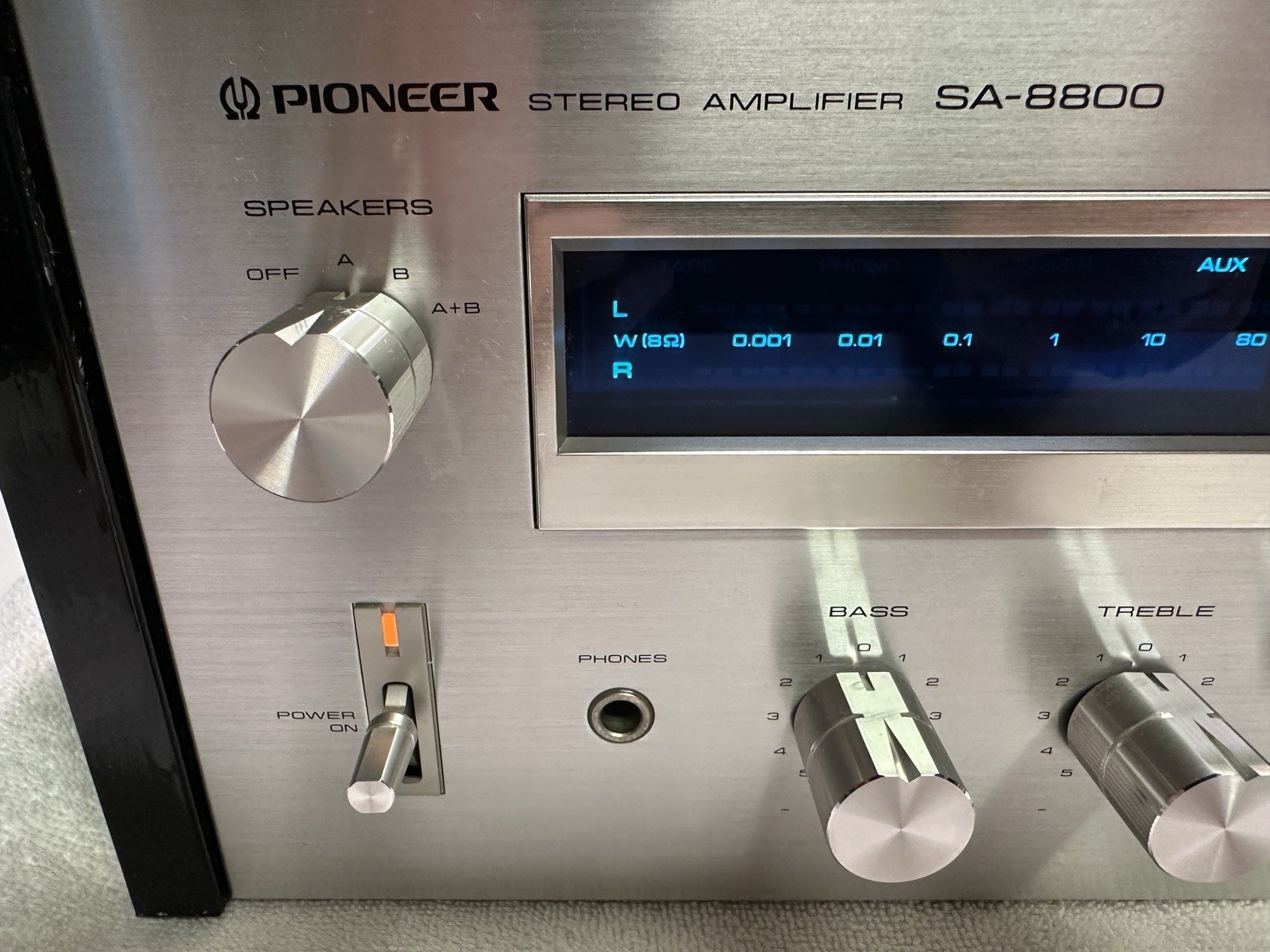
Flanking the central power knob are two large, vertically mounted power meters—rare on integrated amplifiers of this class. These meters provide real-time visual feedback on output levels per channel, helping users monitor for clipping or imbalance. The speaker selector allows switching between Speaker A, B, or both, with impedance compatibility rated at 4–16 ohms for individual pairs and 8–16 ohms when both are engaged. This flexibility made the SA 8800 suitable for multi-room setups or A/B speaker comparisons, a feature appreciated by serious listeners.
Tone Controls and Filters
The SA 8800 includes fully adjustable tone controls: bass ±7 dB at 100 Hz (with turnover frequencies at 200 Hz and 400 Hz), and treble ±7 dB at 10 kHz (turnover at 5 kHz and 2.5 kHz). A loudness contour activates below -40 dB volume, adding +8.5 dB at 100 Hz and +4 dB at 10 kHz to compensate for human hearing response at low levels. High and low filters are also present—low pass at 30 Hz (6 dB/octave), high pass at 8 kHz (6 dB/octave)—useful for protecting speakers or tailoring system response. These features reflect a design philosophy that prioritized user control without sacrificing signal integrity.
Historical Context
The SA 8800 was introduced at a time when integrated amplifiers were rapidly evolving from convenient all-in-ones to high-performance components capable of rivaling separates, with one 1979 test measuring 84 watts RMS into 8 ohms at clipping with both channels driven HI-Fi-Stereo-Buyers (July 1979, p.62). Its silver front panel, angular design, and dense layout typify the aesthetic of late-1970s high-fidelity gear—a period when functionality and technical specification took precedence over minimalist styling. The amplifier’s construction quality, with a rigid chassis and internal bracing, reflects Pioneer’s commitment to minimizing microphonics and vibration, hallmarks of serious audio engineering in the era.
Collectibility & Value
Today, the SA 8800 is regarded as a collectible piece, with a market value ranging from $600 to $1,200 depending on condition, cosmetics, and functionality. Units with working meters, clean potentiometers, and fully operational switches command premium prices, especially if recently serviced. A rare eBay listing once appeared at $1,999, indicating strong demand among dedicated collectors. Its collectibility rating is 8 out of 10, reflecting its reputation for durability, sound quality, and historical significance within Pioneer’s lineup. However, due to its age, most units require restoration—particularly capacitor replacement, potentiometer cleaning, and meter bulb replacement, as original incandescent lamps are prone to failure and difficult to source.
eBay Listings
As an eBay Partner, we earn from qualifying purchases. This helps support our independent vintage technology research.
Related Models
- Pioneer CS-53 (1978)
- Pioneer CS-545 (1979)
- Pioneer CS-66 (1979)
- Pioneer CS-77A (1979)
- Pioneer CS-811 (1979)
- Quad 44/405-COMBINATION (1976)
- Braun AUDIO-1 (1965)
- Braun AUDIO-250 (1965)
- Braun AUDIO-310 (1965)
- Magnavox Component Systems (1972)