Luxman L-80 (1975)
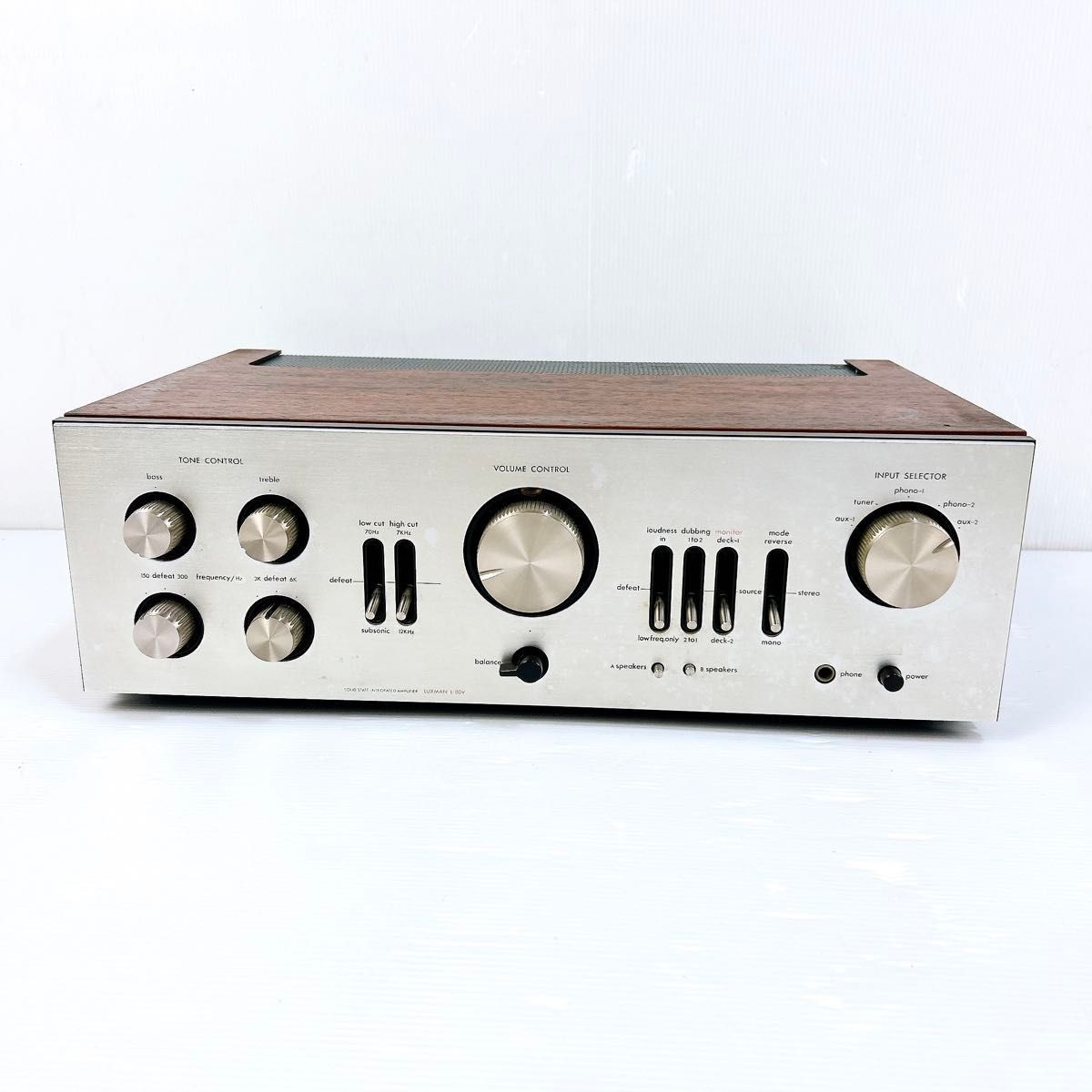
At 9.5kg and with a clean faceplate flanked by chunky knobs, it looks like a serious piece of gear—because it was built to be one.
Overview
The Luxman L-80 is a pre-main amplifier introduced in June 1975 as part of the Japanese manufacturer’s push into high-fidelity integrated designs that balanced control, power, and refinement. Priced at ¥72,500 at launch, it occupied a premium tier in Luxman’s lineup, targeting audiophiles who wanted more than just amplification—they wanted shaping, flexibility, and quiet performance. Unlike pure preamplifiers or standalone power amps of the era, the L-80 combines both stages in a single chassis, offering a streamlined but capable hub for a full analog system. Its design philosophy leans toward precision without sterility, with measured specs and thoughtful features that reflect Luxman’s engineering-first approach during the mid-1970s.
Weighing in at 9.5kg and measuring 450 mm wide, the unit has a substantial presence on a rack, its dimensions suggesting serious internal layout and shielding. The L-80 was developed as a sister unit to the L-80V, sharing design language and likely circuit architecture, though differing in final configuration and output capability. While the fact sheet does not confirm discrete construction or specific component types, the inclusion of multiple filters and tone-shaping options indicates a focus on user control and system integration.
Key Features
High and Low Filters with Low Boost & Loudness Switch
Paired with a low boost function and a loudness compensation switch, these features make the L-80 adaptable to less-than-ideal listening environments or modest speaker systems. The loudness switch likely applies a rising bass curve at lower volumes to compensate for human hearing response, a common but welcome inclusion on higher-end gear of this period.Tape Dubbing Switch
A dedicated tape dubbing switch enables direct routing from input to tape output, simplifying the process of copying between analog sources—particularly useful in an era when reel-to-reel and cassette duplication was routine. This feature, while not unique, underscores the L-80’s role as a central node in a multi-component audio setup, where signal flow management was as important as amplification quality.
Specifications
The L-80 delivers 40 watts per channel into 8 ohms with both channels driven, a conservative but robust rating for the time. HiFI-Stereo (June 1977, p.151) noted Luxman's design emphasis on comprehensive frequency response and robust power handling in contemporary models.
Total harmonic distortion is rated at 0.1% or less under full load, suggesting tight control and clean output even near maximum volume. Cross modulation distortion, a more demanding test of intermodulation under mixed-frequency signals (70 Hz and 7 kHz at a 4:1 ratio), is also specified at 0.1% or less, indicating strong channel separation and minimal signal interaction.Frequency response extends from 10 Hz to 40 kHz at the -3dB points with a 0.1% distortion threshold, placing it well beyond the audible range on the high end and deep into sub-bass territory on the low. Input sensitivity is finely graded: phono inputs require just 2.5 mV, suitable for moving magnet cartridges of the era, while line-level inputs (Tuner, Aux1, Aux2) are matched to the standard 120 mV, ensuring compatibility with most preamp-level sources.
Signal-to-noise ratio varies by input type—phono signals achieve 63 dB or better, while tuner and auxiliary inputs exceed 78 dB, reflecting the inherent noise challenges of amplifying low-level cartridge outputs. The unit’s physical footprint—450 mm wide, 160 mm tall, and 300 mm deep—houses all this circuitry in a layout that prioritizes stability and serviceability, though internal construction details are not documented.
Historical Context
Released in June 1975, the Luxman L-80 arrived during a peak period for Japanese high-fidelity audio, when brands like Sansui, Yamaha, and Pioneer were exporting increasingly sophisticated gear to global markets. At ¥72,500, it was a premium product, positioned for serious listeners who valued both performance and flexibility. Its development as a sister model to the L-80V suggests Luxman was refining a platform across multiple variants, possibly tailoring gain structure, output stage design, or feature sets to different market segments. The inclusion of both phono and line inputs, along with comprehensive tone controls and filtering, reflects the typical all-in-one role many integrated amplifiers played in 1970s home audio systems.
eBay Listings



As an eBay Partner, we earn from qualifying purchases. This helps support our independent vintage technology research.
Related Models
- Luxman MS-11 (1974)
- Luxman 5T-50 (1975)
- Luxman AS-4 (1973)
- Luxman C-9II (1979)
- Luxman CL-88 (1979)
- Denon POA-800 (1978)
- Eico 3150 (1967)
- Fisher CUSTOM-ELECTRA-I (K-14/K-15) (1957)
- Fisher CUSTOM-ELECTRA IV (E33/E44) (1960)
- Akai AM-2600 (1977)