Klipsch La Scala (1963–Present)
At 123 pounds and 105 dB sensitivity, these aren’t speakers—they’re acoustic artillery built to command any room, from campaign rallies to living rooms.
Overview
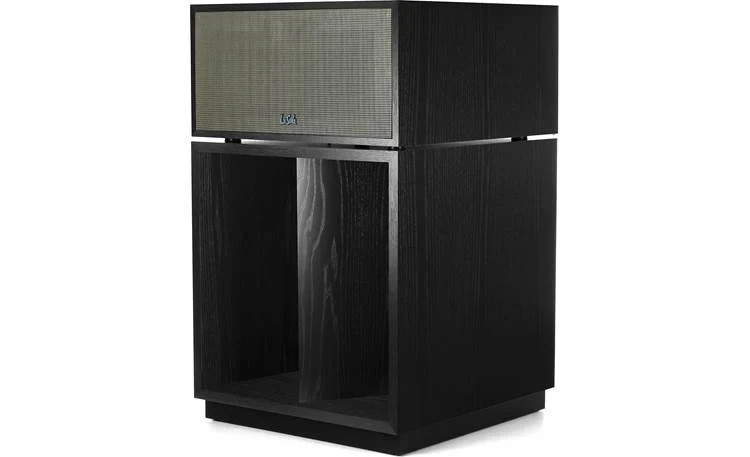
The Klipsch La Scala is one of only two fully horn-loaded designs in Klipsch’s Heritage series that doesn’t demand corner placement, standing alongside the Klipschorn and Belle Klipsch as a pillar of the brand’s high-efficiency legacy. Introduced in 1963 as a professional-grade loudspeaker, it was engineered for applications where brute output and reliability were non-negotiable—think political rallies, theaters, and public address systems. Unlike the Klipschorn, which relies on room corners to complete its bass horn, the La Scala integrates a fully enclosed folded horn within its cabinet, freeing it from architectural constraints while preserving the core tenets of horn-loaded design: extreme efficiency, low distortion, and explosive dynamics. Its 104–105 dB sensitivity means it can achieve concert-level volumes with just a few watts, making it a favorite among tube amplifier enthusiasts and purists who value unamplified realism. As noted in High-Fidelity (February 1979, p.97), these speakers perform with far less distortion than most others, capable of filling large venues like Radio City Music Hall or an opera house with clarity and power.
Key Features
15" Folded Horn-Loaded Woofer with Fiber-Composite Cone
At the low end, the La Scala employs a K-33 or K-33-E 15" fiber-composite cone woofer, rear-firing into a folded exponential horn path that wraps through the cabinet and exits at the front. This self-contained horn design sacrifices some deep bass extension—typically reaching 45–51 Hz compared to the Klipschorn’s 33 Hz—but delivers exceptionally tight, articulate bass with minimal distortion. Horn loading reduces cone excursion, allowing the driver to handle up to 100 watts continuous (400 watts peak) without strain, while maintaining pitch definition even at high sound pressure levels.
2" Phenolic Diaphragm Midrange on K-700 Exponential Horn
The midrange is driven by a K-55-V, K-55-X, or K-55-M 2" phenolic diaphragm compression driver mounted on a K-700 exponential horn. This configuration ensures high output and low coloration through the critical vocal and instrumental range, with a crossover point around 400 Hz. The horn’s controlled dispersion contributes to a coherent, lifelike midrange presence, a hallmark of Klipsch’s professional audio lineage.
1" Compression Driver with Phenolic or Titanium Diaphragm
High frequencies are handled by a K-77-series 1" compression driver—either phenolic or titanium diaphragm depending on generation—feeding into a dedicated horn. The tweeter crosses over at approximately 4500 Hz and delivers a frequency response extending to 17 kHz (±4 dB), with later models like the AL5 reportedly reaching 20 kHz. This high-frequency clarity, combined with the horn’s fast transient response, renders sibilance, string harmonics, and brass attacks with startling realism.
8 Ω Nominal Impedance and High Power Handling
With a nominal impedance of 8 ohms, the La Scala presents a stable load for both tube and solid-state amplifiers. Its 100-watt continuous power handling (400 watts peak) ensures resilience in high-output environments, a necessity given its origins in commercial sound reinforcement. The combination of high sensitivity and robust power tolerance makes it one of the few speakers that can be driven effectively by low-wattage amplifiers while still scaling with high-powered setups.
Heritage Active Crossover in AL6 Generation
The La Scala AL6 introduces an optional Heritage Active Crossover, requiring three separate amplifiers and utilizing advanced DSP for refined filtering and driver signal delay. This active system bypasses passive crossover components entirely, allowing for precise control over each driver—woofer, midrange, and tweeter—enhancing time alignment and reducing intermodulation distortion.
Historical Context
The La Scala was conceived for professional use where the Klipschorn’s corner-loading requirement was impractical. Its first major deployment came during Nelson Rockefeller’s campaign for Governor of New York in the 1960s, where its ability to fill large spaces with clear, undistorted sound impressed the candidate enough to deploy them on his campaign train. Over the following decades, the speaker became a staple in small theaters, dance halls, and commercial installations across the U.S. Despite its utilitarian roots, audiophiles quickly recognized its sonic virtues, adopting it for high-fidelity home systems. In 2006, Klipsch formally inducted the La Scala II into the Heritage series, elevating its status from commercial workhorse to collectible audio icon with furniture-grade finishes and domestic refinement.
Collectibility & Value
Original vintage pairs have listed for as much as $2,625, with asking prices around $2,100 for well-maintained examples. The eBay market shows wide variance, with completed sales ranging from $19 to $5,000, though median values hover near $214—likely reflecting incomplete or non-functional units. High-end listings for current models are far steeper: AL5 pairs appear at $15,400, while AL6 pairs reach $15,400 or more. The original MSRP for a vintage pair was reportedly $1,400, though this figure comes from a single seller and lacks broader confirmation. Maintenance is a known consideration: owners report midrange and tweeter driver issues, occasional buzzing in late-seventies Industrial variants, and aging crossover capacitors—common enough that recapping is a routine service. Replacement parts, such as the K-55-PH midrange driver (P/N 1007181), remain available, and service manuals like the “KLIPSCH LA SCALA SPEAKER SYSTEM SCH” are accessible online, supporting long-term ownership.
eBay Listings


As an eBay Partner, we earn from qualifying purchases. This helps support our independent vintage technology research.
Related Models
- Klipsch Belle (1985)
- Klipsch CHORUS
- Klipsch Cornwall III (2006-)
- Klipsch Cornwall IV
- Klipsch Forte III
- Quad 44/405-COMBINATION (1976)
- Braun AUDIO-1 (1965)
- Braun AUDIO-250 (1965)
- Braun AUDIO-310 (1965)
- Magnavox Component Systems (1972)