JBL L40 (1978–1982)
At 44 pounds, it feels like a serious piece of gear before you even press play—solid, purposeful, and built to last in a way few bookshelf speakers are today.
Overview
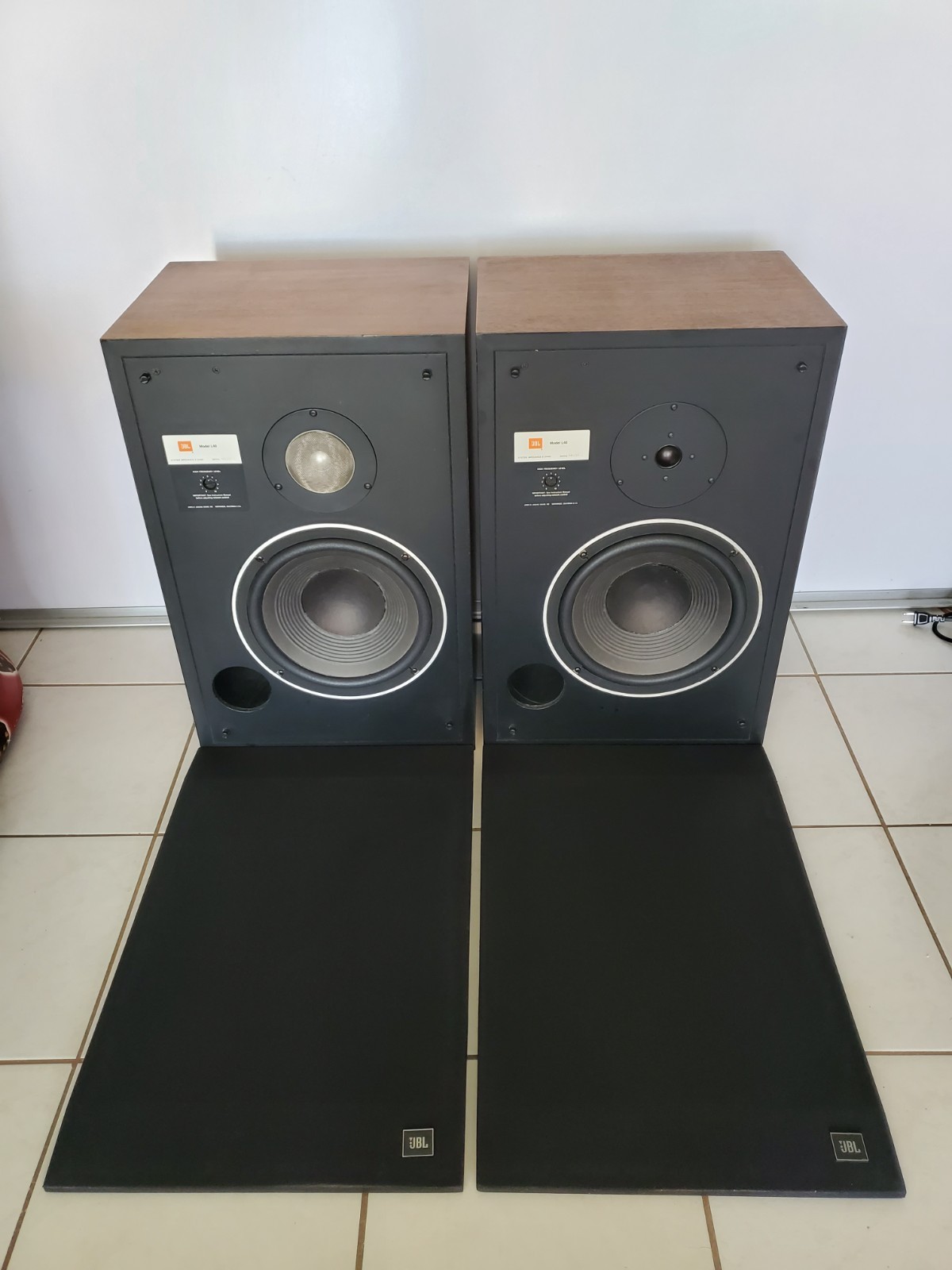
The JBL L40 isn’t flashy, but it carries the quiet confidence of a tool built for work. Introduced in 1978 as part of JBL’s refreshed L-series lineup, this 2-way, 2-driver bass reflex bookshelf speaker was engineered to deliver high-fidelity performance in compact living spaces without sacrificing the sonic authority the brand earned in professional studios. Weighing in at 20 kg (44 lbs) per cabinet, the L40’s heft comes from its dense walnut veneer enclosure and the serious driver complement within. It was positioned between the entry-level L26 Decade and the more sophisticated L50—more refined than the former, more affordable than the latter, and with its own distinct engineering signature. The original price in Japan was ¥76,000 per unit, placing it as a premium but accessible option in the late 1970s hi-fi market.
Key Features
10-Inch 127A Woofer with Ribbed Corn Paper Cone
The heart of the L40’s low-end performance is the 127A 10-inch (25 cm) woofer, a driver that blends rigidity with controlled breakup characteristics thanks to its ribbed corn paper cone. This material choice wasn’t just cost-effective—it provided a natural damping quality that helped maintain clarity even at higher volumes. The voice coil is a 5 cm copper ribbon, edgewise-wound, contributing to efficient heat dissipation and long-term reliability under sustained power. Most notably, the 127A incorporates JBL’s innovative glass wool shell: a basket-shaped damping structure mounted behind the cone that flattens impedance peaks without restricting cone movement. This acoustic solution was a clever alternative to complex electrical filtering, preserving phase coherence while improving bass control.
1-Inch 033 Dome Tweeter with 14,000 Gauss Magnetic Circuit
The 033 dome tweeter marked a turning point for JBL in this price class—it was the company’s first use of a dome design in a mid-tier bookshelf model. The 1-inch (2.5 cm) phenolic-treated hard diaphragm is driven by a 14,000 Gauss magnetic circuit and an aluminum ribbon wire, edgewise-wound, enabling extended high-frequency response beyond the audible range. Unlike the horn-loaded tweeters found in larger JBL models of the era, the dome design offers more consistent dispersion and reduced beaming, making the L40 less sensitive to room placement. The result is a smooth, extended top end that avoids the harshness sometimes associated with early dome tweeters, though owners report a slight roll-off above 15 kHz that contributes to a non-fatiguing listening experience.
Glass Wool Shell Technology for Impedance Smoothing
JBL’s glass wool shell, integrated into the 127A woofer, is one of the L40’s most underappreciated innovations. Positioned behind the cone, this fibrous basket acts as a mechanical damper that reduces resonant peaks in the driver’s impedance curve. By flattening these peaks, the speaker presents a more stable load to the amplifier, improving power transfer and reducing distortion. Unlike resistive Zobel networks or other electrical correction methods, the glass wool shell achieves this without introducing phase shifts or power loss. Collectors note that preserving this component during restoration is critical—removing or damaging it alters the speaker’s fundamental behavior.
Continuously Variable HF Level Control
Mounted on the rear panel, the continuously variable high-frequency level control allows users to tailor the tweeter output to their room acoustics or personal preference. This feature, borrowed from JBL’s professional studio monitors, gives the L40 unusual flexibility for a consumer speaker of its era. Whether compensating for a bright room or taming an overly aggressive amplifier, the control provides a practical means of fine-tuning the sound. It’s a small detail, but one that reflects JBL’s commitment to real-world usability over pure spec-sheet performance.
Transition to Ferrite Magnets in Driver Design
The L40’s development coincided with JBL’s broader shift from Alnico to ferrite magnets across its driver lineup—a move driven by both cost efficiency and long-term stability. Ferrite magnets are less prone to demagnetization over time and are not subject to the volatile pricing of cobalt and nickel, which were key components in Alnico formulations. While some purists argue that Alnico delivers a “warmer” sound, the ferrite magnets in the 127A and 033 drivers provide consistent performance and greater reliability, especially under high power conditions. This transition marked a maturation in JBL’s manufacturing philosophy, balancing performance with practicality.
Historical Context
The L40 arrived in 1978, a time when high-fidelity audio was becoming increasingly mainstream, and consumers were demanding serious sound from compact systems that could fit in urban living rooms. JBL responded by refining its L-series with models that brought professional-grade engineering to the home without the footprint of floor-standing giants. The L40 was part of this strategy—offering a middle ground between the budget-conscious L26 and the more advanced L50. It was also more affordable than larger 3-way models like the L112, making it a popular choice for stereo enthusiasts who wanted JBL’s signature clarity without the bulk. HiFi-Stereo (June 1979, p.36) called it “the best $250 two-way loudspeaker you can buy,” noting that “it’ll play right up there with loudspeakers twice its size.”
Collectibility & Value
Today, the L40 occupies a sweet spot in the vintage audio market—respected for its engineering, accessible in price, and distinctive in sound. Complete, unrestored pairs typically sell for $400–600, while professionally restored examples with fresh foam surrounds and recalibrated crossovers can command $800–1,200. The 127A woofer’s foam surrounds are known to degrade over time, and replacement is considered a standard restoration step that dramatically improves bass response and overall dynamics. Original 033 tweeters are generally robust, but the phenolic diaphragms can become brittle with age, so careful inspection is advised. Crossover capacitors often drift from their original values, so servicing them during restoration is recommended. The walnut veneer cabinets usually hold up well, though refinishing may be needed on heavily worn units. Original grilles, particularly in the less common red and camel finishes, add noticeable value. High-Fidelity (November 1977, p.28) summed up the appeal: “You’ll be getting the same craftsmanship, the same components, the same sound heard in the very top recording studios in the world.”
eBay Listings
As an eBay Partner, we earn from qualifying purchases. This helps support our independent vintage technology research.
Related Models
- JBL 2234H
- JBL 2308
- JBL 4310 (1970)
- JBL 4311B (1975)
- JBL 4312M
- Quad 44/405-COMBINATION (1976)
- Braun AUDIO-1 (1965)
- Braun AUDIO-250 (1965)
- Braun AUDIO-310 (1965)
- Magnavox Component Systems (1972)