JBL 4333B (1977–1985)
At 62 pounds and with a 12-inch doped cone woofer, the 4333B doesn’t just sit in the room—it commands it, delivering the unvarnished clarity that made JBL monitors the standard in broadcast booths and mastering suites.
Overview
The JBL 4333B is a full-range, three-way passive monitor from JBL (James B. Lansing Sound, Inc.), introduced in 1977 as an evolution of the original 4333 and discontinued in 1985. As part of the revered 4300 series, it was engineered for professional environments where accuracy trumps euphony. This isn’t a speaker designed to flatter recordings—it’s built to expose them. Weighing in at 62 lbs per cabinet, the 4333B combines a robust MDF enclosure with high-efficiency compression drivers and a Tractrix Horn, resulting in a monitor that can handle punishing SPLs while maintaining neutrality. Its 94 dB sensitivity means it plays loud with modest amplifier power, and its 50–200 watt recommended range gives it flexibility across tube and solid-state gear. The 24.5" x 14.5" x 12.5" cabinet, finished in walnut veneer with a black cloth grille, is compact enough for mid-field placement yet substantial enough to anchor a serious monitoring setup.
Key Features
12" D130F-8 Woofer with Doped Cone
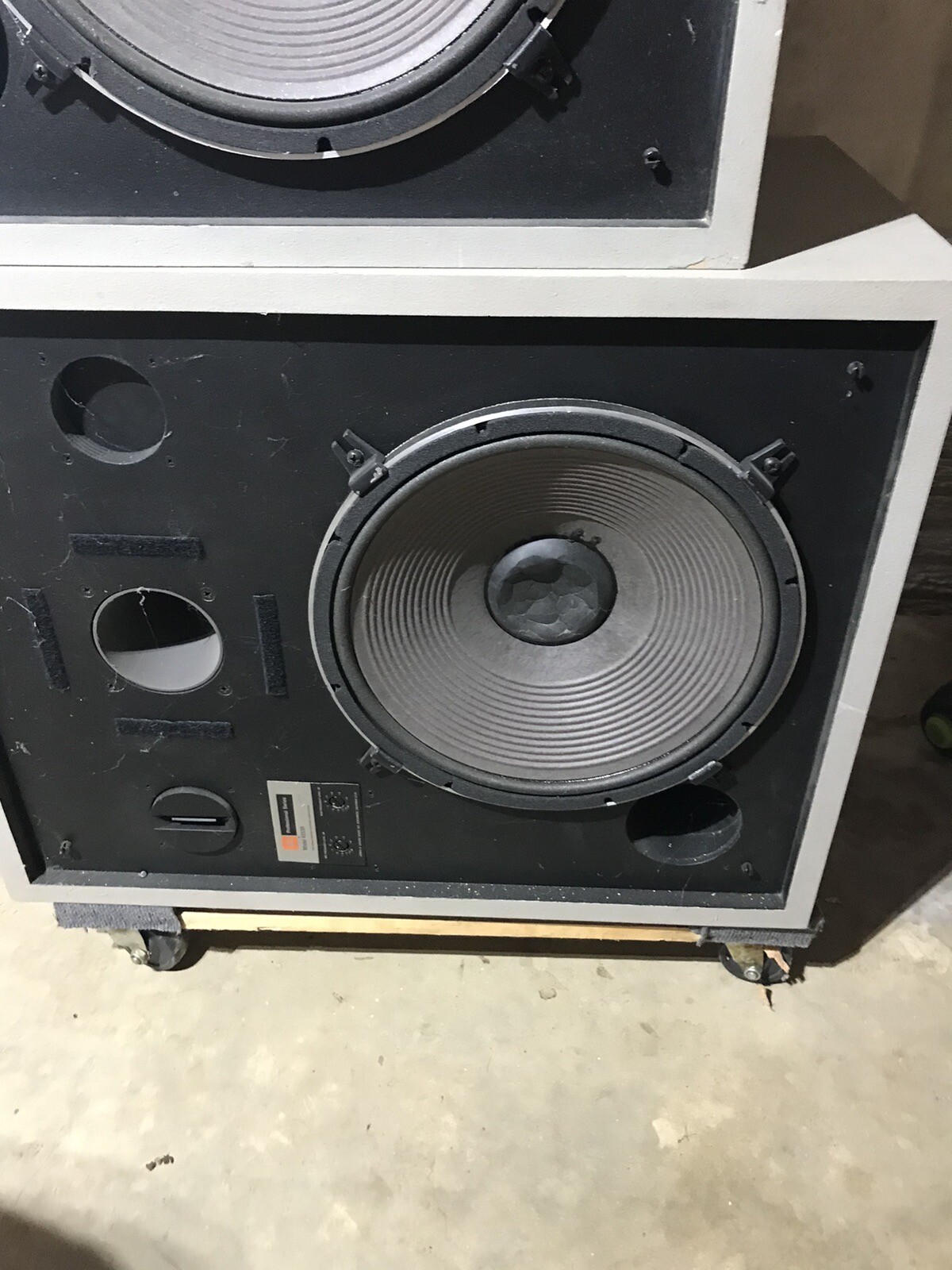
The 4333B’s bass foundation is the 12" JBL D130F-8 woofer, featuring a doped cone for reduced resonance and improved transient response. This driver delivers tight, articulate low end that reaches down to 45 Hz with authority—fast and controlled, avoiding the sluggishness that plagues many vintage designs. Unlike ported systems that can muddy transients, the 4333B’s vented enclosure is tuned for precision, making it ideal for critical listening where timing and definition matter more than sheer sub-bass extension.
5" 2405-8 and 1" 2406-8 Compression Drivers on Tractrix Horn
Mounted on a 2412-8 Tractrix Horn with 90° x 60° dispersion, the 5" 2405-8 midrange and 1" 2406-8 tweeter form a high-efficiency horn-loaded system that minimizes distortion and maximizes clarity. The compression driver design allows both units to handle high sound pressure levels without fatigue, a necessity in studio environments where engineers might monitor for hours. The Tractrix Horn’s geometry reduces internal reflections and improves time alignment, resulting in a clean, coherent high-frequency response that extends smoothly to 20 kHz. Some owners describe the top end as “analytical” rather than “sweet,” but that’s by design—flaws in recordings are not masked but revealed.
Heavily Braced MDF Enclosure with Vented Design
The cabinet is constructed from medium-density fiberboard with extensive internal bracing to minimize panel resonance and coloration. The vented (ported) design enhances bass output without sacrificing transient speed, a careful balance that distinguishes the 4333B from sealed-box monitors. The result is a speaker that remains stable and neutral even at high volumes, a trait that earned it trust in broadcast and mastering applications where consistency is paramount.
Gold-Plated Dual Banana-Compatible Binding Posts
Terminated with industrial-grade gold-plated binding posts, the 4333B supports both single-wiring and bi-wiring configurations. The dual banana-compatible terminals ensure reliable, low-resistance connections—critical in professional installations where cable runs are long and signal integrity is non-negotiable. These posts are built to last, resisting corrosion and maintaining contact even after years of use.
B-Revision Refinements for Reliability and Neutrality
The “B” in 4333B wasn’t just a suffix—it marked meaningful improvements over the original 4333. The revision addressed early reliability concerns, particularly in driver durability and crossover stability, while refining the frequency response for a flatter, more neutral curve. These updates made the 4333B a more trustworthy tool for engineers who needed consistency across sessions and studios.
Historical Context
JBL had already established itself as a leader in professional audio by the 1970s, thanks to studio standards like the 4310 and 4311. The 4333, launched in 1972, was the company’s first large-format, three-way monitor aimed at high-fidelity and broadcast markets. Five years later, the 4333B emerged as a significant upgrade, incorporating advances in driver materials, crossover design, and cabinet construction. It was widely adopted by radio stations, TV networks, and mastering houses—environments where sonic accuracy was mission-critical. The BBC, for instance, used variants of the 4333 series in their monitoring chain, and top-tier studios in Los Angeles, New York, and London relied on them during the peak of analog recording. While the 4310 series defined the near-field monitor category, the 4333B was built for mid-field accuracy, earning its place as a “big brother” in the JBL lineup.
Collectibility & Value
Today, the JBL 4333B is a sought-after collector’s item. A matched pair in excellent condition typically sells for $1,200 to $2,000, with prices climbing for units that have been professionally restored or come with original packaging and documentation. Fully refurbished models—featuring reconed woofers and updated crossovers—can command upwards of $2,500. Provenance matters: speakers from famous studios or broadcast stations carry a premium. Original drivers (D130F, 2405, and 2406) significantly increase value, as do well-preserved walnut veneer cabinets and intact grilles. Replacement parts, such as the 2231H 15" woofer or tweeter diaphragms, remain available but can be costly—evidence of an active restoration ecosystem.
eBay Listings
As an eBay Partner, we earn from qualifying purchases. This helps support our independent vintage technology research.
Related Models
- JBL 2234H
- JBL 2308
- JBL 4310 (1970)
- JBL 4311B (1975)
- JBL 4312M
- Quad 44/405-COMBINATION (1976)
- Braun AUDIO-1 (1965)
- Braun AUDIO-250 (1965)
- Braun AUDIO-310 (1965)
- Magnavox Component Systems (1972)