Denon TU-280 (1992)
At 2.6 kg, it sits on the rack like a quiet promise—solid, no-nonsense, ready to pull music from the air.
Overview
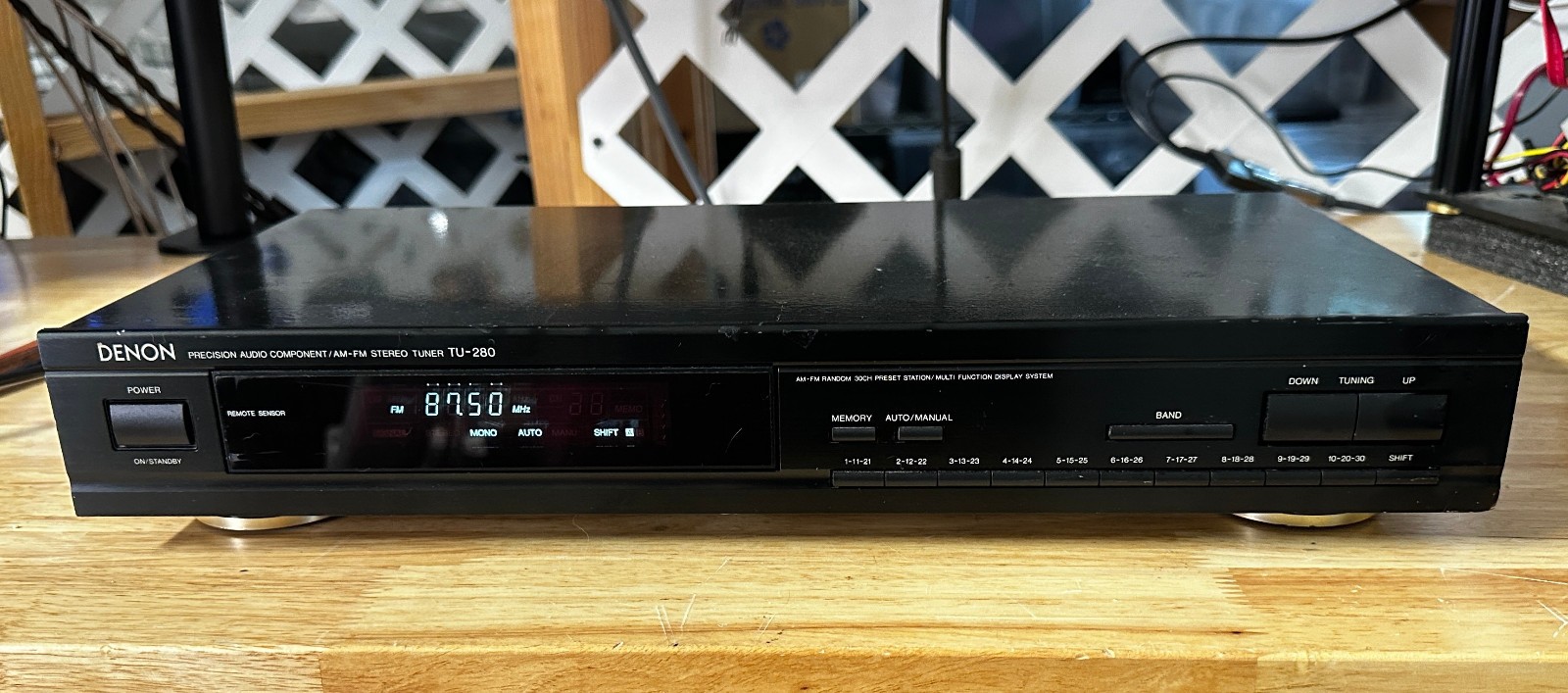
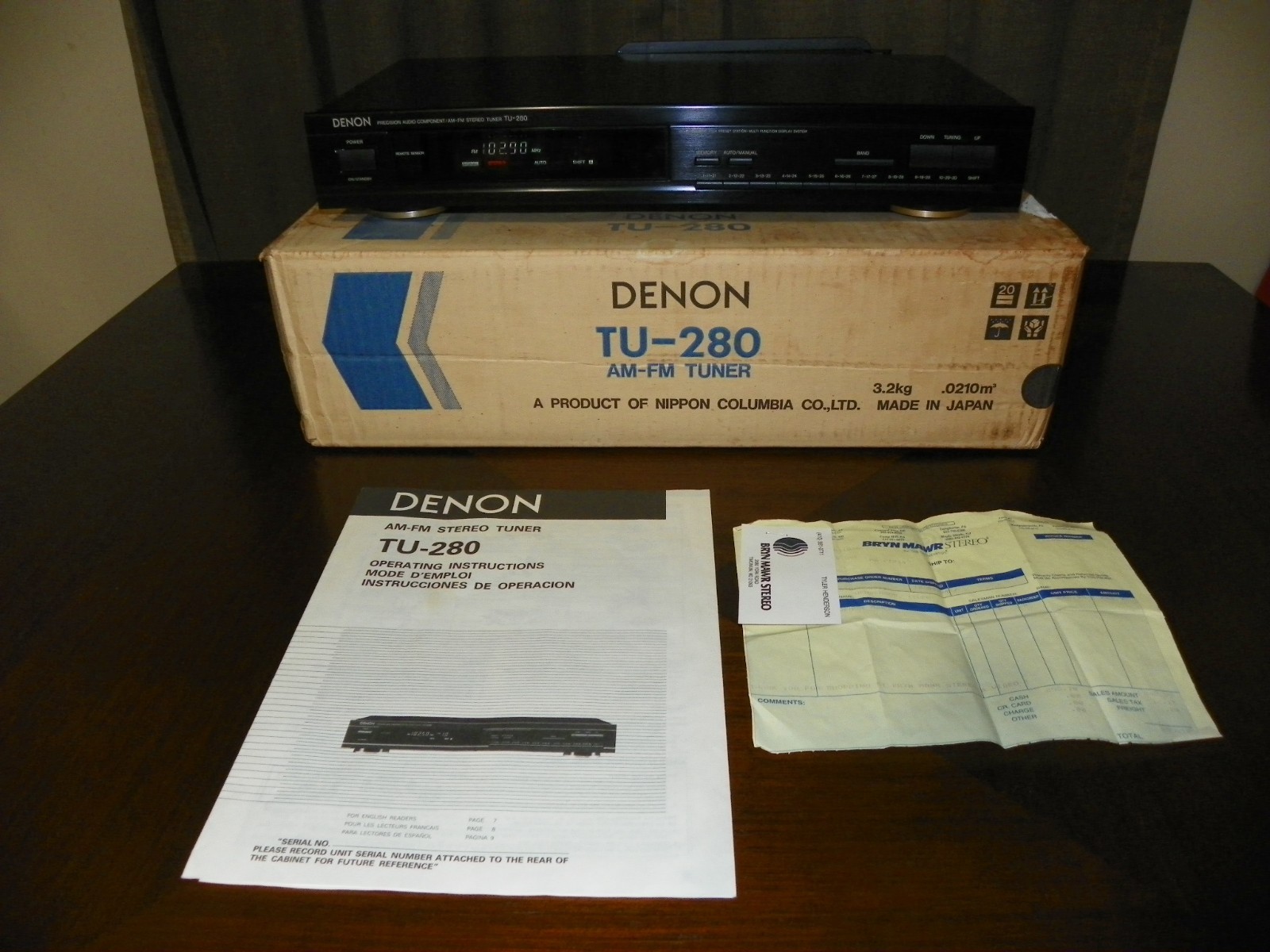
The Denon TU-280 arrived around 1992 as a mid-tier stereo tuner with a focus on practical performance and modern convenience, standing in contrast to the all-analog, high-end FM-only tuners Denon had built in earlier decades. Unlike the minimalist, broadcast-focused designs of the 1970s, the TU-280 embraced the era’s shift toward user-friendly features and expanded functionality, offering both FM and AM stereo reception in a compact chassis. It was priced at ¥32,000 at launch, with a slightly upgraded TU-280G variant—featuring wood-clad side panels and a gold front panel—introduced around 1993 at ¥36,000. This model marked Denon’s continued effort to balance audiophile expectations with mainstream usability during a time when tuners were increasingly integrated into receivers and beginning to face competition from emerging digital audio sources.
Key Features
AM Stereo Demodulation with LC Tuning and Ceramic Filtering
One of the TU-280’s standout features was its inclusion of an AM stereo demodulation circuit, a relatively rare capability in consumer tuners of the early 1990s. This allowed it to decode AM stereo broadcasts where available, improving the listening experience on compatible stations. To support this, the tuner used an LC tuning circuit paired with a 4-element ceramic filter, which helped widen the bandwidth necessary for AM stereo while also improving rejection of adjacent channel interference—a persistent issue on the crowded AM band.
30-Station Random Preset Function
Gone was the mechanical tuning counter of vintage Denon flagships; the TU-280 embraced electronic convenience with a 30-station random preset system. This allowed users to store and recall favorite stations quickly, a significant usability upgrade over manual tuning. The presets worked across both FM and AM bands, making it easier to navigate a diverse listening schedule without constant retuning.
Low-Impedance Output Circuit for Clean Signal Transfer
The TU-280 was equipped with a low-impedance output circuit rated at 500 Ω or less, a design choice intended to improve signal integrity when connected to an amplifier. This reduced the risk of high-frequency roll-off and minimized noise pickup in the interconnects, contributing to cleaner audio transmission. Denon noted this feature helped prevent matching issues and interference-related problems, especially in systems with longer cable runs.
Included Wireless Remote Control (RC-126)
A full-featured wireless remote control, the RC-126, was included with the TU-280—a notable inclusion at its price point. The remote measured 58 x 125 x 19.5 mm and weighed 70 g with its two UM-4 (C-size) batteries. It enabled control over frequency up/down, preset channel selection, band switching, power on/standby, auto/manual tuning modes, preset scanning, and muting functions. This level of remote functionality was uncommon in tuners at the time and suggested Denon intended the TU-280 for integration into complete, remotely operated audio systems.
Gold and Wood Variant: TU-280G
In addition to the standard black TU-280, Denon offered a TU-280G variant with a gold-colored front panel and wood side panels. The TU-280G was slightly wider at 470 mm compared to the standard model’s 434 mm, with a minimal increase in depth and height. It also weighed more—2.9 kg versus 2.6 kg—likely due to the wood cladding. This version catered to buyers who preferred a warmer, more traditional aesthetic in their audio gear.
eBay Listings


As an eBay Partner, we earn from qualifying purchases. This helps support our independent vintage technology research.
Related Models
- Denon TU-701 (1976)
- Denon TU-1500RD (1995)
- Denon TU-210RD (1978)
- Denon TU-400 (1976)
- Denon TU-501 (1977)
- Kenwood KR 3200 (1973-1975)
- Kenwood KR 3400 (1977-1979)
- Kenwood KR 4200 (1975-1977)
- Kenwood KR 5150 (1977-1979)
- Marantz 1515 (1976-1978)