Denon DRS-610 (1992–1994)
A heavy-duty cassette deck with a misleading name—this is no resonance stabilizer, but a full-featured, triple-motor machine built for precision tape handling and clean analog recording.
Overview
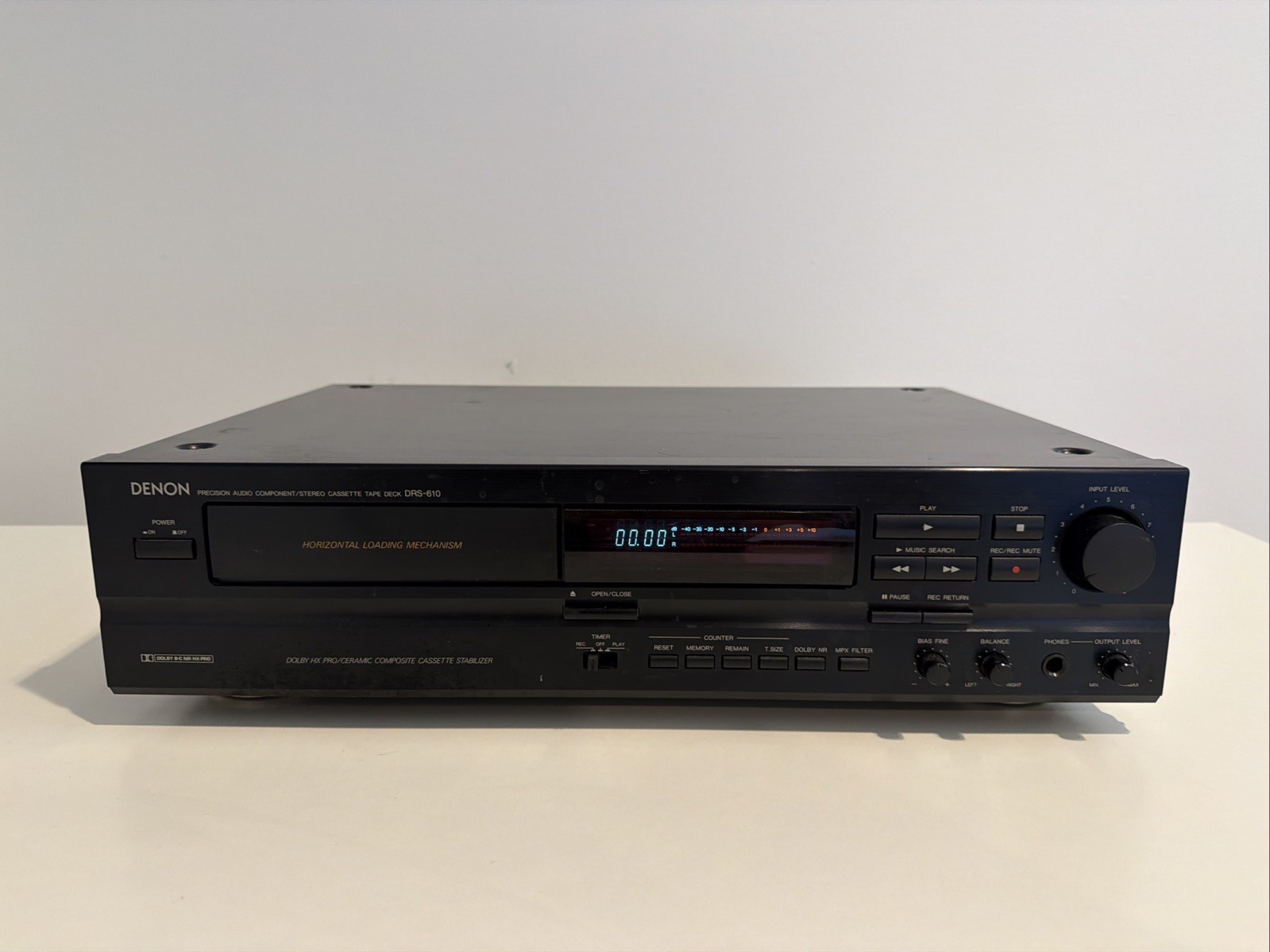
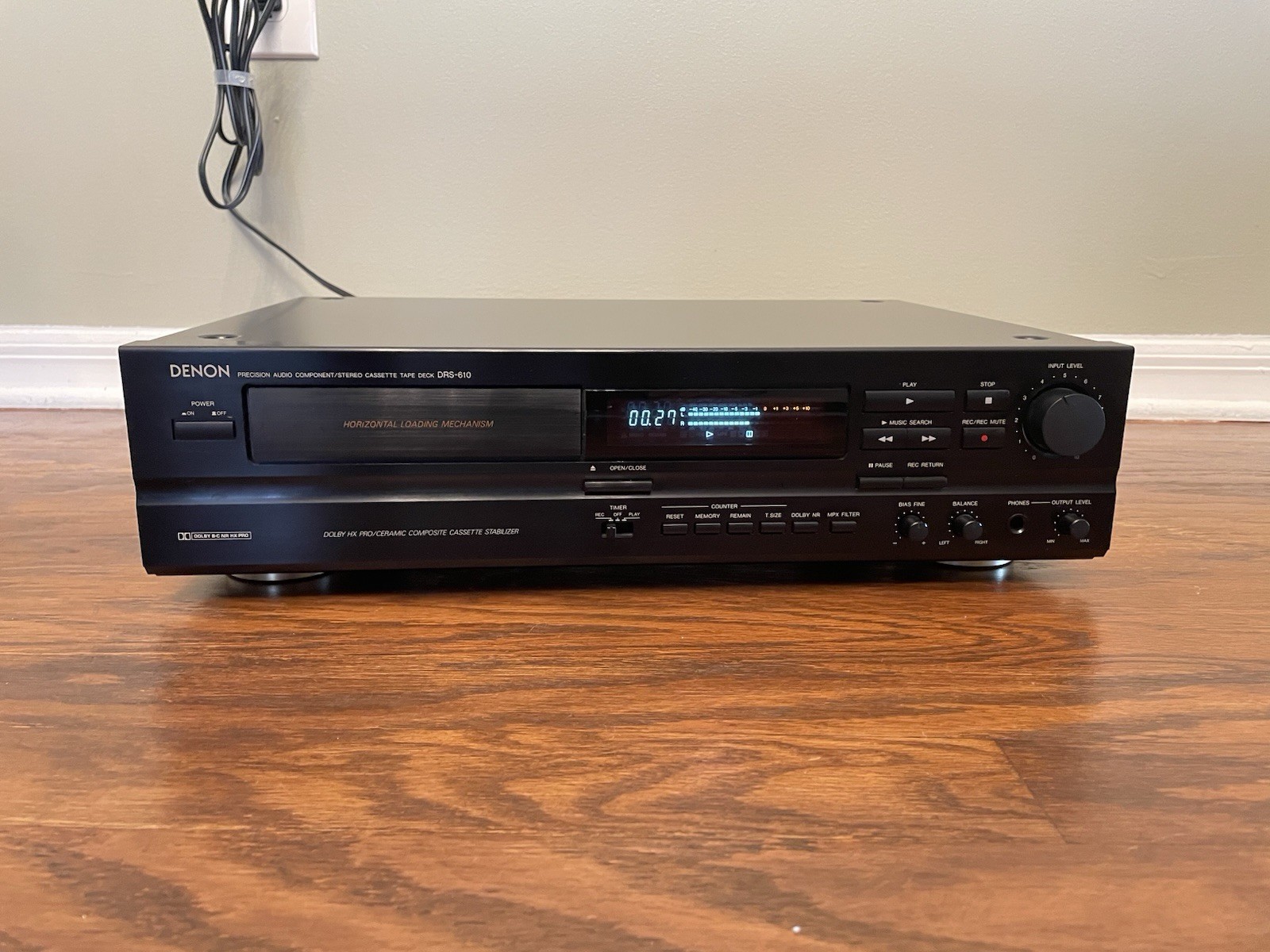
The Denon DRS-610 isn't a speaker stabilizer, despite persistent confusion from mislabeled web articles. It’s a 2-head, triple-motor cassette deck released in 1992 and manufactured through 1994, built with Denon’s characteristic attention to mechanical stability and signal integrity. At 4.4 kg, it sits with the heft of a machine meant to resist vibration—not through external gizmos, but through internal design: a tray-loading transport, ceramic composite cassette tray (C.C.C.T), and separate DC motors for capstan, reel, and loading systems. The 18-watt power draw reflects its robust motor array and discrete amplifier stages, while its width of approximately 434 mm fits standard rack bays. Marketed in black and nickel finishes and made in Japan, the DRS-610 was positioned as a high-quality, no-nonsense recorder for critical listening and dubbing, not a novelty add-on. Its name may invite confusion, but its construction places it firmly in the lineage of Denon’s serious audio hardware.
Triple-Motor Transport System
Denon equipped the DRS-610 with three dedicated DC motors—one each for the capstan, reels, and loading mechanism—ensuring consistent tape tension and smooth operation. This separation minimizes crosstalk and mechanical interference, a step above single-motor decks that rely on belts and clutches. The capstan motor is electronically controlled, contributing to stable speed regulation. Combined with a non-slip reel drive system, the transport maintains proper tape-to-head contact, reducing modulation noise and dropout risk. The tray-type horizontal loading mechanism further enhances stability by supporting the cassette during rotation, a design choice that also aids in flywheel-driven smoothness.
Ceramic Composite Cassette Tray (C.C.C.T)
Denon incorporated a ceramic composite material into both the cassette tray and the stabilizer component that presses against the tape, a feature branded as C.C.C.T. This material offers high rigidity and low resonance, helping to dampen micro-vibrations that can degrade high-frequency response. By reducing unwanted oscillations at the tape interface, the C.C.C.T system contributes to cleaner playback and more accurate azimuth alignment, especially during long recording sessions. This attention to mechanical damping reflects Denon’s broader engineering philosophy, seen across their turntables and amplifiers, of controlling physical variables to preserve signal purity.
Dolby B, C, and HX Pro Noise Reduction
The DRS-610 supports Dolby B and C noise reduction for hiss suppression across Type I (ferric), Type II (CrO₂), and Metal tapes, with a 3-level auto tape selector that detects tape type and adjusts bias accordingly. It also includes Dolby HX Pro, a non-dynamic headroom extension system that prevents over-biasing during high-frequency recording, allowing for cleaner transient capture without distortion. This trio of noise management technologies—standard on upper-mid-tier decks of the era—ensures high signal-to-noise ratio and extended dynamic range. Some owners note that the frequency response rolls off significantly in both bass and treble during playback, particularly on worn or poorly aligned units.
FL Bar Graph Peak Meters
Flanked by a linear time digital counter with memory stop, the DRS-610 features an FL (Fetron Liquid) bar graph peak meter capable of displaying levels from -40 dB to +10 dB with high precision. Unlike needle VU meters, the FL display responds quickly to transients, giving users accurate visual feedback during recording. The metering system is tied to a DC amplifier configuration in the recording and playback stages, which uses a ±2 power supply system to eliminate coupling capacitors and reduce phase shift. This design enhances low-frequency stability and transient response, aligning with Denon’s goal of minimal signal path interference.
Optical Pulse Reel Sensing
Instead of mechanical sensors that can wear or introduce drag, the DRS-610 uses an optical pulse detection method to monitor reel rotation. This non-contact system tracks tape movement without burdening the reel motors, preserving speed accuracy and reducing long-term wear. The digital counter, driven by this optical system, maintains accurate elapsed time even during pause or stop modes, and the memory stop function allows users to program recording endpoints—a useful feature for automated dubbing from LPs or radio broadcasts. However, common counter malfunction issues have been reported, often linked to common counter malfunction issues, requiring maintenance.
Historical Context
Released in 1992, the Denon DRS-610 entered the market as compact discs gained dominance, yet high-end cassette decks still held appeal for analog enthusiasts and home archivists. With its triple-motor drive, C.C.C.T tray, and comprehensive noise reduction, the DRS-610 represented Denon’s commitment to analog tape fidelity even as the industry pivoted to digital, offering a frequency response of 20 Hz to 19 kHz (±3 dB with metal tape) and wow and flutter of 0.055% WRMS (JIS), as measured under Japanese industrial standards. Priced at ¥43,000 (around 1991), it occupied a mid-premium tier—above mass-market portables but below flagship 3-head decks with dbx or Dolby S. Audio (October 1992, p.208) included the Denon DRS-610 in its survey of analog cassette decks, reflecting its presence in the high-fidelity market of the early 1990s. It shared its series designation with the somewhat better-equipped DRS-640, suggesting a focused product line for users prioritizing durability and precise tape control.
Collectibility & Value
The DRS-610 is not widely collected, but it maintains a quiet following among cassette deck enthusiasts who appreciate its robust build and clean signal path. Its all-metal construction and lack of complex microprocessor logic increase long-term reliability compared to fully automated competitors. Despite some owner reports of limited bandwidth, the deck was praised in period context—Hi-Fi Choice noted the DRS-610 "doesn't just offer value for money. It offers outstanding..." fidelity within its class, suggesting strong perceived performance at launch.
eBay Listings


As an eBay Partner, we earn from qualifying purchases. This helps support our independent vintage technology research.
Related Models
- Denon DR-M20 (1982)
- Akai GX-52 (1975)
- Akai GX-7 (1970)
- Akai GX-9 (1975)
- Akai GX-95 (1975)
- Akai GX-F35 (1977)
- Akai GX-F44R (1979)
- Akai GX-F66RC (1981)
- Akai GX-F71 (1979)
- Akai GX-F80 (1979)