Denon DR-M07
A no-frills cassette deck that traded flash for function—and delivered solid performance where it counted.
Overview
The Denon DR-M07 is a stereo cassette deck positioned as an entry-level model in Denon’s tape deck lineup during the late 1980s. Sources conflict on the production year, citing both 1987 and 1989, placing it in the era when compact cassettes had become a mature high-fidelity medium. At a time when many manufacturers were pushing feature-heavy designs, the DR-M07 took a minimalist approach—focusing on reliability, ease of use, and consistent playback without unnecessary complexity.
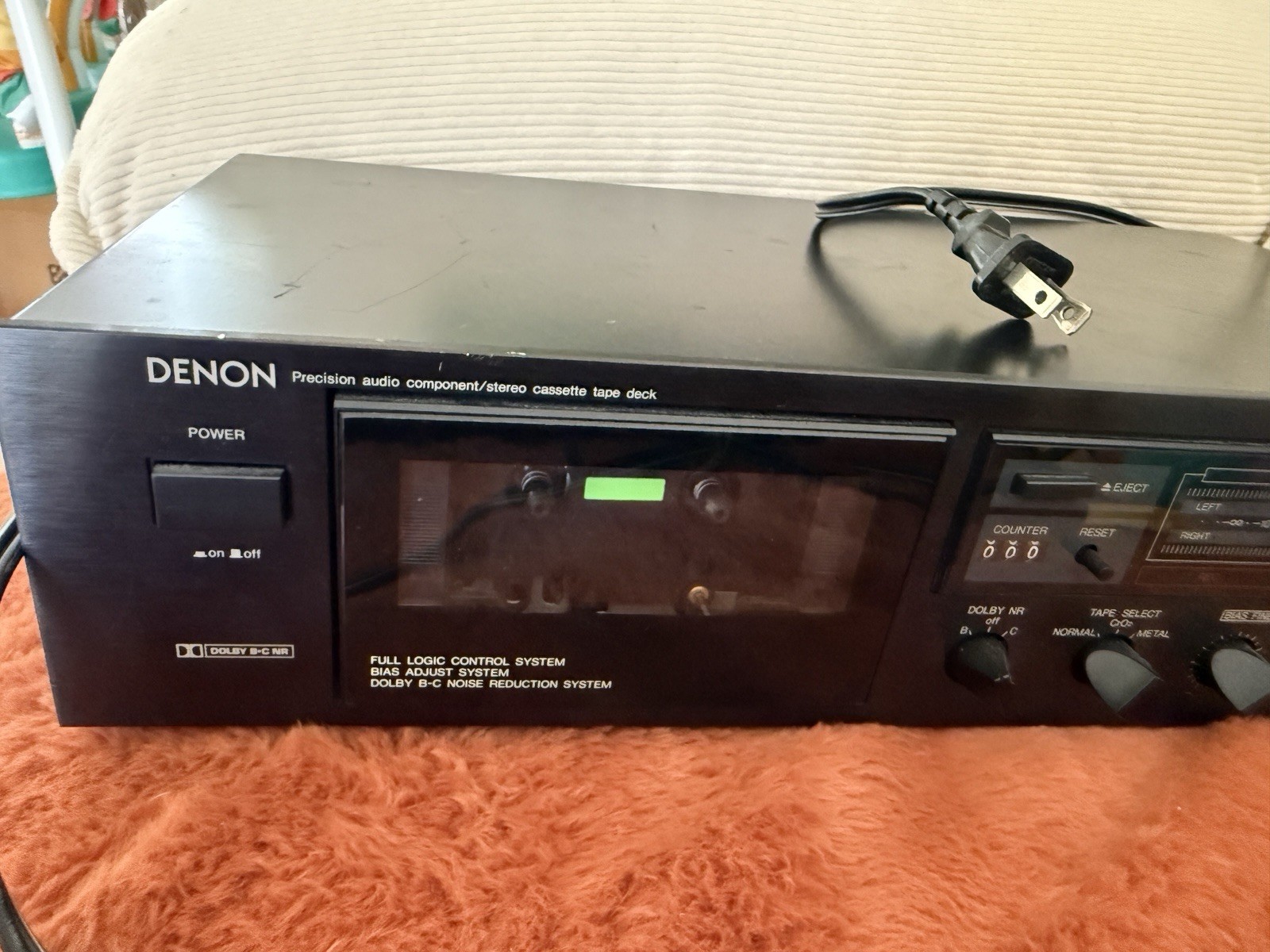
It employs a 2-head, single compact cassette transport with a 4-track, 2-channel configuration, standard for stereo cassette decks of the period, enabling full stereo recording and playback across both sides of the tape. The transport is built around full logic control, which automates functions like auto-stop and play/record sequencing, reducing mechanical wear and improving long-term durability, and includes Denon's proprietary transport design with solenoids mounted on the same circuit board as the logic circuitry to eliminate loose lead wires HiFI-Stereo (March 1987, p.17).
One of its standout features is the inclusion of both Dolby B/C noise reduction and HX Pro (Headroom Extension), a combination uncommon at this price point. HX Pro dynamically adjusts bias during high-frequency recording, preventing tape saturation and allowing cleaner, more detailed highs—especially on metal tapes. This made the DR-M07 particularly well-suited for recording from high-quality sources without distortion. Automatic tape type selection further simplified operation, eliminating the need for manual input when switching between ferric, chrome, or metal formulations. A mechanical 3-digit tape counter provided basic navigation,
Key Features
2-Head, Full Logic Transport with Automatic Tape Type Selection
The DR-M07 uses a 2-head system— This configuration was cost-effective but still offered reliable performance, with solenoids and logic circuitry integrated onto a shared board to minimize loose wiring and potential failure points. The full logic system ensured smooth transitions between play, stop, rewind, and fast-forward, while automatic tape type selection detected whether a Type I, II, or IV tape was inserted and adjusted bias accordingly. This feature, combined with manual bias trimming available on the DR-M07, allowed users to optimize recording levels for different tape types while maintaining ease of use for casual users.
Dolby B/C and HX Pro Noise Reduction
Noise reduction was central to the DR-M07’s design. Dolby B reduced high-frequency tape hiss, beneficial for standard ferric tapes, while Dolby C offered up to 20 dB of suppression, making it far more effective on CrO2 and metal tapes. The addition of HX Pro was a significant advantage: unlike noise reduction systems that operate during playback, HX Pro works during recording by reducing the bias signal when high-frequency content is detected, thereby increasing headroom and reducing distortion. This allowed the DR-M07 to capture more detail on metal tapes than most budget decks of the era, giving it a performance edge despite its modest positioning.
Mechanical 3-Digit Tape Counter
The tape counter is a simple mechanical unit with three digits, typical of mid-tier decks from the late 1980s. It advances based on reel rotation rather than elapsed time, so accuracy varies depending on tape speed and spool diameter. While not a real-time counter, it was sufficient for basic navigation—such as finding rough locations on a mixtape or setting a general stop point.
Reliable, Serviceable Design
Owners and technicians consistently describe the DR-M07 as one of the simplest, well-built, and most reliable cassette decks of the last 30 years. Its construction avoids overly complex mechanisms, favoring robust components and straightforward service access. A freely available service manual (via ManualsLib) and multiple repair videos on YouTube confirm that common maintenance—such as head cleaning, belt replacement, and capstan lubrication—can be performed with basic tools.
Historical Context
The DR-M07 emerged in the late 1980s, a transitional period in audio technology. Cassettes had reached their technical peak, competing directly with vinyl in many home systems, while digital formats like DAT were just beginning to appear. Denon, already respected for its precision turntables and amplifiers, applied that same engineering discipline to its cassette offerings—even at the entry level. It reflected a broader trend among Japanese manufacturers to ensure even budget components met a baseline standard of performance, particularly in noise reduction, frequency response, and mechanical reliability.
Collectibility & Value
The Denon DR-M07 is not considered a rare or high-value collectible, but working examples are increasingly sought after by analog enthusiasts and DIY repairers. As of late 2022, the top price observed on eBay was $95, Units with replaced belts, cleaned heads, and demagnetized tape paths command higher prices, especially if sold with original packaging or accessories. Given its reputation for reliability and the availability of repair resources—including a free service manual and multiple YouTube repair guides—it remains a practical choice for those rebuilding vintage systems or exploring analog tape recording.
eBay Listings
As an eBay Partner, we earn from qualifying purchases. This helps support our independent vintage technology research.
Related Models
- Denon DR-171 (1978)
- Denon DR-210 (1985)
- Denon DR-M22 (1981)
- Denon DR-M3 (1985)
- Denon DR-M33HX (1984)
- Infinity RS-IIA (1977)
- Sony TC PB5 (1970s)
- Infinity RS-4.5 (1978)
- Sony TC-K333ESG (1989)
- Sony TC-K333ESJ (1991)