Crown IC-150A (1976–1977)
At 9.1 kg and with a frequency sweep stretching to 100 kHz, this preamp doesn’t shout—until you hear how little it gets in the way.
Overview
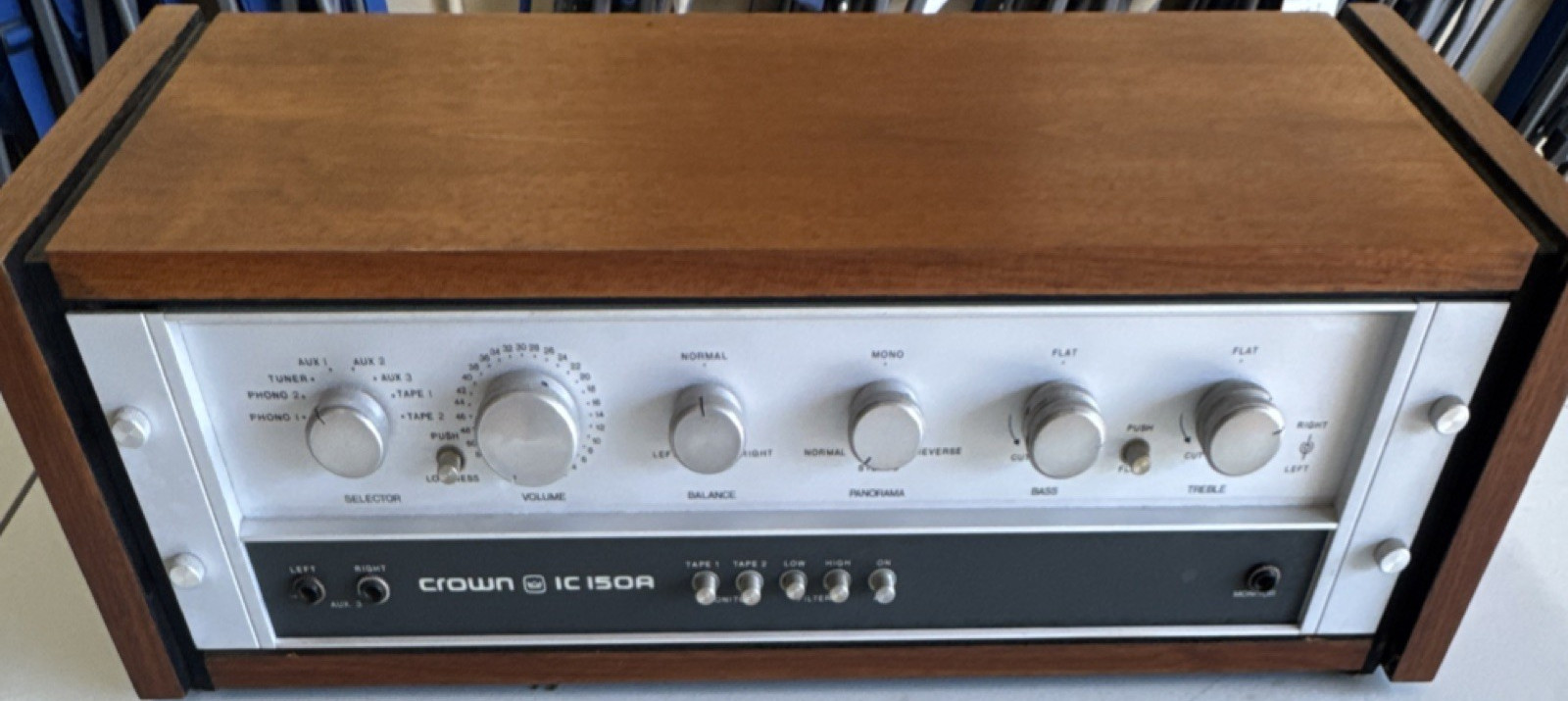
The Crown IC-150A isn’t the amplifier most collectors expect from Crown. , the IC-150A took a different path: precision, transparency, and surgical control. Released in limited numbers between 1976 and 1977, it was a solid-state stereo preamplifier aimed at high-end audiophiles and system integrators who demanded ultra-low distortion and flexible signal routing. Priced at $399 at launch—no small sum back then—it occupied a niche space, not as a flashy centerpiece but as a serious tool for those who wanted their system to disappear sonically.
Built as a control amplifier with extensive input options and a unique panorama system, it allowed users to manipulate stereo image placement in ways few preamps of the era could match.
Despite its low profile in mainstream vintage circles, the IC-150A has quietly earned respect among those who’ve used it. It wasn’t widely advertised or mass-produced, but its engineering pedigree—backed by Crown’s no-nonsense design philosophy—gave it staying power. Today, it surfaces occasionally in forums and auctions, often paired with its companion power amp, the D-150A, as part of a complete high-fidelity chain that still holds up.
Specifications
| Manufacturer | Crown International |
| Model | IC-150A |
| Type | Control amplifier / Preamplifier |
| Production years | 1976–1977 |
| Original price | $399 |
| Frequency response, High level | 3 Hz to 100 kHz ±0.6 dB |
| Frequency response, Phono | 10 Hz to 20 kHz ±0.1 dB |
| Input sensitivity/impedance, High level | 100k Ω |
| Input sensitivity/impedance, Phono | 0.75 mV (max) / 47k Ω |
| Gain, High level | 20.8 dB |
| Gain, Phono | 30 dB to 50 dB |
| Tone control, Bass | ±15 dB at 30 Hz |
| Tone control, Treble | ±15 dB at 15 kHz |
| Signal-to-noise ratio, High level | 95 dB |
| Signal-to-noise ratio, Phono | 85 dB |
| Total harmonic distortion | 0.05% or less (20 Hz – 20 kHz) |
| Filter, Low | 24 Hz, 6 dB/octave |
| Filter, High | 5 kHz, 12 dB/octave |
| Power requirements | 100 VAC, 50/60 Hz |
| Power consumption | 2 W |
| Dimensions (W x H x D) | 432 x 133 x 206 mm |
| Weight | 9.1 kg |
Key Features
Panorama Balance Control with Image Placement
Unlike a standard balance knob that merely shifts volume between channels, this system allowed continuous adjustment from normal stereo to mono, reverse stereo (left and right swapped), and everything in between. More than a gimmick, it gave users precise control over soundstage geometry—useful for optimizing speaker placement or compensating for asymmetrical room layouts. andEight Input Systems with Adjustable Phono Gain
The IC-150A offered eight input options, accommodating a wide range of sources. Two dedicated phono inputs supported magnetic cartridges with gain adjustable between 30 and 50 dB—ideal for matching different cartridge outputs without overdriving the stage. The remaining inputs included tuner, auxiliary, and tape loops, giving system builders flexibility. Input impedance for high-level sources was a high 100k Ω, minimizing loading effects on upstream gear.
Extended Frequency Response and Ultra-Low Distortion
With a high-level response stretching from 3 Hz to 100 kHz within ±0.6 dB, the IC-150A operated well beyond the audible spectrum. Paired with a total harmonic distortion rating of 0.05% or less across 20 Hz to 20 kHz, the result was a signal path so clean it practically vanished. The phono stage, optimized for RIAA compliance, maintained ±0.5 dB of RIAA accuracy, ensuring faithful vinyl playback.
Dedicated Tone and Filter Controls
The tone controls were unusually wide-ranging: ±15 dB at 30 Hz for bass and ±15 dB at 15 kHz for treble. These weren’t subtle trimmers—they allowed dramatic shaping when needed. Additionally, the IC-150A included switchable filters: a 6 dB/octave high-pass at 24 Hz to eliminate subsonic rumble, and a 12 dB/octave low-pass at 5 kHz to reduce high-frequency noise. These were particularly useful when playing older recordings or tapes with surface noise or hum. The combination of surgical filtering and powerful tone adjustment made the preamp adaptable to a wide range of source material and listening environments.
Collectibility & Value
The IC-150A has no broad market presence, but demand exists among Crown enthusiasts and vintage audio purists. A serviced unit paired with the D-150A power amp once carried an asking price of $1,150, suggesting strong value for fully restored examples. However, untested or uncleaned units typically sell for far less, reflecting the risks of age-related wear.
Common operational issues include speaker “womping” or oscillation, often traced to system interaction rather than the preamp itself. High noise or hum has been reported, though sources suggest this can sometimes stem from downstream equipment—such as a power amp with volume controls turned up too high when no signal is present. Maintenance typically involves a full service: cleaning of switches, potentiometers, and jacks, along with inspection of internal connections. Given its solid-state design and high-quality internal components, the IC-150A is generally reliable if kept clean and powered with stable voltage.
eBay Listings


As an eBay Partner, we earn from qualifying purchases. This helps support our independent vintage technology research.
Related Models
- Crown C-4 (1965)
- Crown CX-844 (1985)
- Crown D-150
- Crown D-150A (1975)
- Crown D-60 (1958)
- Denon POA-800 (1978)
- Eico 3150 (1967)
- Fisher CUSTOM-ELECTRA-I (K-14/K-15) (1957)
- Fisher CUSTOM-ELECTRA IV (E33/E44) (1960)
- Akai AM-2600 (1977)