Bose 501 Series I
A floor-standing Direct/Reflecting® speaker from the early 1970s that helped define Bose’s consumer audio identity—spacious, room-filling sound in a rectangular cabinet that demanded wall placement.
Overview
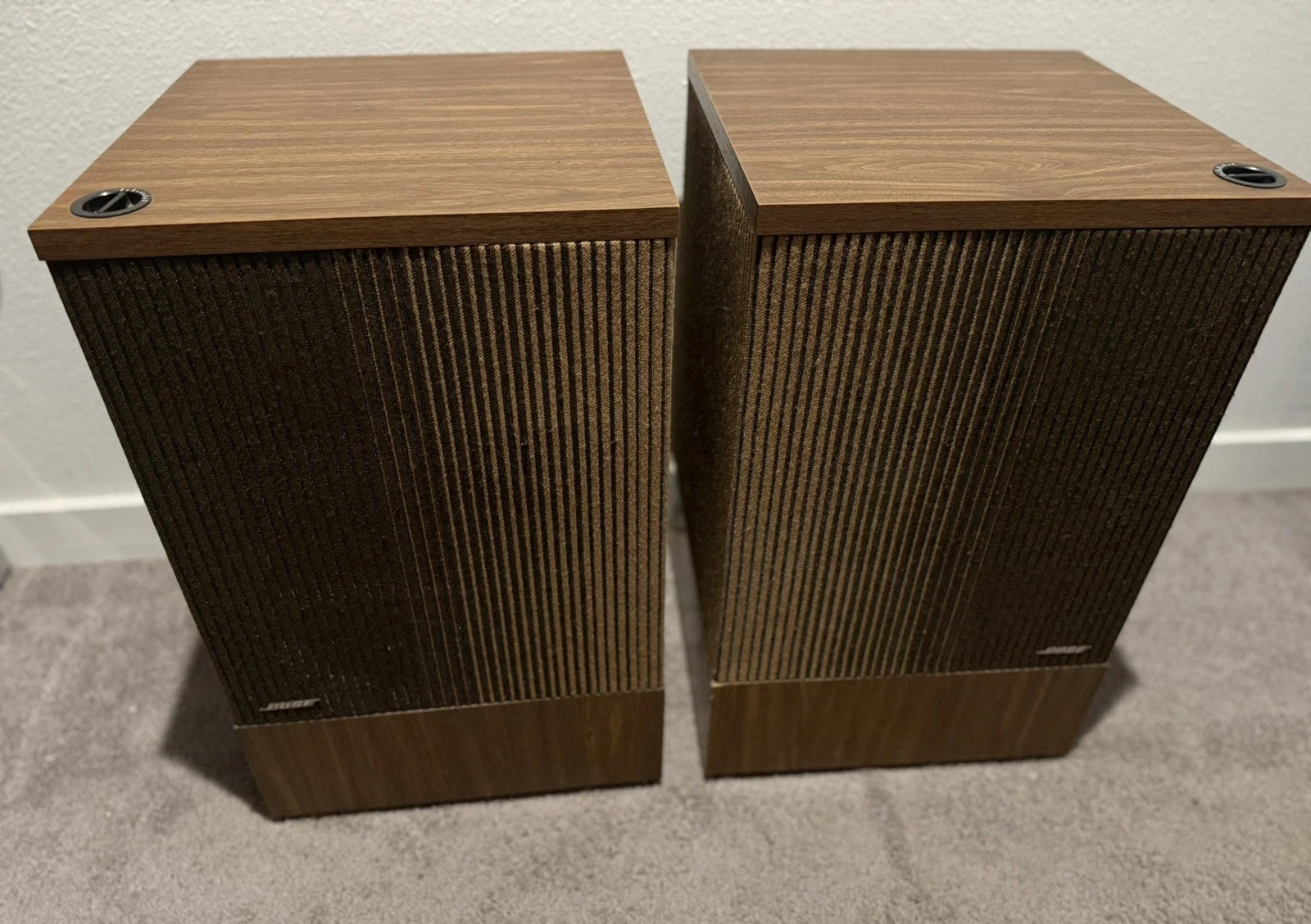
At first glance, the Bose 501 Series I doesn’t scream innovation—it’s a tall, rectangular speaker cabinet, unassuming in its proportions, but its design philosophy was anything but conventional. Introduced as one of the first mass-market loudspeakers from Bose Corporation, the 501 Series I brought the company’s research-driven approach to living rooms across America. Unlike the high-efficiency, showroom-friendly designs that dominated hi-fi retail spaces, this speaker was engineered specifically for real-world home environments, not dealer show floors. It belongs to the foundational 301/501 Series lineage that established Bose’s reputation for spacious, ambient sound reproduction through controlled direct and reflected energy. Owners report that the speaker’s performance hinges on proper placement: it needs to be positioned against a wall with at least 18 inches of clearance on each side to achieve its intended acoustic effect, a requirement that HiFi-Stereo (June 1974, p.101) noted was rarely met in typical audio shops, making home auditions essential.
The 501 Series I relies on a single 10-inch woofer, a size confirmed by the continued availability of foam surround repair kits explicitly labeled for compatibility with both the Series I and II models. This long-excursion driver operates within a ducted-port enclosure, a design choice aimed at reducing low-frequency distortion by managing cone excursion more effectively than a standard ported cabinet. While the exact frequency response and crossover points aren’t documented in surviving literature, the speaker’s voicing leans into Bose’s signature spaciousness rather than tight, analytical bass. It’s not a speaker for purists chasing pinpoint imaging, but rather for listeners who value an enveloping soundstage that mimics the natural reflections of live music in a room. The lack of detailed specs in period documentation suggests Bose prioritized perceptual results over technical bragging rights—a philosophy echoed in their marketing, which focused on listening experience rather than raw measurements.
10-Inch Long-Excursion Woofer with Ducted Port
The 10-inch woofer is the foundation of the 501 Series I’s low-end performance, tasked with delivering bass that supports the speaker’s ambient character. Its long-excursion design allows for greater cone movement, which, when paired with the ducted port, helps maintain control at lower frequencies. This combination was intended to minimize distortion during dynamic passages, a claim supported by HiFi-Stereo (May 1982, p.113), which noted the ducted-port enclosure “controls cone excursion for reduced low-frequency distortion.” While later Series III and IV models would refine this approach with updated crossover networks and driver materials, the Series I laid the groundwork with this core mechanical design. However, the foam surrounds on these woofers are now over 50 years old, and their deterioration is a well-documented failure mode—evidenced by the ongoing market for replacement foam kits from third-party suppliers like Springfield Speaker. Re-coning remains a common restoration path for surviving units.
Direct/Reflecting® Sound Dispersion
The defining trait of the 501 Series I is its Direct/Reflecting® design, which radiates sound both forward toward the listener and rearward into the room to create a more natural acoustic environment. This approach was a deliberate departure from the direct-radiating norm of the time, aiming to replicate the way sound behaves in real spaces by blending direct and reflected energy. The speaker was never meant to be evaluated in isolation or in a dead room; its performance unfolds when integrated into a typical domestic setting. HiFi-Stereo (June 1974, p.101) emphasized that “very few people have really heard the new BOSE 501 SERIES II” because most dealers couldn’t replicate the home conditions it required—underscoring that the Series I, as its predecessor, shared this same dependency on proper room integration. Critics at the time noted that while the imaging wasn’t “pinpoint,” the soundstage was convincingly wide and immersive, particularly with vocal and pop recordings.
Historical Context
The Bose 501 Series I was produced from 1971 to 1977, placing it at the dawn of Bose’s consumer speaker line. It was one of the first models the company designed specifically for mass-market appeal, bridging the gap between academic acoustic research and practical home audio. Alongside the 301 and later iterations of the 501, it formed the core of Bose’s early identity, helping establish the brand as a serious player in the high-fidelity market. These speakers were not just commercial products—they were statements of a different audio philosophy, one that prioritized perceived realism over traditional metrics like flat frequency response or high sensitivity. The 501 Series I’s success paved the way for the more refined Series III and IV models, which would go on to become design icons of the 1980s.
Collectibility & Value
Sold for $575 as a pair in October 2011 according to an Audio-Ho-Ho listing, the 501 Series I has not appreciated significantly in value, with current restoration-grade pairs listed around $289. Their collectibility hinges more on historical significance than sonic superiority—enthusiasts seek them as artifacts of Bose’s early innovation rather than as daily drivers. The continued availability of replacement woofers and foam surround kits indicates a modest but persistent support ecosystem, though full restoration requires careful sourcing of vintage components. Units often surface mislabeled—as one buyer discovered when picking up a pair advertised as “Bose S01s”—highlighting the need for vigilance in the secondhand market. Given their age, most surviving examples will require at least surround replacement to perform as intended.
eBay Listings


As an eBay Partner, we earn from qualifying purchases. This helps support our independent vintage technology research.