Bang & Olufsen M70 (1978)
At 25 kilograms and standing over half a meter tall, the Beovox M70 announces itself not with flash, but with presence — a sculptural statement in Danish audio design.
Overview
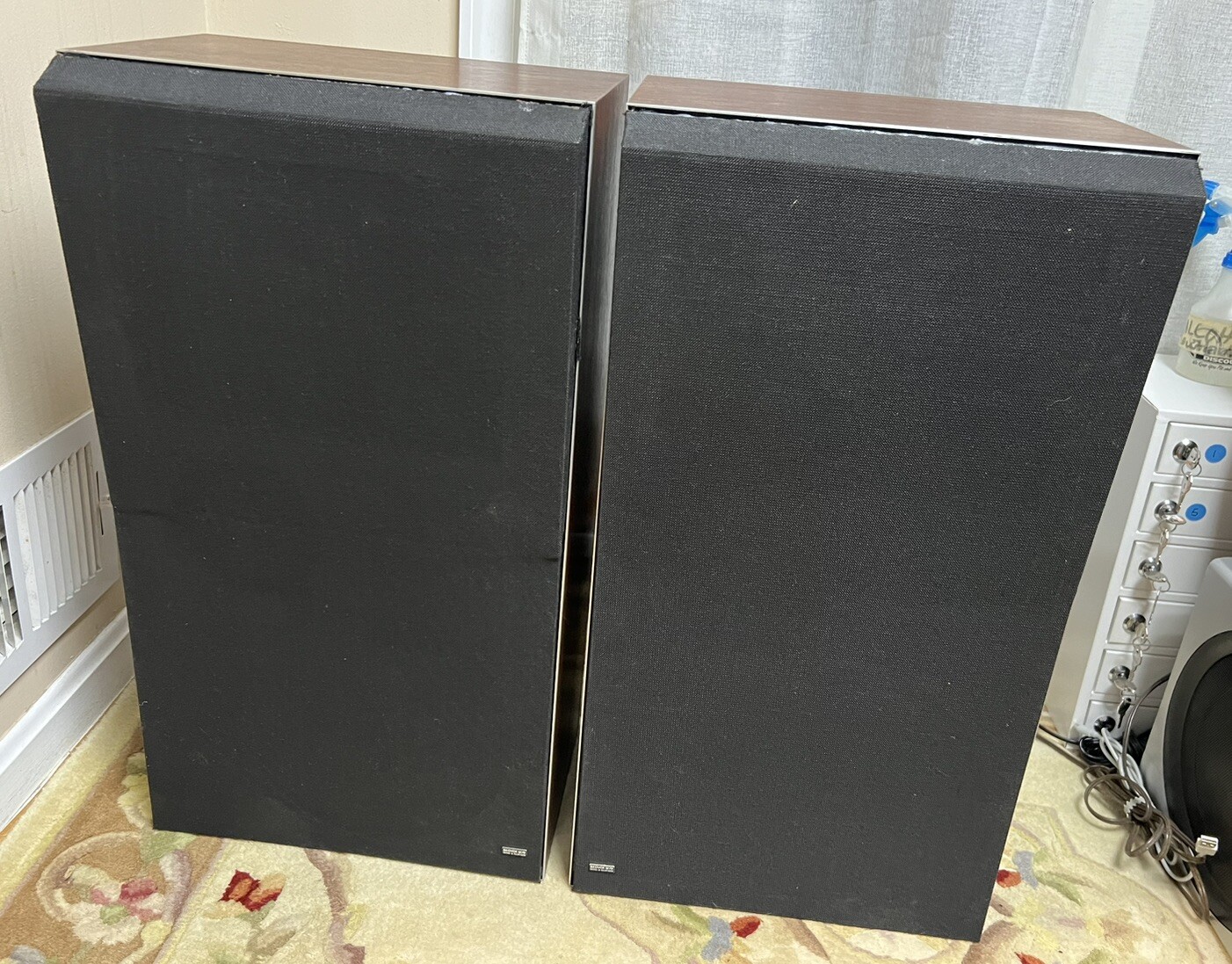
The Bang & Olufsen Beovox M70 is a floor-standing loudspeaker system introduced in 1978, designed to deliver high-fidelity sound through a carefully engineered multi-driver array and innovative crossover topology. Contrary to some mislabeling in the secondhand market, the M70 is not an amplifier or receiver, but a passive speaker system — one that reflects B&O’s growing interest in time-aligned acoustics and phase coherence during the mid-to-late 1970s. The system features a 10-inch (25 cm) woofer, a 2.1-inch (5.75 cm) midrange driver, and a 1-inch (2.5 cm) tweeter, all mounted on an angled front baffle intended to optimize time alignment between drivers. This configuration supports a frequency range of 38 Hz to 20,000 Hz (±4 dB), allowing for deep bass extension and crisp high-frequency reproduction. The nominal impedance is 4 ohms, and the system is rated to handle a music load of up to 100 watts per cabinet, making it suitable for pairing with robust amplification of the era.
One of the M70’s defining technical traits is its crossover design, which departs from conventional low-pass and high-pass filters in favor of a bandpass-oriented network. This approach, as noted in contemporary analysis, contributes to smoother driver integration and reduced phase distortion across the audible spectrum. Audio (May 1978, p.66) described the crossover as “newly devised” and emphasized its role in achieving coherent wavefront delivery. The angled front panel further enhances this time-alignment strategy, with driver placement calculated to ensure that sound from each unit reaches the listener simultaneously. Modern Recording (December 1976, p.54) observed that this design minimizes phase anomalies, particularly in the critical midrange, where human hearing is most sensitive.
Physically, the M70 measures 35 cm wide, 65 cm high, and 29 cm deep, with a weight of 25 kg per speaker. The cabinet design is both functional and minimalist, consistent with B&O’s aesthetic language of the period. The system was supplied with a detachable 14-foot cable, allowing for flexible placement while maintaining clean connections to the amplifier. High Fidelity (February 1976, p.67) noted that the M70 was often used with a matching stand, elevating the speaker to an optimal listening height of 39.5 inches. The same review cited a price of $700 per pair at launch, while Audio (May 1978, p.66) listed the price as $790 — a discrepancy likely due to regional pricing or later revisions. Both figures reflect the M70’s positioning as a premium product in B&O’s lineup.
Owners report consistently smooth impedance behavior across the audio band, with an average slightly above 4 ohms and unusual stability beyond the typical bass resonance rise. Modern Recording (December 1976, p.55) measured the impedance curve as “unusually smooth,” suggesting well-matched driver and crossover design. The same source tested dispersion over a broad angle, finding minimal directional effects below 10,000 Hz — a benefit for off-axis listening and room integration. In practice, this translates to a speaker that performs well in varied seating arrangements, without the “sweet spot” limitations of some contemporary designs.
The Beovox M70 was marketed as part of B&O’s broader ecosystem of high-end audio components, though it lacks the proprietary Beolink control interface found in later systems. It was intended for use with quality external amplification, and its 4-ohm rating suggests compatibility with higher-current receivers of the period, such as the Beomaster 3000-2 or Beomaster 7002. While not part of a modular wall system like some B&O components, the M70’s design language — with its clean lines and restrained detailing — allows it to integrate visually into a curated hi-fi setup.
eBay Listings

As an eBay Partner, we earn from qualifying purchases. This helps support our independent vintage technology research.
Related Models
- Bang & Olufsen BEOMASTER 3000-2
- Bang & Olufsen BEOMASTER 4000
- Bang & Olufsen 7002 (1978)
- Bang & Olufsen M100/2 (1974)
- Bang & Olufsen Beomaster 2600 (1977)
- Teac A-460 (1975)
- Akai AM-16 (1975)
- Realistic STA-47 (1976)
- Teac A-3300 (1972)
- Teac A-3300S (1975)