Akai GX-365 (1975)
Overview
The Akai GX-365 isn’t just another open-reel deck—it’s a statement of intent from a company that refused to compromise. Released in 1975, this dual-capstan, 3-head tape recorder was engineered for serious audiophiles, semi-professional studios, and broadcast engineers who demanded precision, reliability, and sonic neutrality. Unlike consumer-grade recorders of the era, the GX-365 sits firmly in the prosumer tier, offering performance that bordered on professional standards without the six-figure price tag. Owners report a build quality that feels industrial, with a heft and damping that suggests it was designed to survive decades of daily use. It wasn’t trying to impress with flashy features; it aimed to disappear into the signal chain, letting the music speak for itself.
While not as widely recognized today as Revox or Sony equivalents, the GX-365 earned a loyal following for its transparent sound, advanced transport, and meticulous engineering. It was positioned above Akai’s popular GX-260 and GX-635 models, serving as the pinnacle of their consumer/prosumer line. The deck was designed to handle everything from master tape duplication to live concert recording, and its reputation for low wow and flutter, wide frequency response, and stable operation made it a favorite among those who valued accuracy over coloration.
Three-Motor, Three-Head Precision
The GX-365’s 3-head configuration—separate erase, record, and playback heads—isn’t just for show. It enables real-time monitoring with precise azimuth alignment, a critical advantage for critical recording work. Unlike machines that rely on a single head for multiple functions, this setup minimizes crosstalk and ensures the playback signal isn’t contaminated by the record or erase fields. The heads themselves are no ordinary iron cores—they’re Akai’s proprietary Glass & Crystal Ferrite design, a technology the company claimed was “wear free” and “dust free” thanks to a surface composed of glass and single-crystal ferrite. According to Studio-Sound (January 1971, p.14), this head was guaranteed for over 150,000 hours of service life, a bold claim that reflected Akai’s confidence in its material science. The core uses single-crystal ferrite, a material superior to conventional permalloy, and was originally developed for video tape recorders before being adapted for audio. This focus field recording system was said to deliver exceptional high-frequency response and reduced signal degradation over time.
Dual-Capstan Transport with Hysteresis Motor
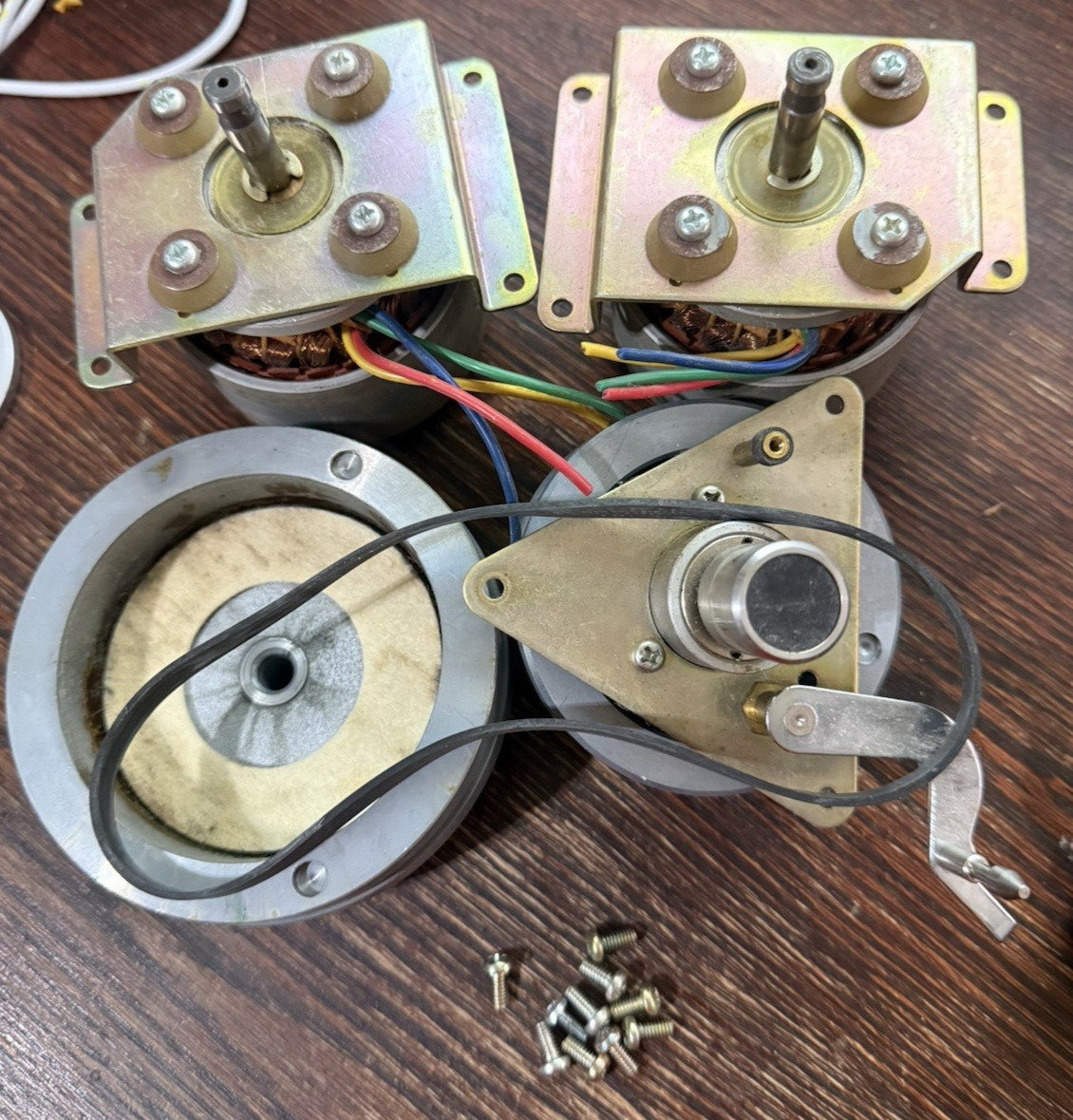
One of the GX-365’s most distinctive engineering choices is its dual-capstan transport system, featuring both a drive capstan and an idler capstan. This design maintains constant tape-to-head contact, drastically reducing speed fluctuations and wow and flutter. Measured at 0.04% RMS or less at 19 cm/s (7.5 ips), the speed stability rivals that of far more expensive professional decks. The capstan is driven by a hysteresis synchronous 3-speed motor, known for its smooth operation and minimal vibration. Unlike belt-driven systems that degrade over time, this direct-drive approach contributes to long-term reliability. The two outer rotor motors handling the supply and take-up reels are eddy current types, providing consistent tension without the need for clutches or belts. Collectors note that while the system is robust, the rubber and steel pinch rollers require periodic inspection—hardened rollers or worn idler tires can compromise the very stability the design was meant to ensure.
Extended Tape Speeds and 4-Track Flexibility
While many sources list the GX-365 as supporting only 7.5 and 15 ips, the full specification reveals a broader capability: 4.75, 9.5, 19, and 38 cm/s (1⅞, 3¾, 7½, and 15 ips), with the higher speed achievable using an optional adapter. This 4-speed flexibility allowed users to optimize tape usage and fidelity based on application—slower speeds for long-duration recordings, faster ones for mastering. The deck supports 4-track stereo/monaural recording, meaning it can lay down two tracks in each direction on a ¼" tape, enabling bidirectional recording without flipping reels. This system, combined with selectable NAB equalization (120µs and 70µs), lets users match the deck to a wide range of tape formulations, from standard ferric to high-energy chromium dioxide. The recording bias frequency is fixed at 100 kHz, a standard for high-quality analog decks of the era.
Frequency Response and Signal Fidelity
At 19 cm/s (7.5 ips), the GX-365 delivers a frequency response of 30 Hz to 28 kHz ±3 dB, extending well beyond the limits of most consumer electronics. Even at 9.5 cm/s (3¾ ips), it maintains a respectable 30 Hz to 23 kHz, making it suitable for high-fidelity playback in all modes. The signal-to-noise ratio is rated at 55 dB or more at 19 cm/s, —a feature standard on the unit. Total harmonic distortion is kept to 1.5% or less at 1 kHz and 0 VU, a figure that reflects clean, uncolored amplification. The crosstalk performance is equally impressive: 70 dB or less in mono mode, 45 dB or less in stereo, ensuring tight channel separation and precise imaging. The erase ratio is specified at -70 dB or less, minimizing residual signal from previous recordings.
Input and Output Connectivity
The GX-365 offers a comprehensive set of inputs and outputs for its time. Line input sensitivity is 70 mV with an impedance of 150 kΩ, suitable for connection to preamps or tuners. A dedicated microphone input accepts 0.7 mV at 10 kΩ, allowing direct mic recording without external preamps. The DIN input offers both high (70 mV) and low (7 mV) sensitivity options, accommodating a range of source equipment. On the output side, the line-level signal delivers 1.23 V at 0 VU into a 100 Ω load, while the headphone output provides 30–40 mV into 8 Ω. The DIN output is rated at 0.4 V. While balanced XLR connections were available on some variants, the standard model relies on RCA and DIN connectors.
Robust Chassis and Operational Details
Housed in a chassis measuring 440 mm wide, 165 mm high, and 380 mm deep, the GX-365 occupies serious real estate—this is not a compact desktop unit. It weighs in at 27.7 kg (61 lbs), a mass that contributes to vibration resistance and mechanical stability. The front panel features dual VU meters for level monitoring, a large tape counter with reset function, and clearly labeled controls for transport and mode selection. Fast forward and rewind times are approximately 60 seconds for a 370-meter tape at 60 Hz, 75 seconds at 50 Hz, indicating strong motor torque. The maximum reel size supported is 7 inches, standard for professional applications. Power consumption ranges from 70 to 200 watts depending on operation mode, and the unit supports 100–240 VAC at 50/60 Hz, making it adaptable to global voltages without modification.
Historical Context
Akai, founded in 1946, had by the mid-1970s established itself as a serious contender in the high-end audio market. The GX-365 represented the peak of their consumer/prosumer engineering, designed to compete with European and American offerings while maintaining Japanese build discipline. Though not as widely known as contemporaries from Sony or Revox, the GX-365 was marketed as a “professional stereo tape recorder” capable of studio-grade results. Its introduction in 1975 placed it at the height of the analog tape era, just before the rise of compact cassette and digital recording. The deck’s focus on durability, low maintenance, and long service life reflected Akai’s broader philosophy: build it once, build it right.
Collectibility & Value
Well-maintained, fully serviced GX-365 units typically sell for $800 to $1,500, with prices influenced by condition, completeness, and provenance. Units with original boxes, manuals, and unmodified internals command premium values, especially if they include rare options like the RC-16 remote control. The dual-capstan design and robust construction make it a favorite for restoration projects and high-end analog setups. However, potential buyers should be aware of common age-related issues: rubber components like pinch rollers and idler tires can harden or crack, leading to speed instability. The reel table bearings may wear over decades, causing wobble or uneven winding. Oxide buildup on heads and guides is inevitable and requires regular cleaning with isopropyl alcohol. Demagnetizing the tape path every few months is recommended. Electrolytic capacitors in the power supply and audio circuits often need replacement after 50 years, and a full recap by a qualified technician is advisable before extended use. Service manuals are available online, easing the restoration process.
eBay Listings


As an eBay Partner, we earn from qualifying purchases. This helps support our independent vintage technology research.
Related Models
- Akai AA-6200 (1975)
- Akai AA-R30 (1978)
- Akai AM-65 (1975)
- Akai AM-A-200 (1979)
- Akai AM-U-1 (1975)
- Quad 44/405-COMBINATION (1976)
- Braun AUDIO-1 (1965)
- Braun AUDIO-250 (1965)
- Braun AUDIO-310 (1965)
- Magnavox Component Systems (1972)