Advent Large Loudspeaker (1970–1981)
At approximately 35 pounds and with a price tag under $120, this speaker delivered acoustic suspension bass that rivaled systems twice its cost — but that quirky "fried egg" tweeter demands patience.
Overview
The Advent Large Loudspeaker didn’t whisper its arrival — it announced itself with a thump, a midrange warmth that made voices sound like they were in the room, and a price so low it made high-end audio accessible to anyone with a decent receiver and a stack of LPs. It was meant to sell, and sell fast. What emerged was something more: a two-way direct-radiator loudspeaker that combined acoustic suspension engineering with cost-conscious materials to deliver performance that shocked reviewers and consumers alike. Priced at $116 each for the walnut veneer version in 1971, it undercut the revered Acoustic Research AR-3a by more than half while offering comparable bass extension and higher output.
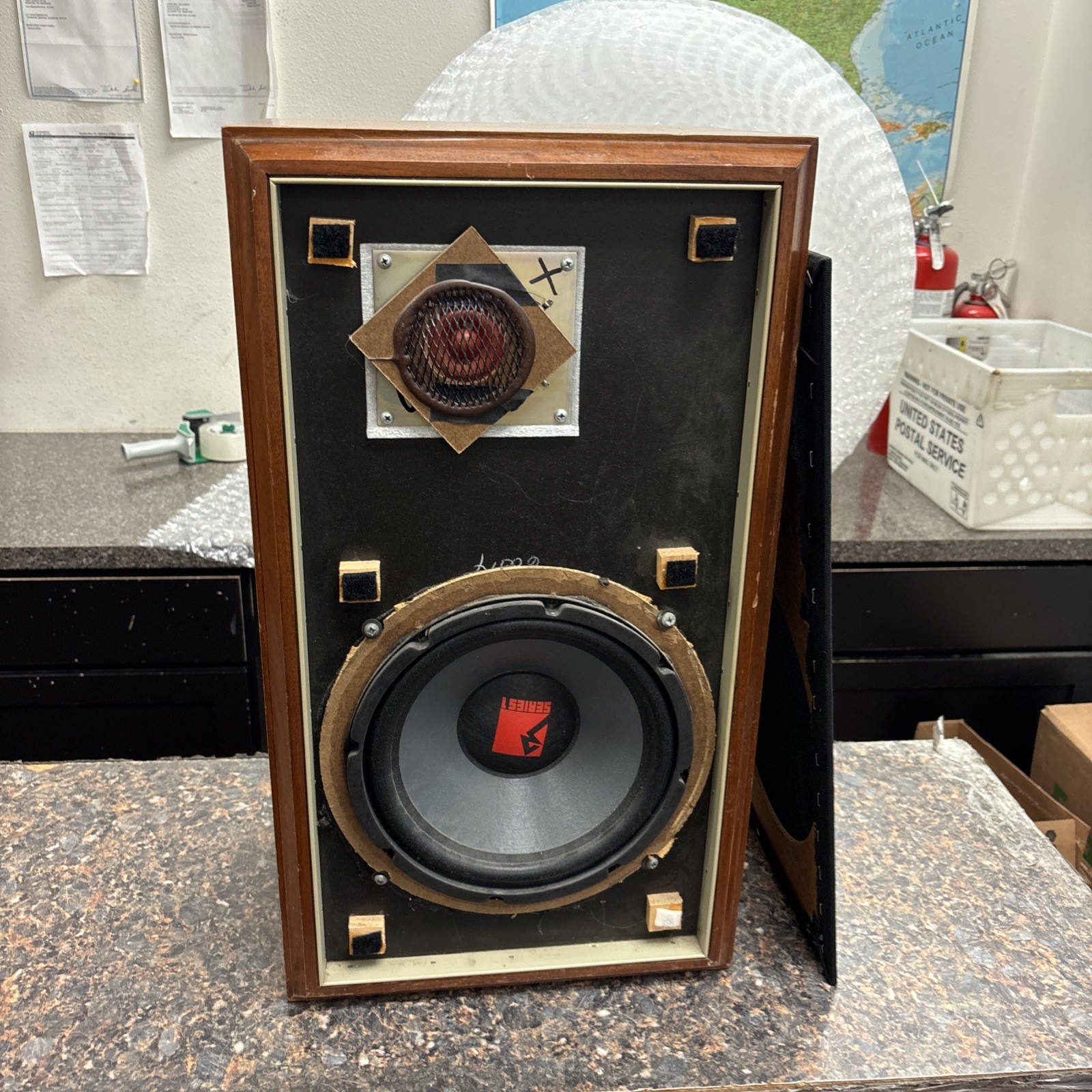
Housed in a sealed cabinet, the Large Advent used a 10-inch paper cone woofer with a foam surround and a peculiar 3-inch paper cone "domed" midrange-tweeter — affectionately (and sometimes derisively) nicknamed the “fried egg” due to its protruding dust cap and square magnet structure. This wasn’t a tweeter in the modern sense; it was a full-range driver handling all frequencies above 1 kHz, which meant it operated under significant strain. The crossover was basic: first-order, with a single capacitor feeding the tweeter and an inductor on the woofer side. Despite its simplicity, the system was carefully voiced to deliver a slightly warm, forgiving character that flattered less-than-perfect recordings — a trait that endeared it to college dorms, suburban dens, and first-time audiophiles.
Rated at 100W program power and presenting an 8-ohm load, the Large Advent was easy to drive, responding well to modest solid-state receivers and even lower-powered tube amps. Its box resonance sat around 43 Hz, allowing it to produce deep, controlled bass without porting — a hallmark of acoustic suspension design. While it lacked the airy top end of electrostatics or the precision of later dome tweeters, its midrange presence and rhythmic punch gave it a musicality that many still chase today. Positioned as Advent’s flagship until the New Large Advent arrived in the late 1970s, it sat above the Smaller Advent and below the short-lived Advent/3, defining the brand’s sound for over a decade.
Key Features
10-Inch Paper Cone Woofer with Foam Surround
The 10-inch woofer is the engine of the Large Advent’s appeal. The foam, however, is the Achilles’ heel — after 50 years, original surrounds are almost certainly degraded, leading to flapping, distortion, or complete failure. Re-coning is standard practice today, with costs ranging from $80 to $120 per driver. While modern replacements can restore performance, some argue they lose the slight softness that contributed to the speaker’s forgiving nature. The woofer’s ability to reach down to approximately 43 Hz in-room made it a standout at its price point, especially when paired with the acoustic suspension topology that minimized time-domain errors.
3-Inch “Fried Egg” Midrange-Tweeter
There’s no avoiding it: the 3-inch “fried egg” tweeter is both the soul and the liability of the Large Advent. Handling all frequencies above 1 kHz, it operates far outside the ideal range for a cone driver, resulting in limited high-frequency extension — rarely exceeding 16 kHz — and dispersion that narrows significantly off-axis. Ferrofluid wasn’t used, so voice coils are prone to overheating under sustained high-level playback, and failed tweeters are common in unrestored units. Yet, in its prime, the driver offered a natural, slightly forward character between 1–3 kHz that brought vocals and acoustic instruments into sharp focus. The rear-panel tweeter level switch — offering flat, +3 dB, and –3 dB settings — isn’t decorative; it’s essential for tailoring the speaker to room acoustics. In bright environments, the –3 dB setting tames glare; in duller rooms, the boost helps maintain presence. Purists argue that no modern replacement captures the original’s character, and NOS units can command over $100 each when they surface.
First-Order Crossover with Electrolytic Capacitors and Sandcast Resistors
The crossover is a study in minimalism: a single capacitor on the tweeter and an inductor on the woofer, forming a first-order (6 dB/octave) filter at 1 kHz. Kloss favored this approach for its transient accuracy and lack of phase distortion, believing that fewer components meant less coloration. But the original components weren’t built to last. Electrolytic capacitors dry out over decades, sandcast resistors drift in value, and inductors can corrode at the terminals. A full recapping is not optional for critical listening — it’s mandatory. DIY rebuilds are common, but choices matter: modern polypropylene capacitors and metal-film resistors tighten the bass and clarify the mids, but some owners report a loss of the original’s forgiving warmth. Original-spec replacements are preferred for authenticity, though sourcing them requires digging into vintage parts suppliers.
Acoustic Suspension Sealed Cabinet
The sealed enclosure is central to the Large Advent’s performance. By eliminating ports, Kloss avoided the time-smearing and chuffing associated with bass reflex designs, resulting in tighter, more accurate low-end response. The cabinet’s resonance, tuned to approximately 43 Hz with the woofer, allowed deep bass without the need for equalization or heroic amplifier control. However, acoustic suspension demands large cabinets for deep extension, and The Large Advent’s dimensions reflect that compromise. The cabinets were offered in walnut veneer, a vinyl-covered “utility” version, and an unfinished option for custom finishes. Structural integrity is key: these speakers weigh around 35 pounds each, and warping or water damage can compromise internal damping and driver alignment.
Historical Context
The Advent Large Loudspeaker arrived at a pivotal moment in American audio. The late 1960s and early 1970s saw high-fidelity moving from niche hobbyist circles into mainstream living rooms, driven by the LP boom and the rise of stereo broadcasting. KLH and Acoustic Research had already proven there was demand for well-engineered, affordable speakers, but the AR-3a remained expensive. Kloss, needing revenue after a failed TV venture, applied his expertise in acoustic suspension to create a speaker that borrowed AR’s principles but simplified construction and reduced cost. The result was a product that reviewers praised for its bass performance and value.
By the mid-1970s, the Large Advent faced growing competition from Japanese brands like Pioneer, Sony, and Yamaha, which offered tighter manufacturing tolerances and flashier aesthetics. Advent responded with the New Large Advent, featuring a more conventional tweeter and updated crossover, but the original had already cemented its legacy. It wasn’t just a speaker — it was a democratizing force, proving that serious sound didn’t require serious wealth. Even as Advent Corporation closed its Cambridge factory in 1979 and filed for bankruptcy in 1981, the Large Advent remained a cult favorite, a symbol of an era when innovation and accessibility collided.
Collectibility & Value
Today, the original Advent Large Loudspeaker is a project as much as a product. Unrestored pairs typically sell for $100–$200, often snapped up by DIYers planning full rebuilds. A pair with original, working drivers, intact veneer, and clean grills — assuming it has been recapped and reconed — might fetch $250–$400. Listings claiming “fully restored” for $600 or more are aspirational and rarely reflect actual transaction data. Tracking completed eBay sales shows most pairs changing hands in the $150–$300 range, depending on condition and location.
Buyers should assume foam surrounds need replacement and budget accordingly. The “fried egg” tweeters are another weak point — voice coils burn out, and replacements are scarce. Inspecting the cabinet for warping or water damage is essential, as these heavy speakers suffer in poor storage. The rear-panel balance switch should be checked for crackling; dirty switches can be cleaned, but broken ones are difficult to source. Photos of the crossover are critical: original sandcast resistors and electrolytic capacitors are expected, but signs of prior repair (like modern wire or heat-shrink tubing) indicate previous work that may not have been done to spec. For those unwilling to restore, buying from honest sellers who disclose all issues is the only safe path. These aren’t museum pieces — they’re working classics that demand attention, but for the right listener, they still deliver a uniquely engaging sound.
eBay Listings


As an eBay Partner, we earn from qualifying purchases. This helps support our independent vintage technology research.