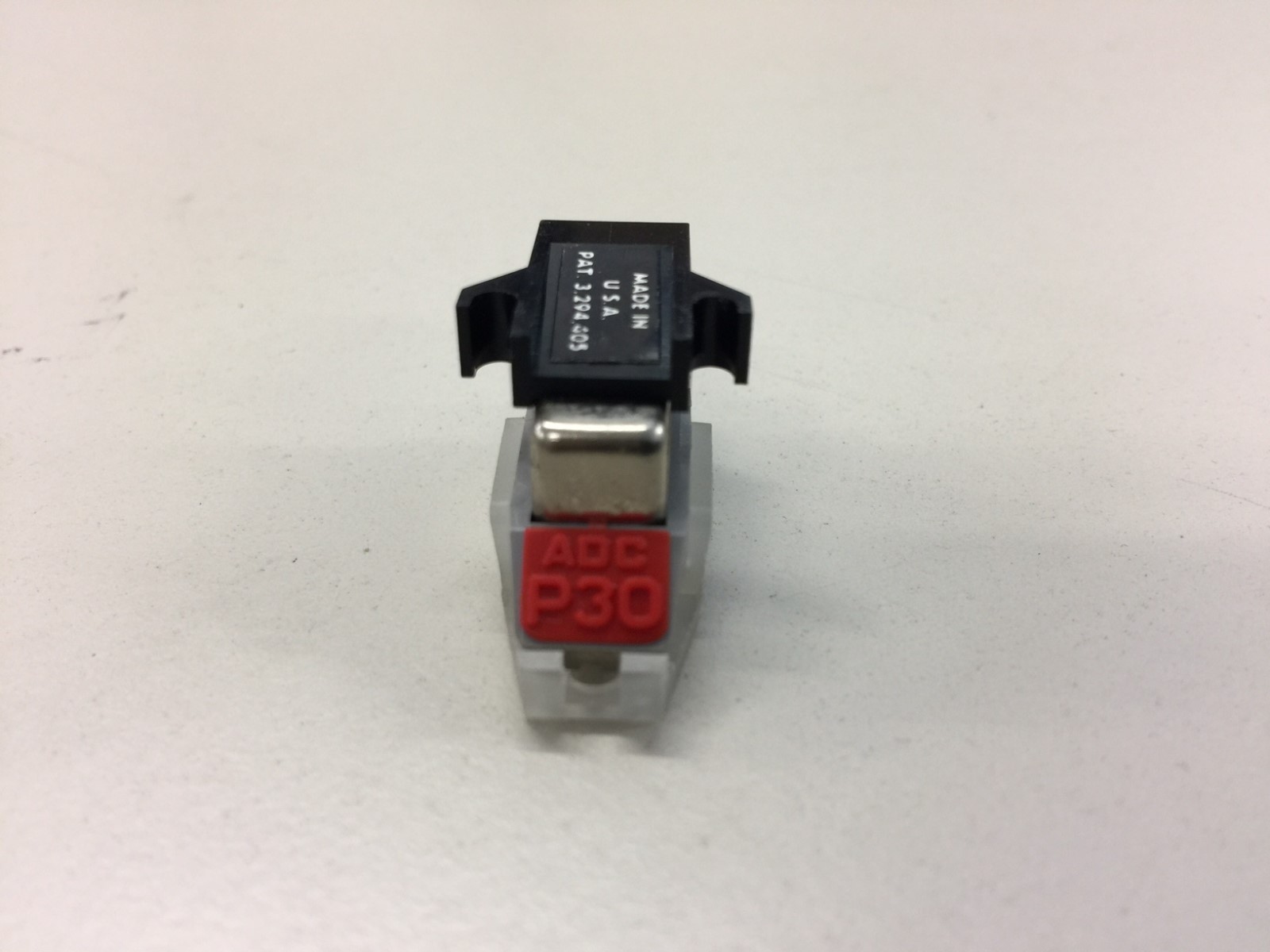
ADC P30 (1975–1978)
That satisfying click when the tonearm drops and you know the groove’s about to sing — this little Japanese-built MM cartridge was there for thousands of living rooms in the mid-70s.
Overview
The ADC P30 isn’t flashy, but it’s got that quiet confidence of a tool built to do one job well: translating vinyl into sound without drama. Made in Japan between 1975 and 1978, it arrived during a time when moving magnet cartridges were becoming the standard for solid, reliable playback — and the P30 fits right into that wave. At its launch, it retailed for 35 DM at SATURN in Köln, a mid-tier price that suggests it was aimed at serious listeners who didn’t need flagship specs but still wanted quality. It’s not a high-end unicorn, but it’s not disposable either — it’s the kind of cartridge you’d find mounted on a Dual or Technics turntable in a well-kept hi-fi setup.
Operating on the induced magnet (moving iron) principle, the P30 outputs a healthy 5.5 mV, which means it plays nice with most standard MM phono preamps without asking for special loading or extra gain. Its frequency response stretches from 15 Hz to 18,000 Hz within ±3 dB, which was respectable for the era — not ruler-flat by modern lab standards, but more than capable of delivering warm, full-bodied analog character. Channel separation checks in at 22 dB, which won’t fool anyone into thinking it’s quadraphonic, but it’s enough to keep the stereo image stable without excessive bleed.
What’s interesting — and a little telling — is the stylus: a bonded conical diamond tip, 0.7 mil (0.018 mm), designated as the 110-D7C. The “C” here isn’t just a model suffix; it stands for compatibility with record changers, meaning the cantilever is slightly stiffer to reliably trigger the changer mechanism. That’s a subtle but important clue about where the P30 was meant to live — not in a purist’s single-play rig, but in a multi-disc console or auto-return deck where durability and mechanical compatibility mattered. The original needle housing was colored blue and dark gray, a small aesthetic touch that collectors might still look for when hunting down NOS units.
At just 5.75 grams, it’s featherlight, so it pairs well with lightweight tonearms, but owners need to respect the 1.0 to 2.0 gram tracking force window. Go too heavy, and you’ll wear that conical tip prematurely; too light, and it might skate or mistrack on warped pressings. It handles both 33 and 45 RPM records and is stereo-ready, though it’s explicitly not for 78s — no point trying to resurrect shellac with this one.
It’s part of a broader ADC family that includes the P32, P36, and later Mk. II variants like the QLM 30 Mk. II and Super XLM Mk. II, but the P30 sits near the entry point. There’s no data on where exactly it slots in performance-wise, but given its conical stylus and modest separation, it was likely positioned below the elliptical-tipped models. Still, for its time and price, it delivered a balanced, listenable experience — not hyped, not dull, just honest.
Key Features
Induced Magnet (Moving Iron) Design
The ADC P30 uses an induced magnet — also referred to as moving iron — transducer system, where a small magnetized element moves within fixed coils to generate signal. This design operates like a standard MM cartridge, making it compatible with typical phono stages of the era, but with a mechanical structure optimized for reliability. The system delivers a robust 5.5 mV output, ensuring strong signal transfer without overloading inputs. Contemporary reviews from the era noted ADC's consistent performance across models, with sensitivity figures aligning with mid-tier expectations — nothing exotic, but dependable.
Bonded Conical Stylus with Changer Compatibility
The P30 ships with a bonded conical diamond stylus, 0.7 mil (0.018 mm) in size, designated as the 110-D7C. The “C” suffix is key: it indicates the stylus is built for record changers, with a slightly stiffer cantilever to reliably activate auto-stop and auto-return mechanisms. This wasn’t an afterthought — it was baked into the design philosophy. While conical tips don’t trace groove walls as precisely as elliptical ones, they’re more durable and less prone to mistracking on worn pressings, making them ideal for high-use environments. The original housing was colored blue and dark gray, a small but distinctive visual cue for technicians and collectors.
5.75 Gram Lightweight Body
Weighing in at 5.75 grams, the P30 is light enough to work with a wide range of tonearms, especially those of moderate effective mass. This helps minimize record wear during playback, a consideration for users spinning large collections. However, that light mass demands careful setup — particularly in anti-skating adjustment — to prevent inner-groove distortion. The recommended tracking force of 1.0 to 2.0 grams must be respected; exceeding it accelerates stylus wear, while falling below risks skipping. It’s a balancing act, but one that most mid-tier arms of the 1970s were engineered to handle.
15–18,000 Hz Frequency Response with 22 dB Separation
The P30’s frequency response spans 15 Hz to 18,000 Hz within ±3 dB, covering the core of human hearing with a slight roll-off at the extreme highs. That’s not lab-grade extension, but it’s more than sufficient for a natural, musical presentation — especially when paired with warm-sounding tube electronics. Channel separation is rated at 22 dB, which keeps stereo imaging coherent without the crosstalk that plagues lower-tier cartridges. Some contemporary ADC models were noted to have higher separation, suggesting the P30’s 22 dB figure prioritized reliability over audiophile-grade imaging — a trade-off that made sense for its intended market.
Historical Context
The ADC P30 emerged at a pivotal moment in analog playback — the mid-1970s, when moving magnet cartridges were displacing ceramic and moving coil designs in mainstream hi-fi. ADC, or Audio Dynamics Corporation, positioned itself as a maker of practical, serviceable cartridges that offered solid performance without premium pricing. The P30, produced from 1975 to 1978, was part of a broader family that included the P32 and P36, and it preceded the more refined QLM series. It was sold in Germany for 35 DM at SATURN in Köln, placing it in the mid-tier bracket — above budget changers, below high-resolution audiophile models. Its design reflects that balance: capable, durable, and optimized for real-world use in multi-play systems.
Collectibility & Value
Today, the ADC P30 trades as a functional vintage piece rather than a high-value collectible. A complete cartridge recently listed on Amazon for $32.99, while eBay examples have ranged from EUR 16.90 to EUR 49.90 — a spread that likely reflects condition, whether it includes the stylus, and seller location. There’s also a listing for a “RARE VINTAGE NOS” three-pack with needle protection priced at $59.99, suggesting that sealed, unused units do surface occasionally and command a small premium.
One thing that can sting: the replacement stylus. A new one costs $34.99 at Amazon (Pfanstiehl) — slightly more than the price of a used cartridge. That imbalance means most buyers are either getting a unit with a working stylus or are prepared to pay a steep toll to restore it. There’s no data on common failures or internal wear, but given its moving iron design and age, dried lubricants or magnet degradation could be lurking in units that have sat unused for decades. For now, though, the biggest risk isn’t mechanical — it’s overpaying for something that, while honest and functional, was never meant to be a legend.
eBay Listings


As an eBay Partner, we earn from qualifying purchases. This helps support our independent vintage technology research.