Acoustic Research LST (1972–1979)
Ninety pounds of particleboard, doped paper domes, and a six-position switch that lets you tune truth itself — this isn’t a speaker, it’s a measuring instrument that happens to play music.
Overview
The Acoustic Research LST isn’t something you casually inherit from your uncle’s basement. It’s a commitment — a 90-pound declaration of intent that announces, the moment you heft it, that high fidelity wasn’t always about comfort. Introduced in 1972 as the Laboratory Standard Transducer, the LST was built for one purpose: to serve as a neutral reference in environments where sonic coloration was a liability. This wasn’t a living-room speaker dressed up as a monitor; it was a full-on studio-grade loudspeaker system, engineered to expose flaws in recordings, amplifiers, and rooms with clinical precision. At $600 per pair — roughly $4,500 today — it was never meant for mass adoption. Instead, it found its way into broadcast facilities, mastering studios, and the homes of engineers who valued accuracy over charm.
Unlike the beloved AR-3a, which balanced warmth and neutrality for home listeners, the LST took AR’s acoustic suspension philosophy to its logical extreme. It uses the same 12-inch woofer as the 3a, but everything above the bass is reimagined. Instead of a single midrange and tweeter, the LST deploys four 1.5-inch hemispherical midrange radiators and four 0.75-inch hemispherical tweeters, arranged in a tight vertical array across an angled baffle. This configuration wasn’t just about brute output — though the system can handle 180 watts for short bursts — but about control. By distributing high-frequency energy across multiple small drivers, each operates at lower excursion and thermal stress, reducing distortion and compression at high levels. The result is a speaker that remains linear even when driven hard, a rare trait in 1970s loudspeaker design.
But the defining feature — the one that separates the LST from every other speaker of its era — is the six-position spectral energy switch on the rear panel. This isn’t a tone control or a crude EQ. It’s a calibrated, passive network that adjusts the speaker’s overall tonal balance to compensate for room acoustics or program material. Each position — including “Flat,” “Bass Boost,” “Treble Cut,” and “Voice” — applies a known, repeatable curve, allowing users to tailor the response without guesswork. DB-Magazine (August 1972, p.29) noted that the AR-LST offers “a total of six different energy profiles — all accurately known and repeatable at the turn of a switch,” a feature that gave engineers unprecedented flexibility in real-world environments. In an era before digital room correction, this was as close as it got to a self-calibrating monitor.
Key Features
Angled Baffle with Multi-Driver Array
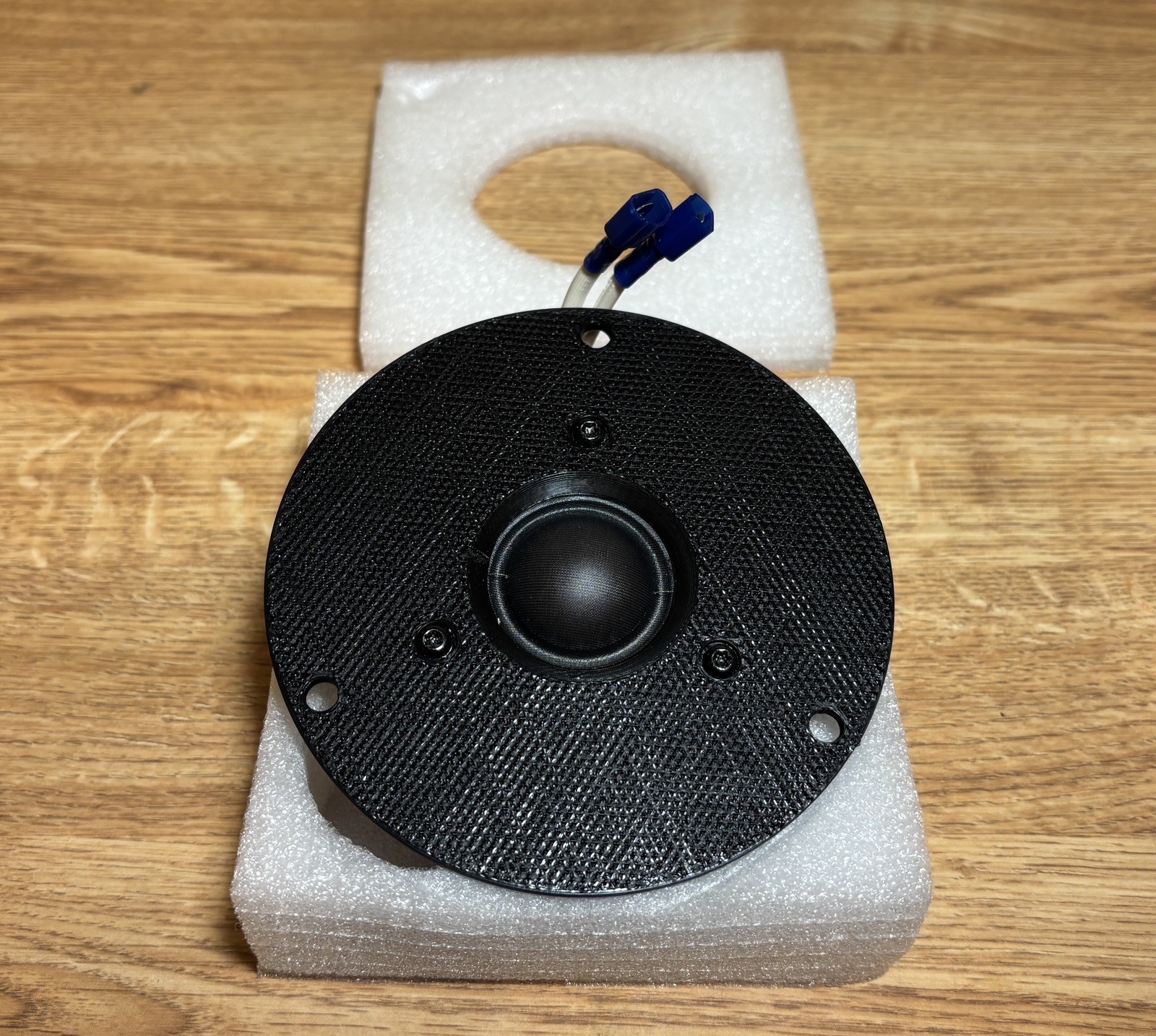
The LST’s front baffle isn’t flat — it’s subtly angled, a design choice that serves a clear acoustic purpose. By placing the midrange and tweeter array on a tilted plane, the speaker achieves a more uniform polar response, minimizing early reflections from the floor and ceiling. This isn’t just theory; the tight vertical alignment of the four midranges and four tweeters creates a coherent wavefront that improves off-axis performance, a concern most consumer speakers of the time ignored. The drivers themselves use hemispherical diaphragms made of doped paper with phase plugs, a design that resists breakup modes and delivers smooth high-frequency dispersion. While the woofers are prone to foam degradation after decades, these midrange and tweeter units are generally robust — though prolonged exposure to moisture or sunlight can cause delamination.
Six-Position Spectral Energy Switch
Mounted on the rear panel, the spectral energy switch is the LST’s most distinctive feature — and its most vulnerable. Decades of use can lead to crackling or intermittent connections, and replacement parts are not readily available. Cleaning the switch with contact cleaner often restores function, but owners report that the impedance varies with position, dropping as low as 2.7 ohms in certain settings. The switch allows users to adapt the speaker to different acoustic environments: “Bass Boost” adds weight in under-damped rooms, while “Treble Cut” tames brightness in reflective spaces. It’s not a substitute for proper room treatment, but in 1972, it was a remarkably practical solution for engineers working in less-than-ideal conditions.
High-Power, Low-Sensitivity Design
With a sensitivity of 89.5 dB (1W/1m) and a nominal impedance of 4 ohms, the LST is not an easy load. It demands amplifiers with strong current delivery — the kind that can handle dips into the 2.7-ohm range without flinching. Owners report that the speakers “love power,” and many recommend at least 200 watts per channel to unlock their full dynamic range. The system’s efficiency is rated at 0.8%, average, into a 2π steradian radiation angle, reflecting its studio-monitor lineage rather than home-audio optimization. Rewiring with modern cable is common, as the original cloth-covered wiring often becomes brittle over time. The single pair of 5-way binding posts is simple but functional, though care must be taken to avoid over-tightening on the older terminals.
Historical Context
When the LST launched in 1972, the professional monitoring landscape was dominated by horn-loaded designs from JBL (like the 4310 and 4311) and Altec (such as the 604 and 605). These speakers were efficient and loud, but often colored by the resonances inherent in horn designs. The LST was the culmination of that philosophy: a full-range, direct-radiating speaker with flat response, low distortion, and wide dispersion, all without horns. Audio (December 1972, p.60) confirmed the manufacturer’s specifications, noting the LST’s 1,000-watt short-term power handling and 4-ohm impedance, underscoring its robust build for professional use. Despite its technical superiority, the LST remained a niche product due to its high price and clinical sound, which didn’t charm casual listeners the way the AR-3a did. Production numbers were low, and the model was discontinued by 1979.
Collectibility & Value
Today, the LST is one of the most sought-after Acoustic Research models among serious collectors and studio restoration enthusiasts. Finding a pair in good condition is difficult — many were used hard in professional settings, and their weight and size made them prone to cabinet damage during moves. Original grilles are especially rare, often lost or damaged over time. Market prices reflect their scarcity: a well-maintained pair typically sells between $1,800 and $2,800, with fully restored examples commanding $3,000 or more. The woofers are the most common failure point — the foam surrounds degrade after 40+ years, and reconing requires skilled hands. Despite their age, the LSTs respond well to careful restoration, and many owners report that a full service brings them back to — or even beyond — their original performance.
eBay Listings


As an eBay Partner, we earn from qualifying purchases. This helps support our independent vintage technology research.