Acoustic Research AR-4x (1967)
At 8.4 kg and just under 50 cm tall, it looks modest—until you hear the deep, controlled 45 Hz bass pushing from a sealed box that refuses to color the sound.
Overview
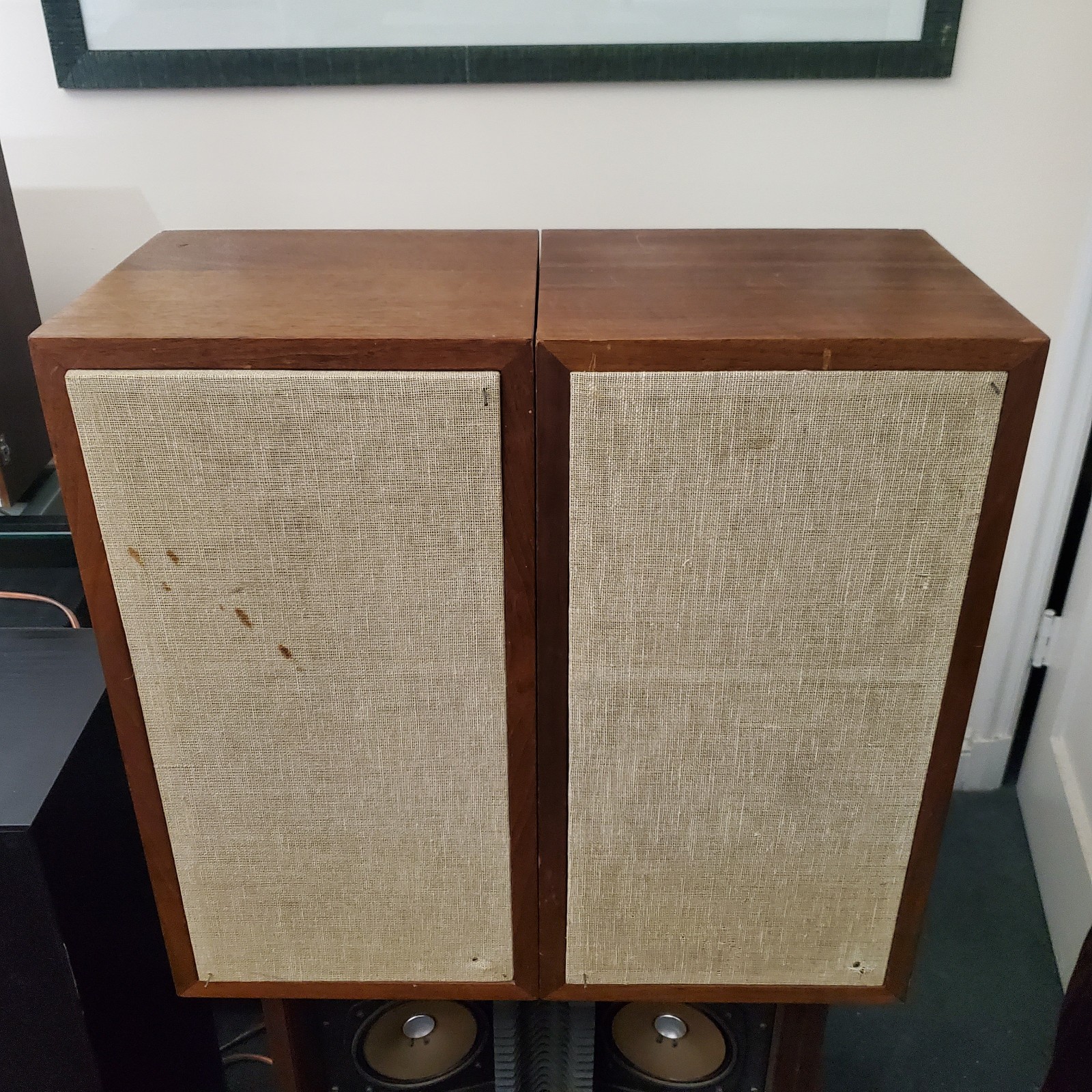
The Acoustic Research AR-4x isn’t flashy. It doesn’t have a horn, a port, or a flashy finish—just clean lines, a walnut oil coating, and a pair of modest cone drivers doing serious work behind a fabric grille. Released in 1967 as a model change from the original AR-4, the AR-4x refined a winning formula with one key update: a new tweeter. This wasn’t just a parts swap—it was a recalibration of the entire sonic balance. The 6 cm cone tweeter came with a high-frequency level control, letting owners tame or boost the highs depending on room acoustics or personal taste.
Under the hood, the AR-4x stayed true to AR’s founding philosophy: accuracy over hype. The 20 cm (8-inch) woofer used high-strength cone paper and operated within a completely sealed acoustic suspension enclosure, a technology pioneered by Edgar Villchur to minimize distortion and eliminate the port noise that plagued bass-reflex designs. The sealed box design meant the bass rolled off gradually below 45 Hz rather than booming artificially, giving it a natural, uncolored character. There was no illusion of deeper extension—just honest, tight low end that stayed in step with the music. The crossover, set at 1.2 kHz, split duties cleanly between the woofer and tweeter, though exact component details aren’t documented. What is clear is that the system was engineered for coherence, not maximum volume.
Despite its technical grounding, the AR-4x wasn’t a lab-bound oddity. It was built for real homes, real records, and real listening. The 8-ohm impedance made it compatible with most tube and early solid-state amplifiers of the late 1960s, and the 15W RMS power handling suggested it was meant to be paired with modestly powered receivers—not muscle amps. Its dimensions—254 mm wide, 483 mm high, and 229 mm deep—made it a true bookshelf speaker, compact enough for small rooms but tall enough to anchor a stereo setup. The 8.4 kg weight indicated serious internal bracing and driver mass, not just a lightweight box with a magnet glued to the back.
Still, time has not been kind to the original materials. Like many AR speakers of this era, the AR-4x is prone to foam surround deterioration. The flexible edges that allow the woofer to move freely degrade over decades, leading to flapping, distortion, or complete failure. Re-foaming is now a standard restoration step, and There’s no evidence the drivers used exotic materials—just well-executed engineering within the limits of 1960s manufacturing. The walnut oil finish, while warm, offers little protection against scratches or moisture, so surviving pairs in good condition often show wear unless carefully maintained.
Specifications
| Manufacturer | Acoustic Research |
| Model | AR-4x |
| Production Year | 1967 (released) |
| Speaker Type | Bookshelf speaker system |
| Design | 2-way, 2-speaker, acoustic suspension system |
| Woofer | 20 cm (8") cone type |
| Tweeter | 6 cm cone type |
| Frequency Response | 45 Hz – 20 kHz |
| Impedance | 8 Ω |
| Power Handling | 15W RMS (minimum recommended amplifier power per channel) |
| Crossover Frequency | 1.2 kHz |
| Dimensions (W×H×D) | 254 mm × 483 mm × 229 mm |
| Weight | 8.4 kg |
| Enclosure Finish | Walnut oil finish |
| Features | Level control for high frequency band |
Key Features
6 cm Cone Tweeter with Adjustable Level Control
20 cm Woofer in Acoustic Suspension Enclosure
The 20 cm (8-inch) woofer was the heart of the AR-4x’s low-end performance. Built with high-strength cone paper, it was designed to operate within a completely sealed box, using air pressure as the restoring force—a hallmark of AR’s acoustic suspension design. This eliminated the resonance peaks and time-smearing associated with ported cabinets, resulting in tighter, more accurate bass. The trade-off was efficiency: the system demanded more amplifier power to achieve deep output, and the bass response tapered below 45 Hz rather than extending further with artificial boost. But within its range, the woofer delivered low distortion and excellent transient response, making it ideal for acoustic music, jazz, and vocal recordings where clarity mattered more than sheer slam.
Sealed Cabinet Construction for Low Distortion
The AR-4x’s enclosure was a fully sealed box, engineered to suppress parasitic motion and cabinet resonance. This design philosophy, rooted in Edgar Villchur’s 1950s research, prioritized accuracy over volume. By eliminating ports and vents, AR avoided chuffing noises and standing waves that could muddy the midbass. The result was a speaker that didn’t call attention to itself—it simply reproduced what was on the record, warts and all. The walnut oil finish provided a warm aesthetic but offered minimal protection, meaning original cabinets often show scuffs or water marks unless meticulously cared for.
Historical Context
The AR-4x arrived in 1967 as a direct evolution of the AR-4, which had been introduced in 1965. It reflected Acoustic Research’s ongoing commitment to refining its acoustic suspension technology, first realized in the AR-1 of 1954. Founded by Edgar Villchur and Henry Kloss in Cambridge, Massachusetts, the company had built its reputation on speakers that told the truth—no hype, no colored sound, just faithful reproduction. The AR-4x continued that mission, targeting listeners who valued accuracy over flash. Its release coincided with Teledyne’s acquisition of AR in 1967, a corporate shift that would eventually influence product direction, though the AR-4x remained true to the original engineering ethos. It wasn’t a radical departure—just a thoughtful update to an established design, swapping the tweeter for a more adjustable cone type and fine-tuning the voicing for broader appeal.
Collectibility & Value
The AR-4x occupies a quiet corner of the vintage audio market. Current listings show individual tested units selling for around $141.51, while complete pairs in working condition appear for $279.99 or more. One listing for a pair labeled "AR-4(?)" reached $299 in October 2024, suggesting demand remains steady among collectors who recognize the lineage. The most common failure is foam surround degradation on the woofer, requiring re-foaming to restore proper function. While replacement parts exist, original, unrestored drivers in good condition are increasingly rare. The original price was approximately 328 DM, but the build quality and engineering suggest it was positioned as a mid-tier offering—more refined than budget models. Today, it appeals to restorers and purists who appreciate its uncolored sound and historical significance within AR’s evolution.
Market Value
┌──────────────────────────────────────────────────────────────────────────┐
│ ACOUSTIC RESEARCH AR-4                                          May 2026 │
├──────────────────────────────────────────────────────────────────────────┤
│ High      $702                                    Latest            $138 │
│ Median    $200                                    Trend           ▼ Down │
│ Low       $51                                     Volume           ~6/mo │
├──────────────────────────────────────────────────────────────────────────┤
│   $800 ┤                                                                 │
│        │.                                                                │
│        │                                                                 │
│   $479 ┤                                                                 │
│        │                                                                 │
│        │            .      .     .                .                      │
│        │            .                                    .               │
│    $50 ┤        .    .           .  .                              .    .│
│        ├─────────────────────────────────────────────────────────────────│
│    vol │▄       ▄   █▄     ▄     █  ▄             ▄      ▄         ▄    ▄│
│        └─────────────────────────────────────────────────────────────────│
│         2026-02                      2026-03                      2026-04│
└──────────────────────────────────────────────────────────────────────────┘
eBay completed sales. Excludes accessories, parts, and non-working units. Hover points for details.
eBay Listings


As an eBay Partner, we earn from qualifying purchases. This helps support our independent vintage technology research.