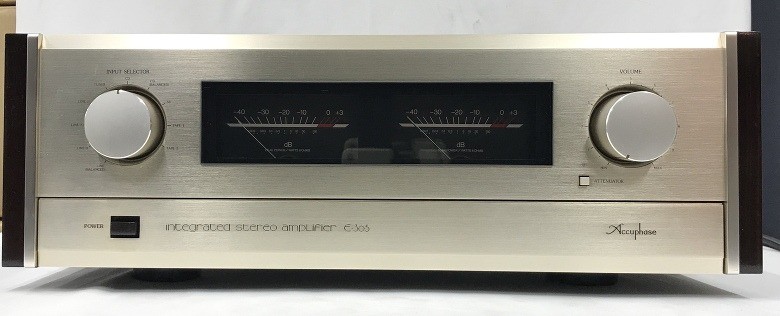
Accuphase E-305 Integrated Stereo Pre-Main Amplifier (1987)
At 20.5kg, it arrives like a promise kept—this is integrated amplification built with the uncompromising logic of separates.
Overview
The Accuphase E-305 isn’t an amplifier that shouts; it commands attention through sheer presence and engineering rigor. Released in December 1987 by Accuphase Laboratory, Inc., it was conceived as a full-scale realization of separate component performance within a single chassis. Priced at ¥270,000 at launch, the E-305 targeted audiophiles who demanded the refinement of standalone preamps and power amps without the clutter. It achieves this through a "3-amp configuration" housing a dedicated equalizer amplifier for analog disks, a high-gain preamplifier, and a robust power amplifier—all engineered to minimize crosstalk and power supply interference. The result is a machine that doesn’t just amplify, but orchestrates, with signal integrity preserved from MC cartridge to speaker terminal.
What sets the E-305 apart isn’t just its power or feature set, but its philosophy: every circuit is directly coupled from input to output, eliminating capacitors in the signal path that could color or slow the sound. DC drift—a risk of such a design—is neutralized by individual DC servo circuits for each stage, ensuring stability without compromise.
Specifications
| Manufacturer | Accuphase Laboratory, Inc. |
| Model | E-305 |
| Type | Integrated Stereo Pre-Main Amplifier |
| Production Year | December 1987 |
| Original Price | ¥270,000 |
| Continuous Average Output (8 ohm) | 130W/ch |
| Continuous Average Output (4 ohm) | 180W/ch |
| Total Harmonic Distortion Factor | 0.02% |
| IM Distortion Factor | 0.01% |
| Frequency Response (Main Amp Input) | 20 Hz ~ 20000 Hz +0 -0.2 dB at rated output |
| Damping Factor | 100 (8 ohm load, 50 Hz) |
| High Level Input Sensitivity / Impedance | 125mV / 20k Ω |
| AD Input (MC) Sensitivity / Impedance | 0.128mV / 100 Ω |
| AD Input (MM) Sensitivity / Impedance | 4.3mV / 47k Ω |
| Pre Output | 1.28V / 200 Ω |
| Headphone Output | 0.4V, 4 ~ 100 Ω |
| Tone Controls | Bass: ±10 dB at 50 Hz (turnover 300 Hz), Treble: ±10 dB at 20 kHz (turnover 3 kHz) |
| Loudness Compensator | +6 dB at 100 Hz (Volume -30dB) |
| Subsonic Filter | 17 Hz, -12dB/oct |
| Power Meter | Logarithmic Compression Peak Level Display, direct reading at dB scale (8 Ω load) |
| Load Impedance | 2 to 16 ohms |
| Semiconductors Used | Transistors: 77, FET: 34, IC: 20 pcs, Diode: 78 |
| Power Supply | 100V/117V/220V/240V, 50Hz/60Hz |
| Power Consumption (8 Ω rated output) | 490W |
| External Dimensions | 475 x 170 (incl. legs) x 375 mm (W x H x D) |
| Weight | 20.5kg |
3-Parallel Push-Pull Output Stage with 780W Collector Loss
The E-305’s power amplifier isn’t just strong—it’s overbuilt with intent. Its output stage employs a triple-parallel push-pull configuration using six bipolar transistors, with each transistor rated for a collector loss (Pc) of 130W. This results in a staggering total collector loss capacity of 780W, a figure that speaks less to efficiency and more to resilience. This design allows the amplifier to deliver 130W into 8 ohms and 180W into 4 ohms with ease, while maintaining control over complex, low-impedance speaker loads down to 2 ohms. The use of MOS FETs in the driver stage ensures low output impedance and high drive voltage, characteristics that mimic the performance of pure Class A separate amplifiers.
Fully Direct-Coupled DC Servo Design from Phono Input to Speaker Output
One of the E-305’s most significant engineering feats is its completely direct-coupled signal path, extending from the MC phono input all the way to the speaker terminals. There are no coupling capacitors in the signal chain, a design choice that eliminates phase shift, bandwidth limitations, and dielectric absorption associated with capacitors. However, direct coupling risks DC offset, which could damage speakers. Accuphase solves this with individual DC servo circuits for each amplifier stage, actively stabilizing the DC level without affecting the AC audio signal. This results in a blacker background, improved transient response, and a sense of immediacy that many describe as "borderline-transparent." The payoff is a sound that feels continuous and unbroken, as if the amplifier itself has disappeared from the chain.
Separate Power Supplies with Full Constant Voltage Regulation
Power supply isolation is critical in high-end audio, and the E-305 treats it as non-negotiable. The preamplifier, equalizer amplifier, and power amplifier each have dedicated transformer windings, preventing interaction and noise modulation between stages. The preamp section goes further with a full-scale constant voltage circuit, ensuring an exceptionally stable operating environment regardless of line fluctuations. This attention to power integrity extends to the phono stage, where a dedicated supply minimizes hum and noise—critical for amplifying the microvolt-level signals from MC cartridges.
Relay-Based Signal Switching with Gold-Palladium Contacts
Signal routing in the E-305 avoids the pitfalls of traditional mechanical switches or semiconductor-based selectors. Instead, switching is handled by sealed relays with cross-bar twin silver-palladium gold-plated contacts, controlled electronically via a logic circuit. This method eliminates the contact resistance, oxidation, and channel imbalance common in potentiometers or slide switches. The relays ensure that the signal path remains as pure as possible, with minimal degradation during input selection. With eight input terminals and two balanced inputs, the E-305 offers extensive connectivity, and the relay system ensures that each source is engaged with precision and consistency. It’s a solution that prioritizes long-term reliability and sonic transparency over cost or convenience.
Independent Recording Selector and Tape Copy Switch
The E-305 includes a sophisticated recording control system that separates monitoring from recording functions. The built-in recording selector operates independently of the input selector, allowing users to monitor one source while recording from another. A dedicated TAPE COPY switch enables direct dubbing between tape decks without affecting the main listening path. This level of functionality was advanced for an integrated amplifier in 1987, reflecting Accuphase’s focus on real-world usability for serious listeners who still relied on analog tape. The system is supported by independent preamp and power amp input/output terminals, allowing the E-305 to function as a standalone preamp or power amp in a larger system.
Historical Context
The Accuphase E-305 emerged from a philosophy of integration without compromise. Developed by leveraging decades of experience in separate component design, it was positioned as a refined successor to earlier integrated models like the E-202. By improving power supplies, refining Class A circuitry, and adopting direct-coupled DC servo topology, the E-305 represented a significant leap in performance. It was built for the "new audio era," where listeners expected the convenience of an integrated unit without sacrificing the fidelity of separates. As part of Accuphase’s integrated amplifier lineage, the E-305 stands as a testament to the brand’s commitment to engineering excellence, offering a level of sophistication that few competitors matched at the time.
eBay Listings


As an eBay Partner, we earn from qualifying purchases. This helps support our independent vintage technology research.
Service Manuals, Schematics & Catalogs
- Service Manual — audiocircuit
- Service Manual — archive.org
- Manual — archive.org
- Manual (1985) — archive.org
- Catalog — archive.org
Related Models
- Accuphase A-100
- Accuphase A-20
- Accuphase A-20V
- Accuphase A-45
- Accuphase A-65
- Denon POA-800 (1978)
- Eico 3150 (1967)
- Fisher CUSTOM-ELECTRA-I (K-14/K-15) (1957)
- Fisher CUSTOM-ELECTRA IV (E33/E44) (1960)
- Akai AM-2600 (1977)